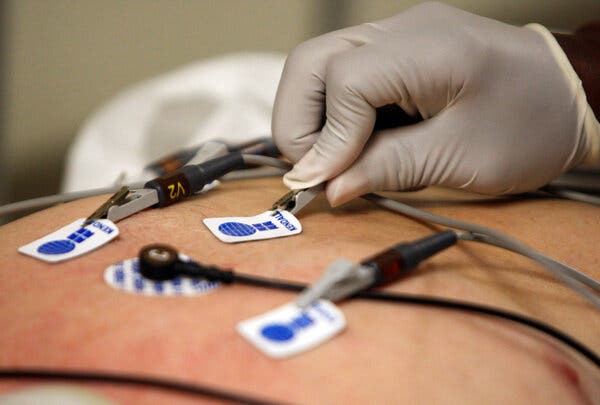
Artificial intelligence technologies are transforming the ability to identify patterns in electrocardiograms (ECGs) that often go unnoticed by human clinicians. A new AI-driven program is now set to become widely accessible to doctors at no cost, offering promising advancements in cardiology.
An AI program named EchoNext recently played a crucial role in a clinical trial by identifying signs of significant heart damage in the ECG of a 45-year-old patient, Louie Quiros. Mr. Quiros arrived at a Queens emergency room in February 2025, experiencing a persistent cough with blood and difficulty breathing for four days.
Despite his rapid heartbeats and breathing issues, a chest X-ray showed no anomalies. His ECG results were abnormal, hinting at coronary heart disease, which is uncommon in individuals his age. However, this was not the accurate diagnosis.
Initially diagnosed with issues related to wildfire smoke exposure, Mr. Quiros was sent home with asthma medication and an inhaler. Fortunately, the emergency room is part of NewYork-Presbyterian’s medical network, where researchers are studying ECGs through EchoNext for heart damage patterns imperceptible to humans.
The AI program is being assessed in a clinical trial led by Dr. Pierre Elias at NewYork-Presbyterian and Columbia University Irving Medical Center. EchoNext processes ECG results shortly after they are conducted, and roughly 500,000 ECGs are analyzed annually. Dr. Elias, who founded Pathway Labs, aims to commercialize this technology.
EchoNext detected severe heart damage in Mr. Quiros’s ECG, prompting a follow-up echocardiogram one week later. The echocardiogram revealed his heart’s impaired function, with only 10 percent of blood being expelled with each contraction. Additionally, a leaking mitral valve was directing blood back into the heart.
 Calm Parenting: Strategies to Manage Stress
  Trump’s Executive Order to Combat Mosquitoes and Ticks in D.C.
  Overcoming Weight Loss Challenges: Brain Health and GLP-1 Medications
  Supporting Children’s Mental Health at Home: Practical Steps for Parents
  Abdul El-Sayed’s Strategy to Attract Health-Conscious Voters in Michigan
  Preventable Infection-Related Cancer Cases Worldwide: Insights from IARC Study