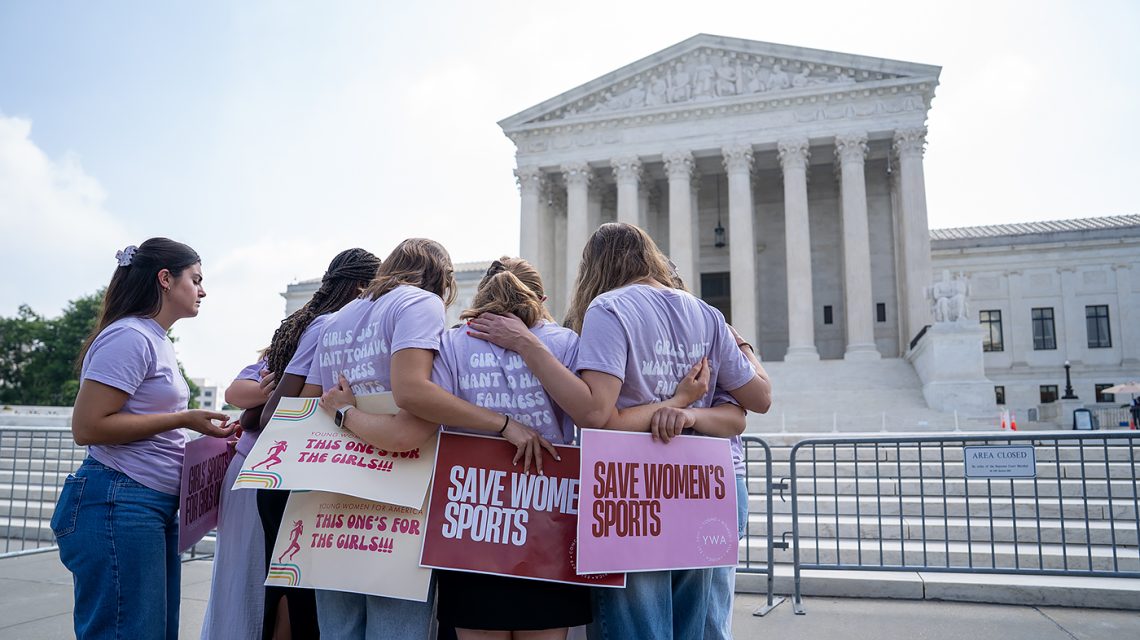
Members of Concerned Women for America gathered in Washington, D.C., outside the Supreme Court to express support for the decision made on June 29, 2026. The Supreme Court acknowledged physical differences between men and women in the rulings on State of West Virginia v. B.P.J. and Little v. Hecox. This decision marked a significant triumph for those advocating for gender-specific sports and for the principle that men cannot be women.
The ruling was unanimous, with a 9-0 vote affirming that Title IX, a federal law designed to ensure equal opportunities for women in education, empowers states to safeguard female athletes through sex-specific sports. Additionally, a 6-3 decision stated that the Equal Protection Clause of the 14th Amendment supports this protection as well. Many Americans now wonder why such a ruling was necessary.
Organizations, including Alliance Defending Freedom, alongside Idaho Attorney General Raul Labrador and West Virginia Attorney General JB McCuskey, defended state laws securing women’s sports. These laws recognized the biological differences between sexes, such as strength, speed, muscle mass, and physiology, reflecting truths once widely accepted. Despite attempts by gender ideology advocates to erase these protections on athletic fields and in locker rooms, these policies were contested due to their widespread harm.
The case involving B.P.J., a young male defeating over 470 girls and impacting scholarship opportunities for women in high school track-and-field events, exemplifies the controversies surrounding gender ideology. B.P.J.’s victory in the women’s state shot put championship and allegations of harassment further highlight the harmful consequences on female athletes. My organization represents Adaleia Cross and Kallie Keeler, two young women facing severe repercussions amid institutions increasingly prioritizing subjective gender feelings over biological realities.
Some institutions adopted policies redefining “sex” in Title IX, targeting women it intended to protect. Lower courts sometimes aligned with these views, complicating legal arguments. The Supreme Court faced challenges defining “sex” and “woman,” leading to confusion. If the court had ruled otherwise, women’s protections beyond athletics, like in locker rooms and restrooms, could have been endangered.
The Supreme Court ruling limited the possibility of turning unsupported ideas into legal precedents. Unbiased laws prove crucial for societal trust, enabling order and liberty. The media portrayed the ruling as complex, yet the real challenge remains straightforward: protecting women’s sports.
Currently, 23 states lack laws ensuring women’s sports protections. Urgent actions are necessary to provide fairness, privacy, and equal opportunity for girls. The ruling stands as a victory and a reminder of the importance of upholding truth legally.
Kristen Waggoner, CEO, president, and chief counsel of Alliance Defending Freedom, highlighted the necessity for actual protection under the law.
© 2026 Nexstar Media Inc. All rights reserved. Redistribution prohibited.
 Record Number of Native Candidates in Elections
  Unexpected Senate Race Challenges in New Hampshire
  Debate Over Judicial Influence in Trump Administration Attorney Appointments
  Former U.S. Representative David Rivera Sentenced for Secret Lobbying
  Political Fragmentation and Rising Extremism Challenge Germany’s Political Center
  Democrats See South Carolina as Potential Senate Pickup