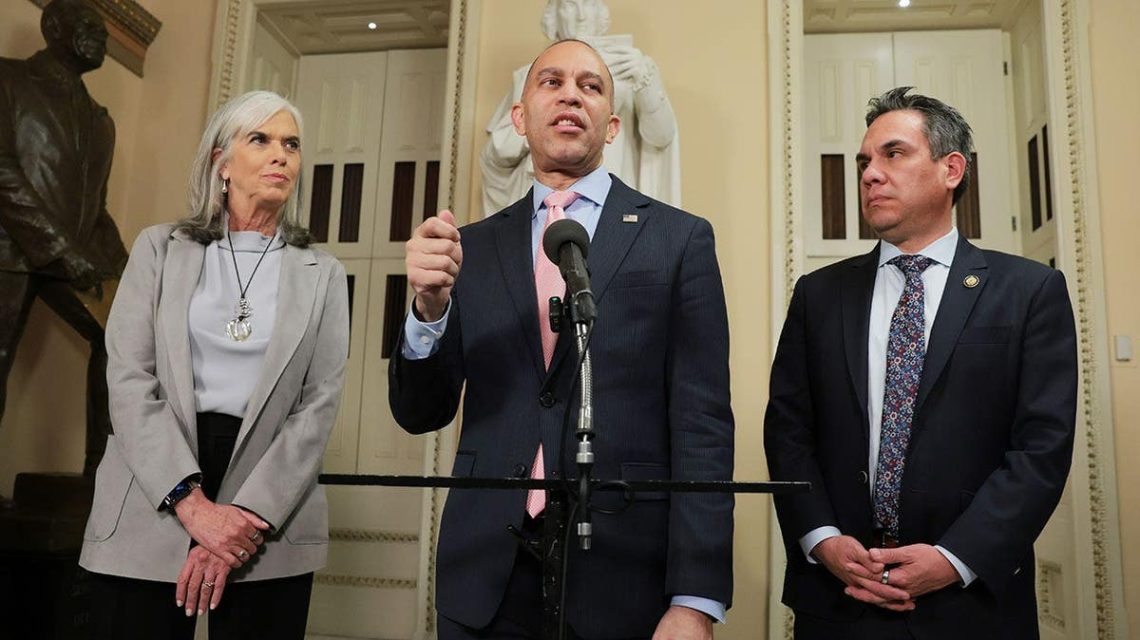
House lawmakers faced a pivotal vote on foreign aid to Israel, revealing a sharp divide among Democrats. The proposal aimed to cut $3.3 billion designated for Israel for the next fiscal year, a measure that split the Democratic leadership, resulting in a 104-313 rejection. This vote marked the first opportunity in this Congress for members to directly address taxpayer-funded aid to Israel.
House Minority Leader Hakeem Jeffries joined 97 Democrats in opposing the amendment’s elimination. In contrast, Rep. Katherine Clark, the chamber’s second-ranking Democrat, with 102 other Democrats, supported cutting the aid. Ten Democrats chose to vote present.
This amendment would embolden the enemies of peace, those pursuing the complete elimination of Israel and those who seek the death of Jews,
Former House Majority Leader Steny Hoyer commented during the debate, strongly opposing the amendment proposed by Rep. Thomas Massie, R-Ky. Massie, known for his critical stance on Israel, introduced the measure as an amendment to a State Department appropriations bill, describing Israel as the United States’ largest welfare recipient. Notably, Massie stood as the only Republican supporting the amendment.
Opponents argued that the amendment could damage U.S.-Israel relations and hinder Israel’s capacity to counter terrorist groups, including Hamas and Hezbollah. Rep. Mario Diaz-Balart explained that supporting Israel reinforces American national security by curbing terrorist threats.
Critics also highlighted that part of the funding is used by Israel to purchase American-made weapons, which in turn backs the U.S. industrial base. Despite the defeat of the amendment, supporters expressed optimism. Congressional Progressive Caucus Chair Greg Casar emphasized the goal to redirect taxpayer dollars toward domestic needs over foreign military expenditures.
Jeffries, who announced his stance against the amendment during a private meeting, described the measure as poorly designed. House Democratic Caucus Chairman Pete Aguilar noted that the proposal’s broad language could affect humanitarian aid, refugee resettlement, and embassy operations.
Conversely, some Democrats argued the ongoing conflict in Gaza requires reconsidering financial support to Israel, citing human rights concerns. Rep. Joaquin Castro emphasized using American influence to influence Israel’s behavior, reflecting party members’ shifting opinions.
A recent NBC News poll indicated a growing number of Democratic voters sympathize more with Gaza than with Israel, highlighting the changing perspectives within the party. In New York’s recent primaries, socialist candidates opposing Israel trounced establishment candidates, further showcasing this shift.
The debate on Israel’s aid continues, fueled by differing ideologies and changing geopolitical contexts.
 The Trump Team’s Challenge to the Military Leadership
  Maryland First State to Restrict Electronic Pricing in Grocery Stores
  Activists Push for Nationwide Ban on Child Marriage in the U.S.
  Democratic Hopes and Historical Warnings in 2026 Senate Race
  Republicans Face Challenges Amidst Cost of Living Concerns
  A Different Kind of Fall for Congress This Year