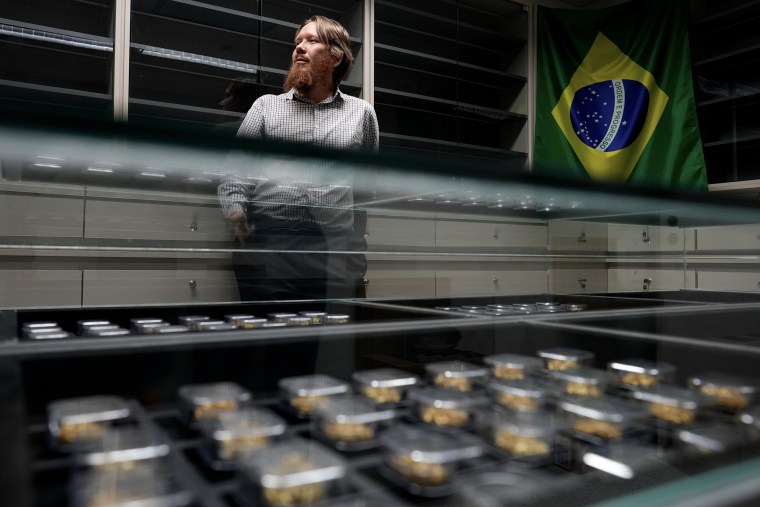
Brazil is employing forensic science to combat illegal gold mining in the Amazon. This practice threatens the rainforest, Indigenous communities, and other local groups, leading to increased deforestation and dangerous mercury contamination. The National Institute of Criminalistics in Brasilia, the country’s capital, hosts a ‘gold lab’ established by federal police to collect and analyze samples from across Brazil.
Gold Fingerprinting
The aim is to identify whether a seized gold sample was mined in a protected area, indicating illegal activity. This process, called ‘gold fingerprinting,’ involves tracing the origin of gold samples with high precision. Experts compare it to examining a person’s DNA.
Sparkling gold flakes at the lab hold invaluable data. As gold forms in nature, within rocks or riverbeds, it absorbs particles from its environment, such as silver and copper traces. This creates a unique fingerprint, enabling investigators to determine if a gold sample was mined as claimed or illegally sourced from national forests or Indigenous lands.
Developed Methodologies
Since 2019, Gustavo Geiser and colleagues have developed this method in collaboration with Brazilian universities. They utilize X-ray fluorescence spectrometry, scanning electron microscopy, and laser ablation mass spectrometry. Despite increasing complexity, the core question remains, “Where did this gold come from?” Proving illegal mining helps police build cases for further investigation and potential charges.
Fraud in Legal Markets
Environmental criminals often commit fraud to introduce illegally mined gold into legal markets. A global gold price surge has intensified mining in the Amazon. According to Amazon Mining Watch, around 496,000 hectares of rainforest have been cleared for mining since 2023, with 223,000 hectares in the Brazilian Amazon alone.
Fraud Detection
Independent reports, like one by Greenpeace, detail how legally authorized mine owners falsely claim to extract significant gold quantities. However, satellite and aerial images reveal inactivity at these sites and large-scale operations on nearby Indigenous lands. This ‘ghost mine’ scam is prevalent.
Regulatory Actions
Brazil’s Federal Court of Accounts cited evidence last year of mining permits being misused to launder gold from protected areas. This month, a federal court in Para ordered institutions to enhance gold control from mines to markets. Federal prosecutors have sued for better oversight of mining permits, as criminals use these permits to launder gold from Indigenous and protected territories.
Global Impact and Collaboration
Geiser notes the importance of the Brasilia gold lab in battling crime and ensuring legitimate gold supply chains. Although the lab’s impact on imprisoning criminals lacks data, Geiser acknowledges that networks are exploiting neighboring countries to launder illegally mined gold. Samples from countries like Venezuela and French Guiana are also analyzed at the lab, expanding its database. Regional collaboration strengthens through the Amazon International Police Cooperation Center in Manaus.
Mercury Contamination
Illegal gold mining contributes to extensive mercury contamination in the Amazon, harming Indigenous communities and the environment. A 2023 MapBiomas report indicated that over 90% of Brazil’s mining occurs in the Amazon, with nearly 40% being illegal.
Environmental and Health Concerns
Although a small contributor to deforestation compared to agriculture, illegal mining inflicts severe environmental damage, mainly due to mercury usage in gold extraction. Once gold is separated, mercury contaminates water and fish, vital to Indigenous life. A 2023 Fiocruz study showed 21.3% of Amazonian market fish exceed WHO mercury safety limits, with young children consuming hazardous levels.
Reducing Mercury Use
Brazil signed the Minamata Convention on Mercury, obligating mercury elimination in gold mining. The Ministry of Mines and Energy is drafting regulations to phase out mercury, with discussions ongoing until Aug. 7. Federal prosecutors stress consulting Indigenous groups, most affected by contamination. A total mercury ban would reduce environmental harm and support forensic investigations by clearly identifying illegal mercury-based mining.
 British Police Arrest Man Suspected of Terror Plot
  Activists Push for Nationwide Ban on Child Marriage in the U.S.
  Investigation into Alleged Incident at Cornell University
  Rising Drone Threats Highlight Vulnerabilities in Moldova’s Airspace Defense
  Bolivia Faces Security Test Amid Unrest
  Atlantic Ends September Without a Hurricane for First Time Since 1994