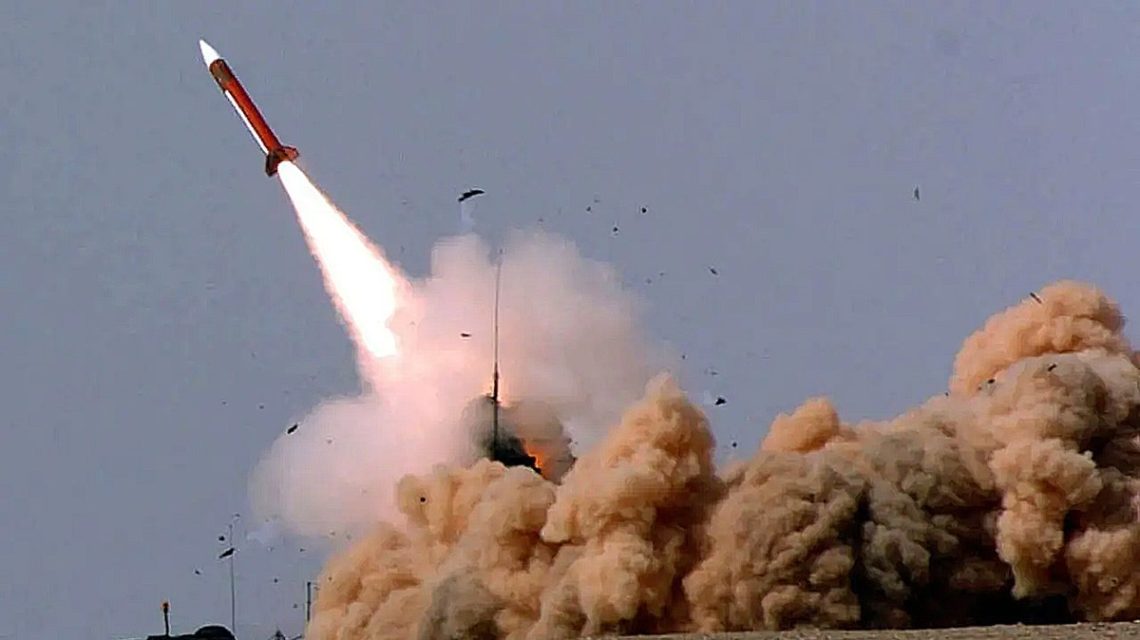
The Pentagon is confronting a pressing issue following months of conflict with Iran: the depletion of its missile defense interceptors. The shrinking stockpile is causing military planners to reconsider the feasibility of ongoing limited retaliatory strikes.
According to the Center for Strategic and International Studies, U.S. inventories of Patriot and THAAD interceptors have significantly decreased. Patriot interceptor numbers dropped from approximately 2,300 pre-war to fewer than 827. Similarly, THAAD inventories fell from 452 to under 278.
“If you look at what we’ve expended for the Patriots, for example, over half the global inventory has now been consumed in the Middle East. Similar to the THAAD interceptors as well,” said Kelly Grieco, a missile expert at the Stimson Center.
This situation raises concerns about the U.S.’s ability to protect its forces and bases worldwide, especially if another major conflict arises, such as in the Pacific. A significant portion of these interceptors has been consumed, leaving minimal resources for defense in other regions, like Europe or the Indo-Pacific.
The Pentagon’s $67 billion fiscal request for 2026 emergency funding includes $18.2 billion for replenishing advanced missile systems like the Patriot, Navy Tomahawks, and THAAD. Bloomberg reports that half of the munitions in the 2027 budget are anticipated to be low-cost munitions valued at $600,000 or less.
By 2031, 70% of munitions purchased are expected to fall within this lower-cost range, according to Jerry McGinn of CSIS. Current munitions are effective and designed for performance, but they aren’t built for mass production, complicating efforts to scale production.
The Pentagon has engaged leading Silicon Valley defense firms to discuss replenishing depleted stockpiles amid ongoing conflict. Concerns persist about these companies’ abilities to scale production of commercial technologies for government use.
Brandon Tseng of SHIELD AI recounted challenges faced when establishing defense technology partnerships with the Pentagon. His company has developed the V-BAT, an AI-driven targeting system used in Ukraine against Russian targets, showcasing its capabilities in combat scenarios.
The V-BAT is likened to a miniature Predator or Reaper drone. Despite its modest price of roughly a million dollars per aircraft, it performs missions typically reserved for more expensive aircraft.
CENTCOM Commander Adm. Brad Cooper devised an intensive air campaign plan to counter Iran’s missile strategies, reflecting concerned efforts to manage dwindling interceptor numbers. Iran’s strategy focuses on targeting U.S. bases to force defensive measures, exhausting U.S. military resources.
Jennifer Griffin, a national security correspondent for FOX News Channel, provides insights into these developments from the Washington D.C. bureau. Her tenure with the network began in 1999, previously reporting from Jerusalem.
 U.S. Monitors Russian Plague Scare
  Poland Prepares for Potential Conflict
  Current Developments in the Iran Conflict and the Impact on Oil Markets
  Defeat Threatens Sánchez and His Leadership
  Tensions Surround Prince William and Prince Harry Amid Diana Anniversary Projects
  Realtor Arrested for Alleged Work as Unregistered Chinese Agent