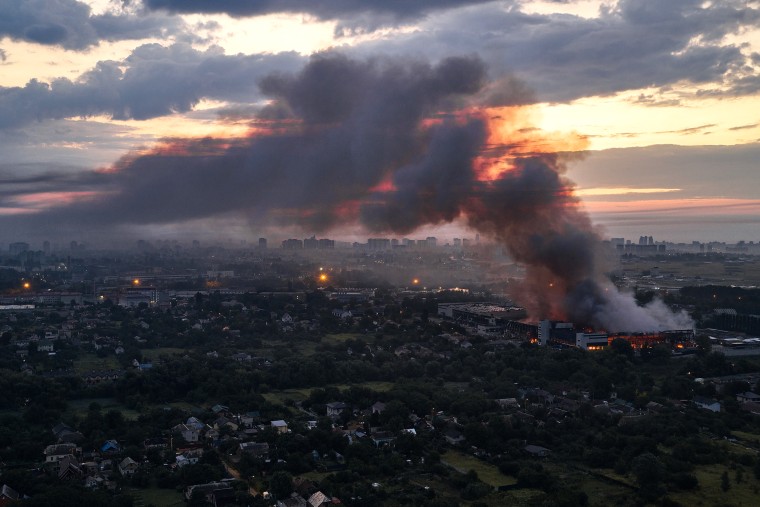
On August 5, 2026, Russian missile and drone attacks on Kyiv and its surrounding region resulted in the deaths of 17 people and injuries to 44 others, Ukraine’s President Volodymyr Zelenskyy reported.
The assault involved the launch of 24 ballistic missiles, additional missiles identified as either hypersonic Zircons or supersonic Oniks, and 115 drones, many of which were jet-powered. According to Zelenskyy, the targets were mainly warehouses belonging to civilian enterprises, infrastructure, and a railway station, described as having “no connection to the war.” Among the affected sites were a brewing company, building materials warehouses, and civilian logistics facilities.
A photograph captured smoke rising from a burning NOVUS supermarket chain warehouse, highlighting the attack’s impact on civilian facilities.
This incident is part of an ongoing pattern of large-scale Russian ballistic missile strikes that have become frequent during the summer. Ukraine, lacking a substantial stockpile of interceptor missiles for its U.S.-made Patriot systems—which are the only air defense capable of shooting down ballistic missiles—faces challenges in stopping such significant attacks. Despite Ukraine’s efforts to target Russian refineries and energy infrastructure, these volleys remain difficult to counter.
President Zelenskyy emphasized the importance of anti-ballistic systems, noting, “Ballistic interceptors are what could have saved the lives of those killed today.” He urged Ukraine’s partners to avoid delays or reluctance in providing these defense systems, as such hesitations result in substantial casualties and destruction.
In the broader Kyiv area, emergency services reported multiple fires across the Brovary, Bucha, and Fastiv districts. Significant fires were recorded in the city of Brovary and the villages of Velyka Dymerka, Kvitneve, and Peremoha. A fire involving vehicles at a Fastiv district enterprise was extinguished. In the Bucha district, a warehouse fire in Chaiky was addressed after a previous fire at a logistics facility in Sofiivska Borshchahivka was put out.
Scenes following the missile attack on Kyiv and surrounding regions depicted destruction and the efforts of emergency crews managing the crisis. Fires in the city’s Obolonskyi, Sviatoshynskyi, Holosiivskyi, and Desnianskyi districts were successfully extinguished, as reported by the Kyiv City Military Administration.
Defense technology adviser Serhii Beskrestnov stated that the war of attrition has entered a new phase, with indiscriminate targeting of retail warehouses, food storages, logistics hubs, and more by the enemy. He shared his views on social media, indicating a change in tactics.
Epicentr, one of Ukraine’s largest retail and construction chains, suffered severe damage. The company reported on social media that Russian missiles destroyed in minutes what took decades to build. One employee died, and three others were injured. Their logistics hubs were targeted, and their ceramic tile factory production floor was destroyed, halting operations and necessitating a production shift abroad. Full recovery could take as long as two years.
Epicentr expressed solidarity with other affected Ukrainian businesses, acknowledging the years of effort behind every enterprise.
In response, Ukraine has launched its own initiatives against Russian retail logistics, targeting multiple Wildberries warehouses, an entity often compared to Amazon, as part of a broader campaign to impact Moscow’s economy and bring awareness to war costs.
 U.S. Monitors Russian Plague Scare
  Poland Prepares for Potential Conflict
  Current Developments in the Iran Conflict and the Impact on Oil Markets
  Defeat Threatens Sánchez and His Leadership
  Tensions Surround Prince William and Prince Harry Amid Diana Anniversary Projects
  Realtor Arrested for Alleged Work as Unregistered Chinese Agent