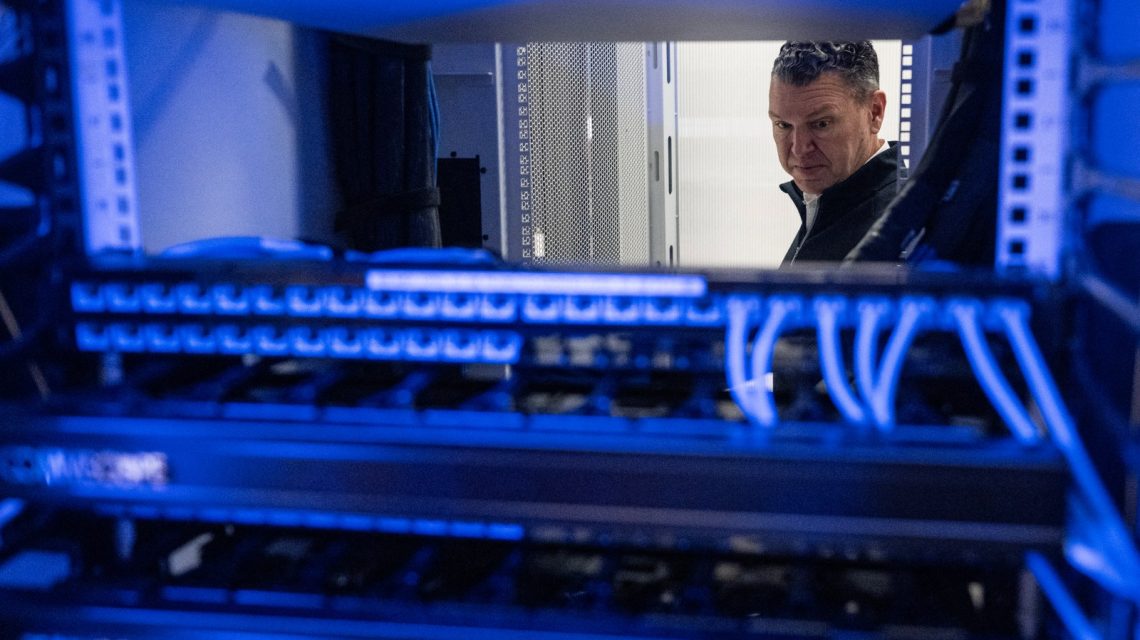
The Trump administration is moving towards banning a Chinese-made component in data centers, due to concerns over security risks related to America’s AI infrastructure. According to Reuters, officials are preparing to prohibit imports of Chinese optical transceivers by the end of 2026. These are devices used to transmit data through fiber-optic cables within data centers. The Federal Communications Commission may revise or cancel these potential restrictions.
This development is part of the ongoing U.S.-China competition in AI, which now includes not only chips and algorithms but also the infrastructure supporting them. The U.S. has already restricted the export of advanced AI chips to China to slow down technological advancements that might benefit the People’s Liberation Army. American intelligence agencies have reported that Chinese state-backed hackers have infiltrated U.S. infrastructure, posing threats of intelligence collection and system disruption during potential future crises.
There are real concerns with the transceivers around data collection, disruption, and long term dependence on Chinese suppliers,” said Adam Segal, director of the Council on Foreign Relations’ Digital and Cyberspace Policy Program.
What Are Optical Transceivers?
Optical transceivers are essential components in communication networks ranging from Ethernet systems to telecommunications. They transform electrical signals into light pulses to transmit large volumes of data via fiber-optic cables. These devices have become crucial in AI data centers, linking thousands of AI chips for processing large data sets and training models such as ChatGPT and Claude.
Reasons for the Proposed Ban
U.S. officials are concerned that dependence on Chinese suppliers for components like optical transceivers could pose risks if China decides to restrict supply. Banning imports of Chinese-made optical transceivers would secure the AI supply chain and reduce dependencies on China,” said Dmitri Alperovitch, chairman of Silverado Policy Accelerator.
China has previously demonstrated its control over critical rare earth minerals, further intensifying trade tensions with Washington. The country also tightened export controls to Japan, reacting to Japanese defense policies and statements on Taiwan.
However, analysts warn of negative consequences. There is the risk that it raises costs and uncertainty for hyperscalers, which could impact AI development,” said Segal. Companies like Amazon could face challenges due to increased costs and uncertainty in supply chains.
China has criticized U.S. restrictions on advanced technology exports, arguing that they harm global supply chains and bilateral relations. Such practices are market-distorting acts of bullying,” said Liu Chang, spokesperson for the Chinese embassy in Washington.
 Senate Panel Investigates Child Safety on Roblox
  New Restrictions on U.S.-China Science Collaboration
  Apple Watch Series 11 Discounted to Lowest Price
  Cyberattack Targets Minnesota Water Systems and Raises Cybersecurity Concerns Nationwide
  AI and Personal Finance: Balancing Automation and Human Insight
  Army’s Artillery Project Stumbles Amid Costly Failures