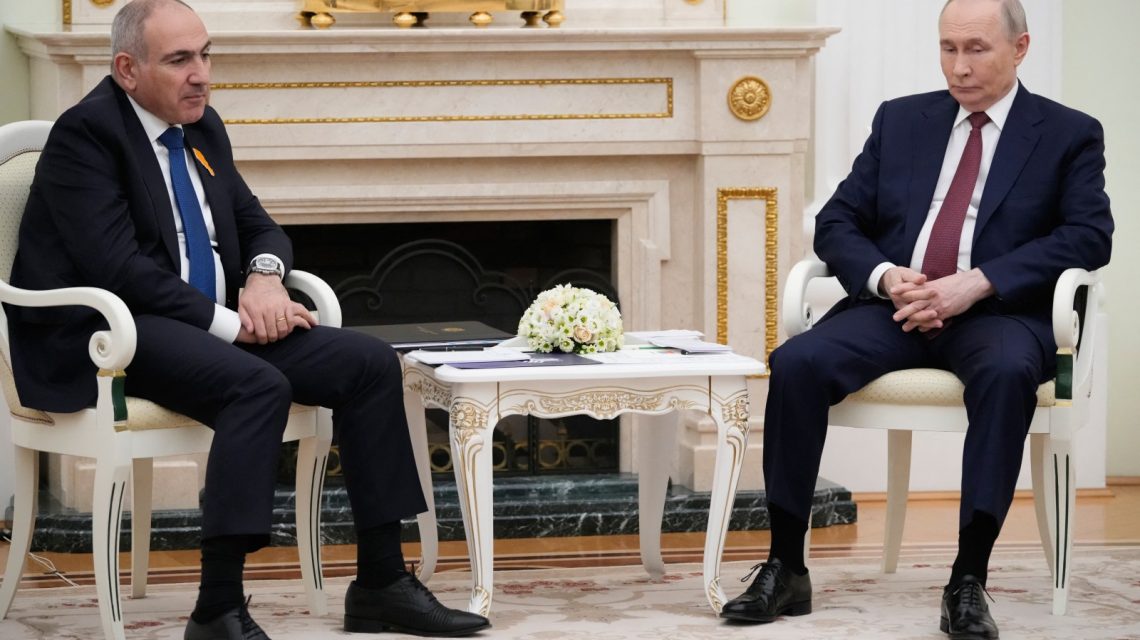
Armenia is reconsidering its place within the Collective Security Treaty Organization (CSTO), a six-nation alliance that includes Russia, Belarus, Kazakhstan, Kyrgyzstan, and Tajikistan. Armenian Prime Minister Nikol Pashinyan has indicated support for exiting the bloc due to its perceived failure in aiding Armenia amid conflicts with Azerbaijan.
Speaking in parliament, Pashinyan declared, “We will not activate our cooperation with the CSTO,” highlighting ongoing discussions within the organization about Armenia’s potential expulsion. Kremlin spokesperson Dmitry Peskov commented that Armenia is free to decide if CSTO membership no longer serves its interests.
Richard Giragosian, Regional Studies Center’s director in Yerevan, criticized the CSTO as unreliable, noting its inability to protect Armenian sovereignty in face of Azerbaijan’s aggression. Diplomatic advances between Armenia and Azerbaijan have superseded the crisis, yet Giragosian warns against provoking Russia by completely withdrawing from CSTO.
Historical Context
Russia’s role in Armenia dates back to a postwar 1828 treaty with Qajar Iran. Following Soviet Union’s collapse, Armenia joined the CSTO’s predecessor in 1992, amid ongoing disputes over Nagorno-Karabakh with Azerbaijan.
Though Azerbaijan and Georgia initially joined the treaty, they withdrew by 1999. Uzbekistan’s CSTO membership also fluctuated before leaving for good in 2012.
Recent skirmishes over Nagorno-Karabakh resulted in severe casualties and the dismantling of separatist presence, raising doubts about Russian intervention capabilities among Armenian leaders.
Recent Developments
Pashinyan described past relations with Moscow as contingent on Russia’s role as Armenia’s security guarantor, noting current limitations due to Russia’s security challenges, including its invasion of Ukraine.
Only Belarus has directly supported Russia’s war in Ukraine. Still, Russia aims to maintain CSTO collaboration, despite Armenia’s dissatisfaction with CSTO’s security support.
Mher Sahakyan from the China-Eurasia Council points out CSTO’s diminishing reliability for Armenia since 2018. He suggests Armenia is using its CSTO involvement freeze as a political signal without escalating tensions with Russia.
US Involvement and Diplomatic Moves
While Russian influence wanes, the U.S. under President Joe Biden has strengthened diplomatic ties with Armenia. President Donald Trump touted the “Trump Route for International Peace and Prosperity” (TRIPP), promoting a rail route connecting Azerbaijan with Nakhchivan via Armenia, enhancing U.S. investments.
Yerevan and Baku reaffirmed the TRIPP initiative, highlighting its potential for infrastructure and resource development.
Pashinyan announced plans for Armenia’s EU membership application, aiming to balance Western partnerships with ties to Moscow.
Challenges and Strategies
Armenia faces challenges in maintaining strategic balance between West and Russsia, with Russia exerting pressure through economic and energy tactics.
Giragosian argues Armenia’s diversification policy successfully broadens security partnerships without committing to one side in Russia-West tensions.
Sahakyan comments on Armenia navigating geopolitical shifts cautiously, avoiding polarizing alignments while leveraging U.S.-Armenia partnership benefits, despite U.S.’s limited regional priority.
 Investigation into Alleged Incident at Cornell University
  Cornel West and Sean Hannity Discuss Differences on Podcast
  Trump Unveils AI-Powered America.gov Platform
  Rising Drone Threats Highlight Vulnerabilities in Moldova’s Airspace Defense
  Upcoming Congressional Elections: Key Districts to Watch
  Bolivia Faces Security Test Amid Unrest