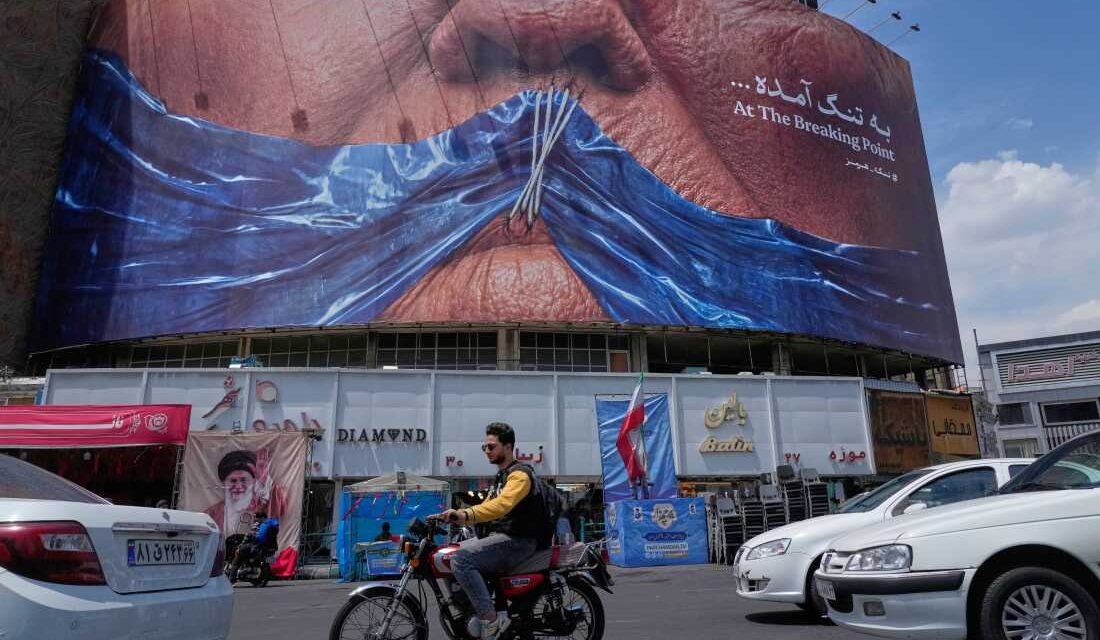
Vehicles move past a billboard showing the Strait of Hormuz in Tehran, Iran, on May 2. The illustration includes an image of President Trump’s lips sewn shut. This visual reflects local sentiment amid ongoing conflict. The image © Vahid Salemi/AP.
When the U.S. and Israel launched military operations against Iran in February, President Trump promised a quick resolution. Six months later, the conflict persists. A failed 60-day ceasefire has left the U.S. embroiled in a prolonged war. The conflict impacts global economies and strains U.S. resources and alliances. President Trump initially aimed to curb Iran’s nuclear program but now seeks regime change. The focus has shifted to controlling the Strait of Hormuz.
Amidst this backdrop, U.S. Treasury Secretary Scott Bessent announced a new sanctions campaign targeting Iran’s economy. This move aims to cut off economic support to the Iranian regime until it stands isolated. Bessent warned countries continuing trade with Iran they would face similar isolation.
“Maximum pressure often leads to maximum resistance,” notes Esfandyar Batmanghelidj of the London-based Bourse & Bazaar Foundation. He observes that Iran might respond by escalating regional tensions.
Regional and International Reactions
The conflict saw Iran’s retaliatory attacks on American Gulf allies. Consequently, trade allies like the United Arab Emirates, once a significant importer of Iranian goods, have ceased transactions with Iran. This shift complicates Iran’s previous sanction-evasion strategies.
Meanwhile, China’s position remains pivotal. A long-standing customer of Iran’s crude oil, China previously bought $31 billion worth of oil annually. However, U.S. efforts to reduce Chinese oil imports, exacerbated by a naval blockade, have seen imports drop by 40%.
Adam Szubin, former director of Treasury’s Office of Foreign Assets Control, states that both the U.S. and China seem to aim for reduced tensions. However, China’s cooperation remains uncertain.
Richard Nephew, a former lead sanctions expert, highlights that applying sanctions to Chinese entities would complicate U.S.-China trade discussions. Nevertheless, sanctions continue to impact Iran despite China’s potential defiance.
Internal Iranian Challenges
In Iran, the U.S. blockade exacerbates economic hardships. A Tehran resident, whose father suffers from cancer, struggles to find necessary medicine. Banking access and daily commerce reflect broader economic distress.
Majid-Reza Hariri from the Iran-China Chamber of Commerce reports soaring shipping costs, illustrating severe trade disruptions caused by the blockade.
Iran’s Strategic Responses
Iran’s officials exhibit defiance in the face of pressure. Security chief Mohsen Rezaei threatens global oil supplies, indicating potential regional escalations. The statement highlights a standoff over economic control and political leverage in the region.
Foad Izadi, an analyst in Tehran, argues that Iran will leverage its current position to negotiate better regional terms. He insists that either all parties benefit from the region’s resources, or none will.
 British Police Arrest Man Suspected of Terror Plot
  Activists Push for Nationwide Ban on Child Marriage in the U.S.
  Investigation into Alleged Incident at Cornell University
  Rising Drone Threats Highlight Vulnerabilities in Moldova’s Airspace Defense
  Bolivia Faces Security Test Amid Unrest
  Incident on FlyDubai Flight Raises Security Concerns