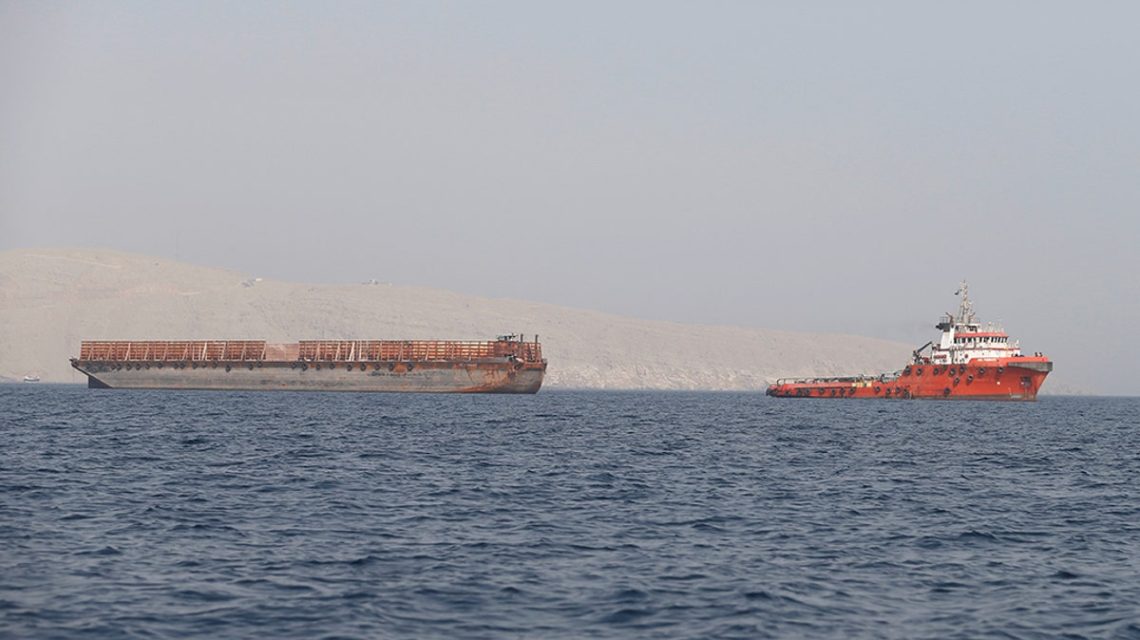
President Donald Trump announced that all mines in the international waters of the Strait of Hormuz had been removed or detonated. U.S. Central Command recently provided insights into the complex operation that led to this conclusion.
Clearing Iranian Sea Mines
U.S. forces have successfully cleared Iranian sea mines from the international shipping lanes. The clearing operation was critical, as these lanes are crucial for global commerce. Despite this achievement, the Strait still faces significant threats. Recent maritime advisories classify the area as having a ‘SEVERE’ threat level.
The cleared mines were located along the Strait’s Traffic Separation Scheme, a crucial route for commercial vessels.
CENTCOM Commander Adm. Brad Cooper stated, “We have successfully cleared the sea mines that the Iranian Revolutionary Guard Corps laid months ago.” This significant achievement highlights the efforts of Navy divers, SEALs, and air power from various branches of the U.S. military.
Strategic Importance of the Strait
The Strait of Hormuz is a critical waterway, with shipping lanes only two miles wide. It serves as a primary route for many large oil-producing nations to the Indian Ocean. Securing these lanes is essential for maintaining the flow of oil globally.
Cooper emphasized that thanks to U.S. military efforts, the internationally recognized routes in the Strait are now free of mines. The operation used a combination of Navy divers, SEALs, and air support to address the threats.
Modern Mine Warfare
The mine clearance operation coincides with significant transitions within the U.S. Navy. The Navy retired its Bahrain-based mine countermeasure ships, opting for newer systems. Advanced technology, such as unmanned systems, is now in use, enhancing the Navy’s ability to locate and neutralize mines.
Despite these advancements, the operation required a broad combination of forces due to the limitations of the Navy’s current mine-sweeping capacity.
Ongoing Threats and Future Operations
The circumstances of the operation were challenging but successfully managed. CENTCOM did not disclose specific details but emphasized that international lanes are open, and clearing efforts continue. However, recent advisories still classify the Strait of Hormuz as a severe risk due to ongoing threats.
Cooper noted that U.S. forces assisted nearly 1,500 commercial vessels carrying approximately 750 million barrels of crude oil through the Strait. This underscores the dual mission of enforcing a naval blockade on Iran while protecting commercial interests.
U.S. forces turned around 75 vessels and disabled three for non-compliance. Meanwhile, ongoing risks prompted joint discussions between Iran and Oman on navigation safety and further mine clearance efforts.
Conclusion
The removal of the mines marks a significant step forward. However, the risk level remains high, with continuing attacks and oil flows below pre-war levels. While the U.S. military declares the commercial lanes open and secure, broader maritime concerns persist, requiring ongoing vigilance and strategic planning.
 Investigation into Alleged Incident at Cornell University
  Rising Drone Threats Highlight Vulnerabilities in Moldova’s Airspace Defense
  Bolivia Faces Security Test Amid Unrest
  Incident on FlyDubai Flight Raises Security Concerns
  Journalist Gershkovich Discusses Wrongful Detention and Release in Russian Prisoner Swap
  Pakistan Airstrikes in Afghanistan: Civilian Casualties Reported