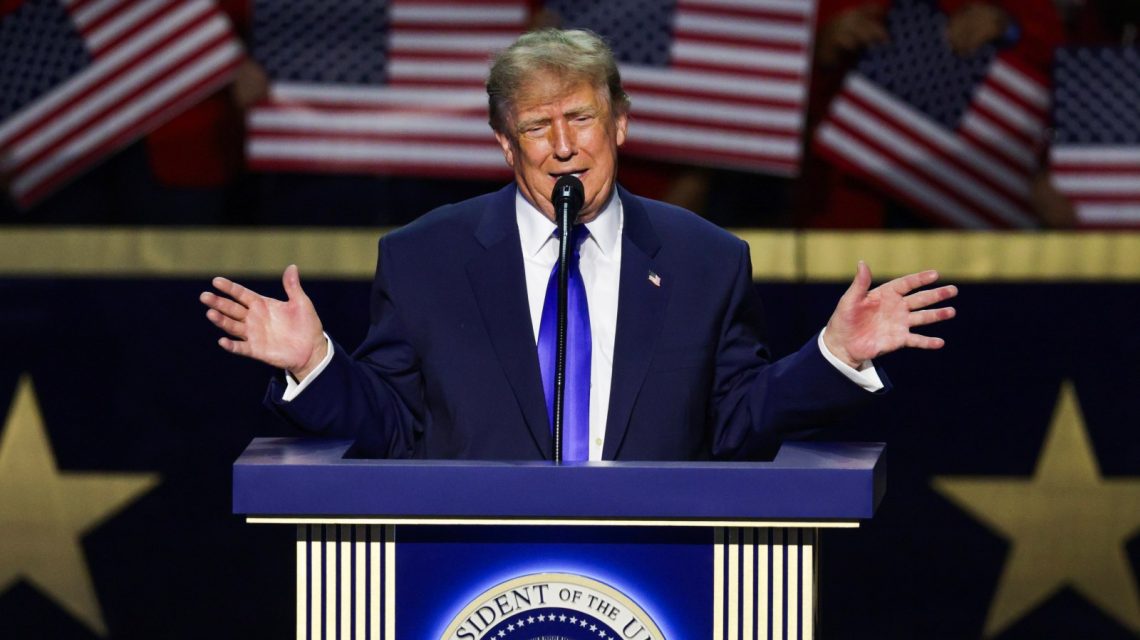
President Donald Trump announced Wednesday that every adult American would receive a $5,000 check if Republicans maintain control of both chambers of Congress in the upcoming midterm elections. This announcement came at the first Republican midterm convention held at Dallas’ American Airlines Center. Trump positioned the payout as a reward for the economic success achieved under Republican policies. The proposal quickly sparked a mix of support and criticism among Republicans.
While many in the audience cheered, fiscal conservatives expressed their concerns. Representative Thomas Massie of Kentucky condemned the plan as an ‘insult,’ suggesting that anything less than $10,000 would be insufficient. Massie also warned of possible inflation from such a large financial distribution.
Former Georgia Representative Marjorie Taylor Greene questioned the strategy. She likened it to another proposal from Vice President JD Vance, which aimed to support stay-at-home parents, estimating that both plans could total around $1.6 trillion. Greene criticized the Republican embrace of what she described as a previously denounced Democratic idea of socialism.
Justin Amash, a former Republican congressman, also vocalized opposition to the plan, calling it an ‘economically illiterate’ measure. He criticized Treasury Secretary Scott Bessent for supporting the proposal, which he described as a ‘trillion-dollar-plus redistribution scheme.’
The Capitol Hill Perspective
The criticisms underscore a long-standing division within the Republican Party regarding government spending and Trump’s populist economic ideas. Representatives like Massie and Chip Roy from Texas have opposed spending they consider excessive, while others have backed Trump’s direct economic benefits approach.
Concerns about funding came up prominently. Roy, retiring after his term, questioned the feasibility of the plan, estimating costs exceeding $1 trillion. Various analyses estimate a $5,000 payment per adult could range from $1.2 trillion to $1.35 trillion. Some Republican operatives view the proposal as a political strategy rather than a feasible economic plan.
Vice President Vance attempted to narrow Trump’s proposal, suggesting payments might not apply to wealthy Americans. He mentioned tariff revenue could fund the plan, highlighting the ‘extraordinary’ revenue generated from tariffs. Trump’s remarks lacked specific details about funding and implementation.
Mixed Republican Reactions
Among Republicans, reactions varied. Florida Senator Rick Scott urged a focus on affordability issues like housing and healthcare instead. Texas Senator Ted Cruz suggested linking the payments to work requirements, acknowledging the need for more specific details. Cruz noted the plan’s significant cost while asserting it was still less than potential Democratic spending.
Conversely, Ohio Senator Bernie Moreno supported the proposal, vowing to prepare legislation to enact the payments post-election. Moreno expressed confidence in Republican success in the election.
House and Senate Election Outlook
The proposed payments occur amid Republicans’ efforts to retain their slim House majority. National indicators currently favor Democrats, with several polls showing them leading on generic congressional ballots.
Democrats require a net gain of three seats to win the House, as evidenced by recent election analyses. With all 435 House seats contested, Republicans focus their campaign on economic issues, immigration, and government spending.
In contrast, the Senate challenges entail Democrats needing four additional seats for control. Several Republican-held seats are contentious, with races in Alaska, Iowa, Maine, Michigan, Ohio, and Texas marked as toss-ups. Democrats, meanwhile, need to defend closely contested seats in states Trump previously secured.
Political observations indicate shifting dynamics in Senate races, as exemplified by The Cook Political Report’s recent updates favoring Democrats in states like Iowa and Texas.
 The Trump Team’s Challenge to the Military Leadership
  Maryland First State to Restrict Electronic Pricing in Grocery Stores
  Activists Push for Nationwide Ban on Child Marriage in the U.S.
  Democratic Hopes and Historical Warnings in 2026 Senate Race
  Republicans Face Challenges Amidst Cost of Living Concerns
  A Different Kind of Fall for Congress This Year