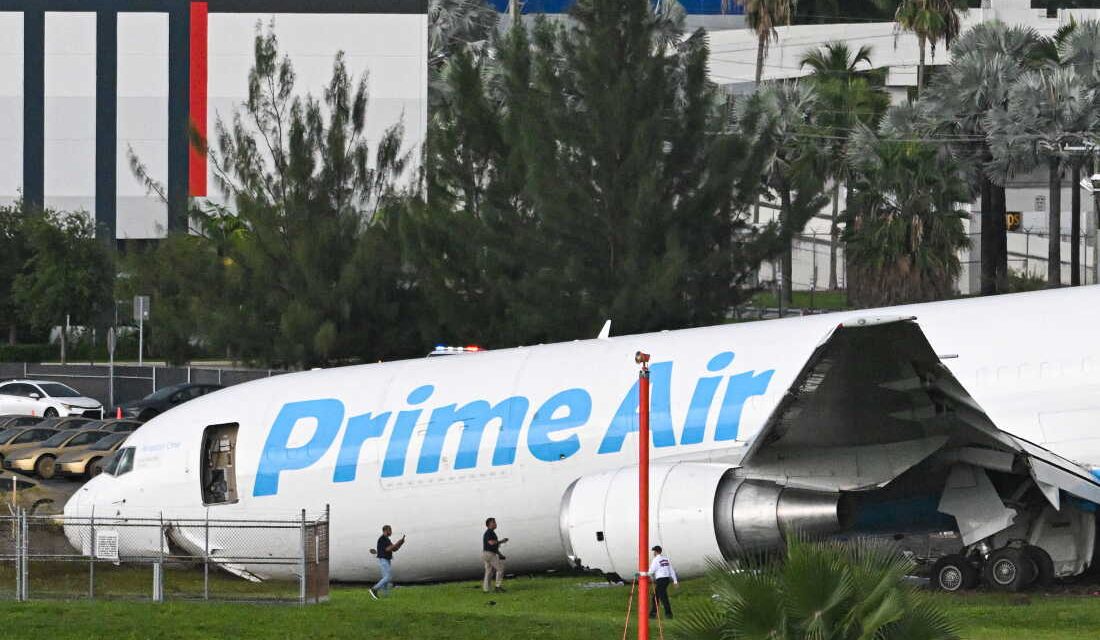
Investigation into Miami Airport Crash Involving Amazon Prime Air Cargo Plane
On September 6, 2026, a Prime Air cargo plane operated by Amazon overran the runway at Miami International Airport, resulting in a crash that caused fatalities and injuries. Officials are examining the sequence of events that led to the tragedy, which included the aircraft colliding with vehicles and igniting a fire upon landing. According to cockpit voice recordings released by the National Transportation Safety Board (NTSB), automatic warning signals alerted the crew to their excessive speed prior to the crash.
Ross Aimer, CEO of Aero Consulting Experts and a retired airline captain, criticized the flight crew’s decisions, noting his shock at their performance. Flight data indicated the plane touched down at approximately 180 miles per hour. Despite attempts to regain air, the plane continued down the runway, eventually impacting two vehicles. Sadly, five individuals were killed, all employed by a firm responsible for cleaning planes. Additionally, five others sustained injuries.
Concerns About 21 Air’s Safety Practices
The incident has raised serious questions regarding the operational practices of 21 Air, the carrier responsible for the flight. Reports from former pilots flagged concerns about safety protocols well before the accident, though 21 Air disputes these claims. There is also scrutiny surrounding Amazon’s choice to contract flights with multiple smaller carriers instead of maintaining an in-house fleet.
Aimer questioned Amazon’s reliance on carriers like 21 Air, describing them as less established operations. Nonetheless, Amazon defended its contracting approach, which involves collaboration with carriers certified by the Federal Aviation Administration. An Amazon spokesperson emphasized the company’s prioritization of safety for flight operators, airport communities, and those handling cargo.
The Miami crash is one of several serious incidents involving Amazon-contracted aircraft. Previous accidents in 2019 and 2024 resulted in fatalities and aircraft damage, with factors such as pilot error and mechanical issues noted by the NTSB.
Pilot Experience and Hiring Challenges
The diverse array of air carriers Amazon utilizes includes major airlines and smaller operators like 21 Air, which managed the Miami flight with aviation novices. The captain and first officer had limited certification times on the Boeing 767 model, as reported by the NTSB. Aimer observed that pilots at smaller cargo airlines often view these roles as stepping stones to more lucrative positions, which results in hiring challenges and less experienced crews.
Efforts by 21 Air to address safety and hiring were unsuccessful. Former employees voiced concerns that management neglected stringent safety standards and failed to attract skilled pilots by offering competitive compensation. Karl Seuring, a veteran pilot formerly employed by 21 Air, had anticipated an accident given the preceding issues and even filed a whistleblower lawsuit after his dismissal for raising these concerns.
Ongoing Investigation
Both 21 Air and Amazon are cooperating with the NTSB’s ongoing investigation into the Miami crash. Investigators, led by NTSB chair Jennifer Homendy, are examining operational dynamics between Amazon and its contracted airline. Homendy highlighted the importance of understanding the collaboration and safety protocols in place, with public input encouraged.
Amazon continues to monitor the investigation and address employee safety concerns, striving to ensure such tragic incidents do not recur.
 TikTok Couple Arrested for Alleged Arson in West Virginia
  21-Year-Old University of Georgia Student Survives Eight-Story Fall
  Texas Authorities Arrest Suspect Over Potential Capitol Attack
  Arizona State University Hockey Incident Leads to Coach’s Administrative Leave
  Senate Vote on Data Center Electricity Cost Legislation
  Fatal Hit-and-Run Leads to Additional Shooting Incident in Miami-Dade