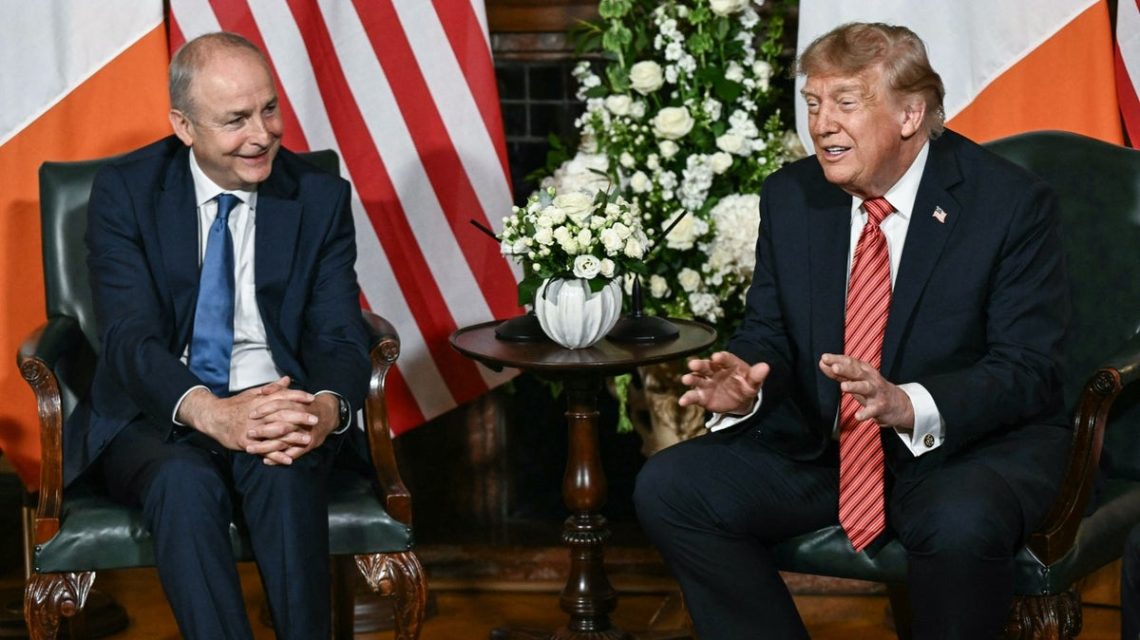
President Donald Trump, during his trip to Ireland, expressed a desire to see the country unified. The Republic of Ireland attained independence from the United Kingdom in 1922, while Northern Ireland, established in 1921, remains a part of the U.K.
“I don’t want to cause any problems, but I will tell you, I’d love to see it unified. I have friends on both sides, great people. They’re Irish people. How can they be bad, right?” Trump remarked in Dublin while sharing the stage with Ireland’s Prime Minister, Micheál Martin. “I’d like to see a unified country. I think it would be a great feather in everybody’s cap if that happened. It’s going to happen eventually.”
He acknowledged that the U.K. “will have something to say about it obviously,” reiterating that unification would be a “great thing.” On September 12, 2026, President Trump met with Prime Minister Micheál Martin at Farmleigh House in Dublin, Ireland.
Later that Saturday, Trump spoke to an audience at the Deerfield Residence, the official home of the U.S. ambassador to Ireland, where U.S. Ambassador Edward S. Walsh introduced him. Trump took the stage to the tune of Lee Greenwood’s “God Bless the USA.”
Early in his address, Trump revisited a reporter’s question concerning the possibility of Irish reunification.
“That’s one of those questions where no matter what you say, no matter how well you say it, there’s no good answer, right?” he commented, suggesting that reunification would be a “cool thing.”
As Trump hinted, the debate over whether Ireland should be unified has been one of the island’s most contentious political issues for decades. The issue has been more than a mere verbal conflict. From the late 1960s to the late 1990s, Northern Ireland endured decades of sectarian conflict known as “the Troubles.”
Irish nationalists and republicans, predominantly from Northern Ireland’s Catholic minority, sought to reunite the island under one Irish state. Conversely, unionists and loyalists, mainly from the Protestant majority, wanted Northern Ireland to remain part of the U.K.
Throughout the conflict, over 3,500 individuals lost their lives due to violence involving Irish republican and loyalist paramilitary factions, as well as British security forces.
 TikTok Couple Arrested for Alleged Arson in West Virginia
  21-Year-Old University of Georgia Student Survives Eight-Story Fall
  Texas Authorities Arrest Suspect Over Potential Capitol Attack
  Arizona State University Hockey Incident Leads to Coach’s Administrative Leave
  Senate Vote on Data Center Electricity Cost Legislation
  Fatal Hit-and-Run Leads to Additional Shooting Incident in Miami-Dade