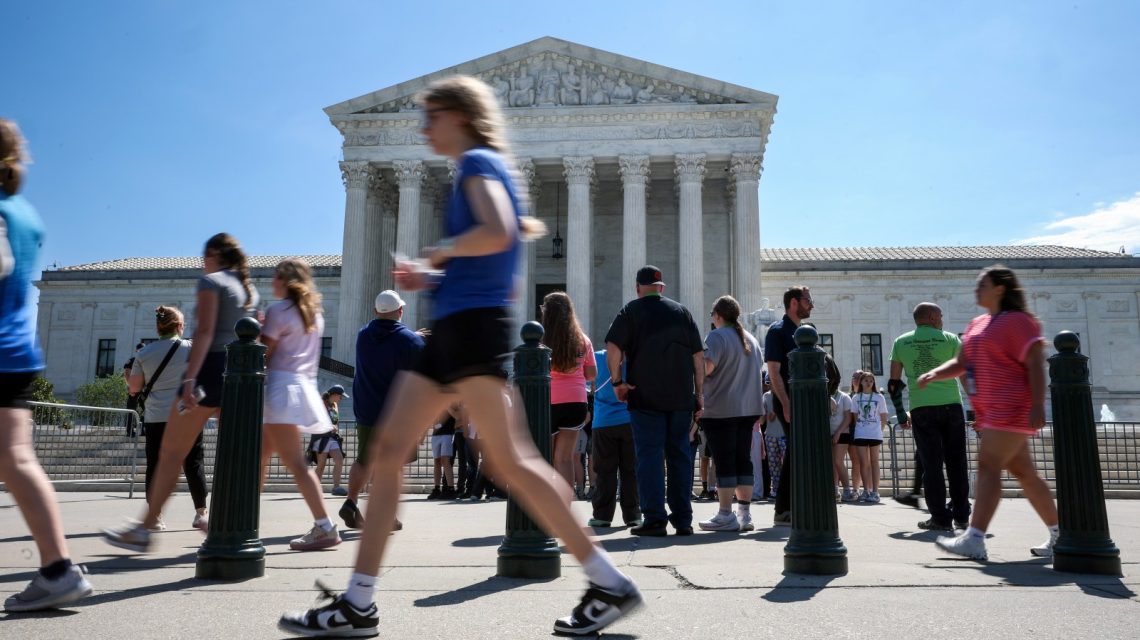
A recent decision by the U.S. Supreme Court has blocked a Republican-backed congressional map in Missouri. This decision narrows one of the GOP’s opportunities to gain an additional seat in the House of Representatives, where they hold a slim majority.
The Supreme Court rejected the proposed map, which aligns with previous orders from the Missouri Supreme Court to use the map from 2022, drawn after the last census. Missouri was a key state for Republicans hoping to expand their representation in the House. The rejection presents a significant setback for the party’s midterm redistricting efforts.
This decision also impacts President Donald Trump, who supported redistricting efforts to strengthen the GOP’s position in the House. Trump has faced declining approval ratings linked to international issues and economic concerns.
Newsweek reached out to the White House for a statement, though no response has been received.
Republican Efforts to Modify Missouri’s Congressional Map
The GOP’s proposed map aimed to make the Kansas City-area district, held by Democrat Emanuel Cleaver, more competitive for Republicans. The current arrangement gives Republicans a 6-2 advantage, but the new map would have shifted this to 7-1.
The 2022 map includes Kansas City entirely in the 5th Congressional District. The proposed changes would have altered the district by extending its boundaries into rural Republican areas. According to AP, approximately 59% of voters would be new under these proposed changes.
The map was utilized during the August primary, but its application in November’s midterms was halted by the Missouri Supreme Court. The court ruled that the map needed voter approval through a referendum.
The issue escalated to the U.S. Supreme Court, which upheld the lower court’s decision, blocking the use of the GOP map for the November elections while legal proceedings continue.
This ruling means Missouri’s voters might experience different congressional districts in the general election compared to those in the primary. This change could affect candidate options for over a million voters, or about 25% of the potential electorate, according to Associated Press estimates.
Impact on National Redistricting Battle
Though losing a single seat might seem minor, Missouri’s situation is part of a national redistricting battle in preparation for the 2026 midterms. With the delicate balance of power in the House, even one additional Republican seat could be crucial.
Since last year, both political parties have aimed to redraw districts outside the standard post-census cycle. States led by Republicans, such as Texas, Florida, North Carolina, and Missouri, pursued maps favoring GOP candidates. Meanwhile, Democrats pushed similar efforts in states like California.
Judicial intervention in various states has further reshaped political landscapes before upcoming elections.
Currently, Republicans are leading the redistricting campaign. Only California, a Democratic-controlled state, has implemented a new map, where Democrats seek five additional seats from their current majority.
Comparatively, nine Republican-controlled states have successfully introduced new maps, enabling potential gains for the GOP. These states include Alabama, Florida, Louisiana, Missouri, North Carolina, Ohio, Tennessee, Texas, and Utah.
Republicans could gain up to 15 seats through redistricting, while Democrats may add six.
Attempts to redraw maps have failed in Arkansas, Indiana, Kansas, Maryland, New York, South Carolina, Virginia, and Wisconsin.
 Maryland First State to Restrict Electronic Pricing in Grocery Stores
  Activists Push for Nationwide Ban on Child Marriage in the U.S.
  Democratic Hopes and Historical Warnings in 2026 Senate Race
  Republicans Face Challenges Amidst Cost of Living Concerns
  A Different Kind of Fall for Congress This Year
  Cornel West and Sean Hannity Discuss Differences on Podcast