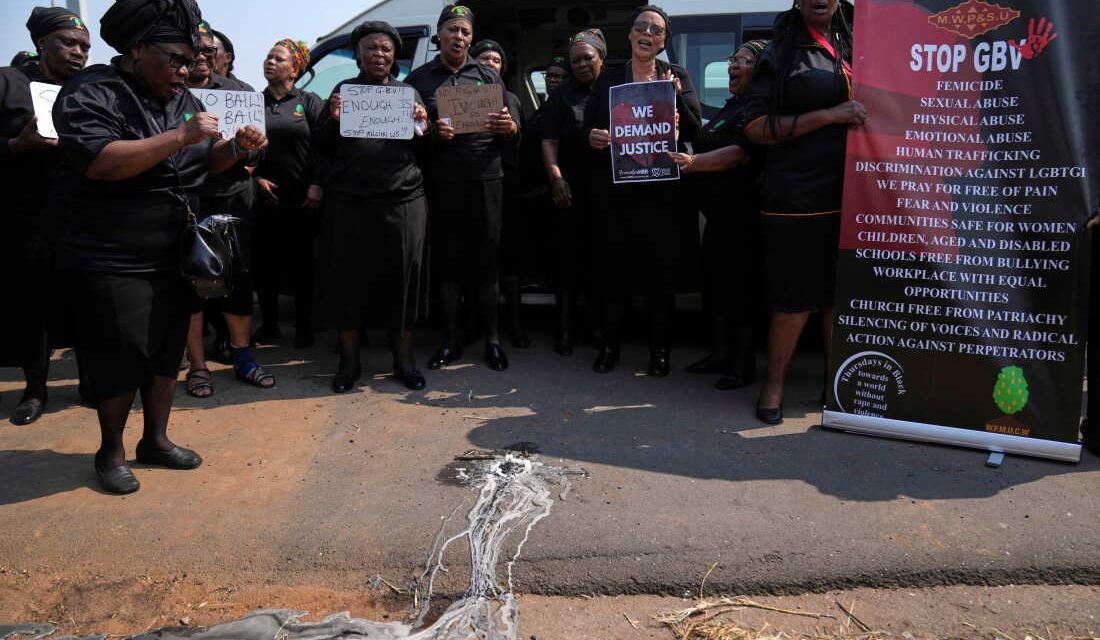
Members of a women’s church group gather beside a melted candle, paying their respects at the site where a woman’s body was discovered last week in Kempton Park, South Africa. The incident took place east of Johannesburg on Thursday, September 17, 2026.
The tragic story of Elizabeth Moselakgomo, a 38-year-old manager, mother, and runner, has shaken the community. Last week, she set out for her usual afternoon jog near Johannesburg airport and did not return home. Her failure to return prompted her 8-year-old daughter to alert relatives, who then contacted the police. Five days later, Moselakgomo’s half-naked body was discovered, brutally beaten and unrecognizable.
Her case is one among nine women found slain in the area, most within a few weeks. The majority of these women were sexually assaulted. Despite South Africa’s notoriety for high rates of gender-based violence, with over 100 rapes and 15 women killed daily according to police statistics, the recent surge in murders has shocked and frightened the nation.
Police are considering the possibility of a serial killer and have advised women to remain “vigilant” and avoid walking or running alone. This has provoked backlash on social media, where women demand that the police should ensure their protection, rather than curtailing their freedom.
President Cyril Ramaphosa assured citizens that “no stone will be left unturned” in pursuing the culprit or culprits responsible. Yet, many South Africans criticize the government for failing to adequately protect women and girls, despite declaring gender-based violence and femicide a national disaster in 2025.
Shenilla Mohamed, Amnesty International’s South Africa Director, expressed frustration, stating, “Women are tired of platitudes. We want to know what is going to be done to make women and children feel safe.”
“Women in South Africa continue to be hunted and denied the most basic right to life and security,” Mohamed said.
Protests are occurring in Kempton Park and Cape Town, with women across South Africa insisting that the violence must end. Moselakgomo, being a dedicated runner, has inspired local running clubs to organize events in her honor and for all victims. Participants assembled in Johannesburg dressed in black, observing a minute of silence before setting off.
Shari Maluluke, a 26-year-old runner, told NPR, “Gender-based violence, but particularly femicide, is such a big issue in South Africa. As a woman you can’t do anything alone.” Her comments highlight the dangers women face while performing everyday activities.
Many runners at the event expressed feelings of insecurity. Didi Tsitsi, 31, explained the precautions women take: “You send your location, you share your Ubers.” When discussing why femicide is prevalent, Tsitsi pointed to government and policing failures and societal issues surrounding masculinity. She mentioned that unresolved impacts from apartheid are contributing factors.
Academic research supports this view. Studies indicate that decades of oppressive minority rule, where Black men lacked agency and autonomy, have resulted in a crisis of masculinity and entrenched patriarchal attitudes.
 British Police Arrest Man Suspected of Terror Plot
  Activists Push for Nationwide Ban on Child Marriage in the U.S.
  Investigation into Alleged Incident at Cornell University
  Rising Drone Threats Highlight Vulnerabilities in Moldova’s Airspace Defense
  Bolivia Faces Security Test Amid Unrest
  Incident on FlyDubai Flight Raises Security Concerns