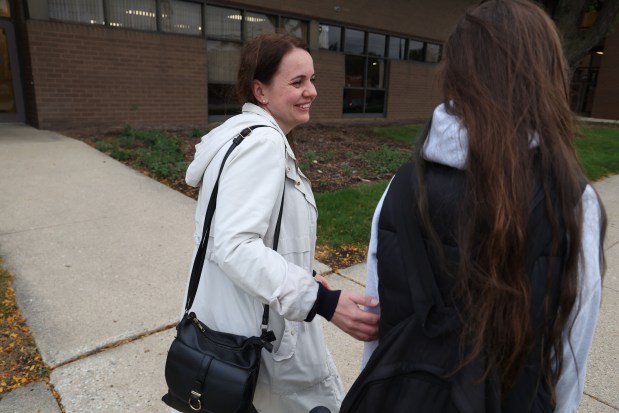
Yaryna Levchuk has always found pride and purpose in work. Even when war erupted in Ukraine over four years ago, she volunteered to organize medical supplies alongside her pharmacy job. When she and her family escaped to the U.S., settling near Chicago, Levchuk resumed work swiftly, never missing an immigration deadline to safeguard her work opportunity. However, recent policy changes and processing delays have jeopardized her employment status. Soon, her husband could face similar issues, leaving their family in limbo about their future in the U.S.
“We do not demand. We’re just friendly asking, if it’s possible, please help us,” Levchuk expressed to the Tribune, seeking permission to work.
The uncertainty follows the looming expiration of Temporary Protected Status (TPS) for over 100,000 Ukrainians who fled Russian aggression. The humanitarian protection was set to expire on a Monday, leaving refugees worried about their legal status, job prospects, and risk of deportation. Reports on Sunday indicated the Trump administration might maintain TPS for Ukrainians temporarily but offered no official announcement. This leaves families like Levchuk’s in a precarious state as they await federal decisions.
For those with alternate pathways, slow processing times hinder progress. The heightened conflict in Ukraine and deteriorating U.S.-Ukraine relations cast additional doubt, as potential reductions in U.S. support could influence TPS matters. Ahead of the deadline, Levchuk lost her pharmacy technician position with the expiration of her work permit. Her husband’s employment also hangs in the balance.
Levchuk, 41, grew up entirely in Ukraine with her family rooted deeply there. Five years prior, she lived near the Polish border with her husband and kids, managing a pharmacy. Warned of conflict looming, she took steps to protect her children. When Russia’s full-scale invasion began on February 24, 2022, her husband joined the territorial army while Levchuk stayed to aid the war effort through pharmacy work and volunteering to organize medical supplies.
As the conflict endured, Levchuk faced the agonizing separation from her children. At her husband’s insistence, due to his health issues, and her sister urging her to join her in the U.S., Levchuk entered through ‘Uniting for Ukraine’ (U4U), a humanitarian parole program initiated by President Joe Biden in 2022. It allowed Ukrainians a temporary stay and work rights with the support of an American sponsor. By late September 2022, Levchuk and her family were in Buffalo Grove, Illinois.
Despite initially speaking little English and lacking transportation, she secured a pharmacy technician role, acclimating quickly to pursue her U.S. pharmacist credentials. Her first U4U parole expired in 2024, prompting an immediate re-application to avoid lapses, including seeking TPS. U4U intended as a bridge, guiding migrants from parole to alternative legal statuses like TPS, as explained by Nicole Hallett of the University of Chicago Law School.
TPS, established in 1990, lets those facing homeland dangers stay and work in the U.S. But TPS application complexity and patchwork work authorization rules complicate security for applicants like Levchuk. TPS-based work permits hinge on final application approval, leaving Levchuk reliant on her humanitarian parole for interim employment.
In his second presidency, Trump aimed to end parole programs at odds with his policies, ordering a U4U freeze that exacerbated delay issues. Processing resumed by court mandate in May 2025, yet sluggishness persists, per Chicago lawyer Julia Sverdloff, stalling many Ukrainians’ renewals.
Levchuk’s husband remains pending for TPS approval but gained interim work eligibility. Federal statutes imply a TPS baseline extension given missed decision timelines, though real-world adherence is unpredictable. Trump’s second-term DHS has stricken TPS for numerous countries, and courts have diminished oversight, complicating reliable expectations.
Comparisons arise with El Salvador’s TPS lapse in silence last month.
The administration’s differing treatment of Ukrainians, as noted by a Senate aide, grants them reassurances like ongoing U4U re-parole, fostering hope despite uncertainty. USCIS stated potential TPS outcomes would arrive in due course via Federal Register. DHS didn’t provide immediate comments, but questions about the duration and handling of TPS remain.
With TPS unpredictability, employers wary of compliance might avoid staff with unresolved status. Sen. Tammy Duckworth and others requested an 18-month Ukraine TPS extension, suggesting advocacy impacts possibilities. But meaningful legislative change awaits Congress’s next session, emphasizing enduring dialogues on paths to residency for those with protected status.
RefugeeOne, a West Ridge support organization, acknowledges client queries about looming deadlines. TPS shifts could affect 1,500 families in their care, leaving clients with expired permits wresting with resultant questions and frustrations.
Levchuk’s son, a high school senior, hopes for their family’s stay for his graduation and college opportunities, though with financial aid challenges ahead. The family frequently discusses a path forward in an environment filled with uncertainty. Despite hardships faced, Levchuk remains thankful for the time given thus far, expressing profound gratitude.
The Associated Press contributed.
 In-Flight Altercation on Qatar Airways Leads to Police and FBI Response
 Mayor Mamdani’s Policing Reform Plans
 Virginia Residents Sue Over Alleged Immigration Violations
 Gen Z Voter Shifts and Their Impact on the 2026 Midterm Elections
 Disappearance of US Senate Candidate Raises Questions
 DOJ Rule Change Reduces Appeal Time for Immigrants Facing Deportation