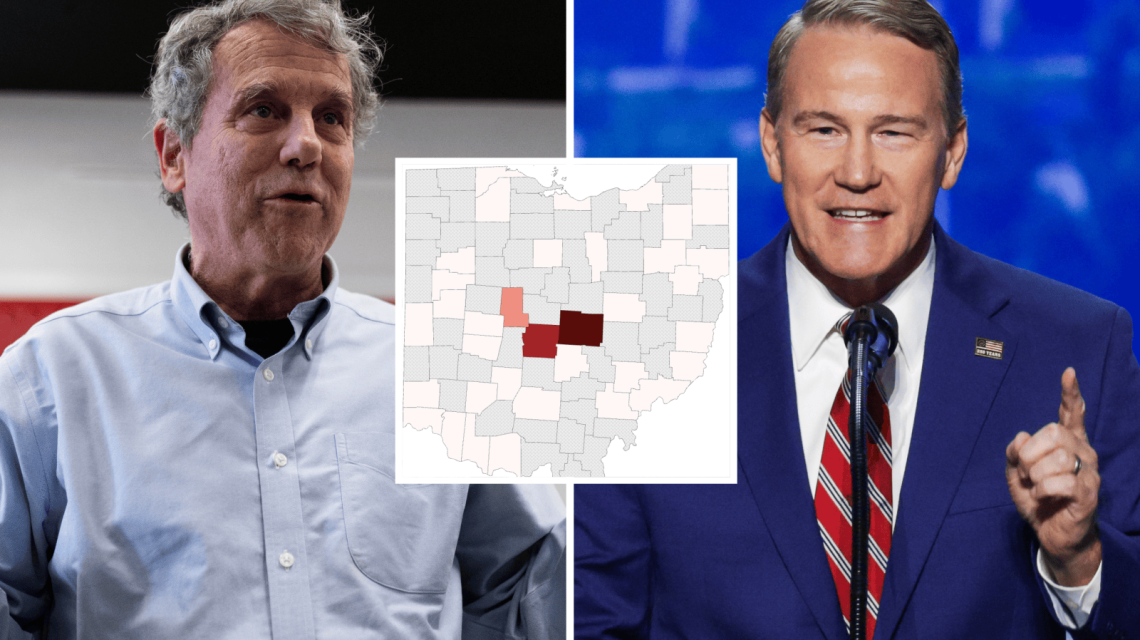
In the Ohio Senate race, data centers have become a key issue dividing Republican Senator Jon Husted and Democratic former Senator Sherrod Brown. Candidates are taking sides on data center development, a topic reshaping the midterm election. Many Americans express reluctance about having data centers in their communities. Advocates argue these centers, crucial to artificial intelligence infrastructure, offer significant job opportunities, including union jobs. However, critics highlight environmental concerns, increased water usage, potential hikes in electricity bills, and noise pollution.
Over the years, numerous large AI data centers have emerged across Ohio. Activist Erin Brockovich provides a map detailing several large AI-focused centers that have been constructed or are under development. This map emphasizes significant AI-focused and hyperscale facilities, leaving out smaller or unannounced ones. Additionally, “community-reported” pins on the map showcase smaller data centers scattered across the state.
As voter apprehension grows, Brown and Husted advocate for regulations on the campaign trail, positioning themselves as best suited to tackle this issue when Congress reconvenes in 2027.
Ohio’s Data Center Revolt
Data centers have spread widely across rural Ohio, bringing noise, pollution, and higher utility rates,
stated David Niven, a professor at the University of Cincinnati’s School of Public and International Affairs, in an interview with Newsweek. He explained that for Democrats, data centers serve as a potent wedge issue as they proliferate in traditionally Republican rural counties. Rather than responding to public outcry, Ohio Republicans have supported data center construction, providing tax breaks.
Niven noted that Brown was among the first candidates to recognize the potential of data centers as an electoral issue. Paul Beck, professor emeritus of political science at Ohio State University, highlighted a lack of transparency as a key concern for voters, stating that data centers have been approved and subsidized without sufficient transparency.
A Bowling Green State University poll released in September revealed that a majority of Ohio voters oppose having data centers in their communities. Seventy-five percent opposed, while only 25 percent supported, data center construction in their areas. Additionally, 63 percent opposed data centers being built anywhere in Ohio. A large majority, 78 percent, supported a temporary ban on data center construction until more information on their effects becomes available.
Data Center Development in Ohio
The primary development of AI data centers occurs around Columbus due to its access to significant population centers. Significant data center projects have emerged in the suburban counties of Licking and Union as well as Franklin County, home of Columbus. Franklin County leans Democratic, but conservative suburban areas have seen data center investment and subsequent opposition. A petition in Licking County, for instance, aimed to ban data centers exceeding 25 megawatts.
Economic factors draw data centers to Central Ohio. As Niven stated, the region offers cheap, flat land and attractive water and electric rates, with proximity to population hubs as an added advantage. Ohio has extended at least $2.3 billion in sales tax breaks for data centers, per reports from Signal Ohio in June.
Different Stances
Jon Husted and Sherrod Brown have responded to data center concerns. Husted introduced the Ratepayer Protection Act in the Senate. This proposed legislation would have encouraged states to establish standards for large electricity users, like data centers, connecting to the grid. The proposal aimed to prevent rising electricity costs for consumers but failed in the Senate when Democrats opposed it, claiming it was insufficient.
Husted has emphasized public demand for data centers. During a podcast interview, he noted that people create the need for data centers by using digital products, suggesting that consumers should opt-out if opposed. Newsweek’s AI Policy Scorecard currently rates Husted’s AI stance as mixed. While serving as lieutenant governor, Husted supported data center development, including related tax incentives, according to the Ohio Capital Journal.
Amy Natoce, Husted’s campaign spokesperson, stated that Husted views data centers as a local decision, with different priorities managed by local leaders. She suggested Brown was avoiding honest discussion of his record and criticized Democrats for blocking Husted’s bipartisan legislation that required data center companies to cover their power costs.
Sherrod Brown, in contrast, has expressed skepticism about data centers. In a recent post, he acknowledged Ohioans’ concerns over the influx of data centers, emphasizing his stance to challenge corporations raising utility bills, defend resources, and protect communities. Brown argues that data centers should cover the full cost of their utility consumption, avoiding passing costs onto Ohioans. Newsweek contacted Brown’s campaign for comment via email.
Data Centers and Labor Unions
Labor unions contribute another dimension to the data center debate in Ohio. Union voters historically form a crucial base for Brown, yet unions see data centers as an opportunity for union jobs amid economic upheaval. Dorsey Hager, a key figure in the Columbus/Central Ohio Building and Construction Trades Council, criticized political opposition to data centers, citing potential job creation in construction.
Democrats, Niven argued, may have softened their stance to avoid antagonizing unions, a major source of job opportunities in construction. Yet, he pointed out that the issue was too important to continue avoiding conflict with unions. Despite job creation during construction, data centers require few operational jobs once complete.
Senate Race Polls
The race between Husted and Brown remains close. RealClearPolling’s polling aggregate reflected a narrow 2.1-point lead for Brown. An InsiderAdvantage poll indicated a 3-point lead for Brown, with 47 percent support versus 44 percent for Husted. This survey of 1,200 likely voters had a margin of error of plus or minus 2.83 percentage points. A subsequent Fox News poll found Brown leading Husted by 5 points, with 52 percent support against 47 percent, conducted among 1,592 likely voters with a 2 percentage point margin of error.
Sherrod Brown’s Comeback Efforts
Brown served as a Senator from 2007 to 2025, witnessing a political evolution in Ohio from battleground to more conservative stronghold. Although Ohio backed former President Barack Obama in 2008 and 2012, it pivoted in support of President Donald Trump in subsequent elections, including by an 11-point margin in 2024. Trump’s appeal to white working-class voters shifted the state’s political dynamics, gaining rural and northeastern voters near Cleveland.
Democrats feel optimistic about this year’s race given the typical midterm loss trend for White House-aligned parties and President Trump’s low approval ratings amid economic concerns such as affordability and cost of living. The Ohio race could impact congressional power balance, representing a critical toss-up for Democrats to potentially win in a conservative state.
Despite past losses, Brown has occasionally succeeded in Trump-era Ohio. He secured reelection during the 2018 “blue wave” but lost to Republican Bernie Moreno in 2024, a challenging year for his party.
Outlook
The Ohio Senate race remains a focal point for its competitiveness in the 2026 midterms. The Cook Political Report and Sabato’s Crystal Ball classify the race as a toss-up with early voting currently underway.
 Mayor Mamdani’s Policing Reform Plans
 Gen Z Voter Shifts and Their Impact on the 2026 Midterm Elections
 Disappearance of US Senate Candidate Raises Questions
 DOJ Rule Change Reduces Appeal Time for Immigrants Facing Deportation
 Hakeem Jeffries’ Bid for House Speaker Faces Progressive Hurdles
 Ohio Judge Dismisses Defamation Lawsuit by Rep. Max Miller