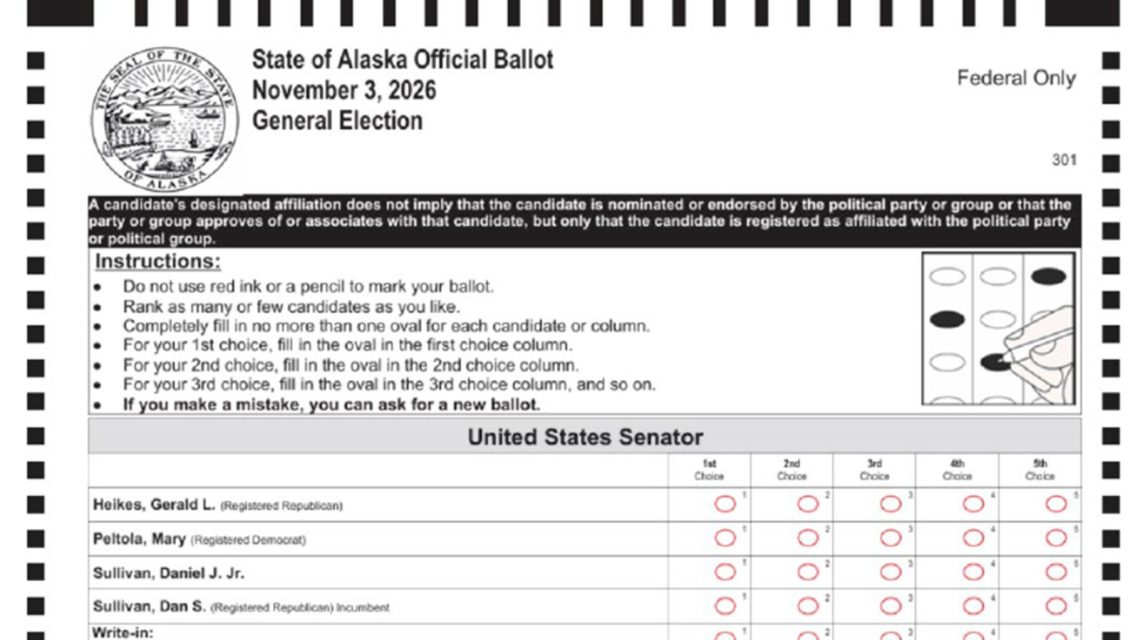
President Donald Trump recently voiced concerns about the Alaska Senate ballot, implying it confuses voters due to similar candidate names. Republican Senator Dan S. Sullivan appears alongside Daniel J. Sullivan Jr., a retired teacher, on the ballot. Trump criticized the ballot setup before heading to a rally in Michigan.
Trump labeled the ballot format as unfair, particularly because of ranked-choice voting, which he described as flawed. He suggested the incumbent senator should be identified with a clearer title on the ballot than merely ‘incumbent’. He stated many people might not understand the term ‘incumbent’.
This issue also involves a Justice Department lawsuit with Election Day fast approaching. Newsweek contacted the Alaska Division of Elections for comments.
Two Dan Sullivans in Alaska
The ballot lists Dan S. Sullivan as the Republican incumbent using the ‘Incumbent’ label. Daniel J. Sullivan Jr. is identified with his full name, lacking any party affiliation. Trump argued that Daniel J. Sullivan Jr.’s presence aims to confuse voters and impair Senator Sullivan’s campaign against Democrat Mary Peltola and other contenders.
Trump claimed the situation is a deliberate act by Democrats, although he provided no evidence for these accusations. Daniel J. Sullivan Jr. countered allegations of candidacy invalidity and confirmed his intention to run based on dissatisfaction with current representation.
Alaska officials initially removed Daniel J. Sullivan Jr., citing intentions to mislead voters, but courts restored his candidacy after a challenge.
DOJ Lawsuit Over Election
The Justice Department filed a lawsuit against Alaska and its election officials, accusing Daniel J. Sullivan Jr.’s candidacy of voter manipulation tactics to undermine Senator Sullivan’s campaign. They request to block election certification if Sullivan loses by fewer votes than those his namesake gains, pending further investigation.
Trump claimed personal involvement in initiating the lawsuit, although Attorney General Todd Blanche clarified that the department acted independently. During a CBS News interview, Blanche refused to disclose his communications with Trump.
Senator Lisa Murkowski opposed the DOJ lawsuit, stating Alaska’s ballot provides adequate candidate distinctions. Trump retaliated with strong criticism, labeling Murkowski a disgrace to Alaska and beyond.
Alaska’s ranked-choice system, which Trump criticized, involves voters ranking candidates. As votes are tallied, the system narrows down candidates based on preferences until a majority emerges.
Legal Challenges to DOJ Lawsuit
The DOJ lawsuit faces objections in federal court. Two Alaska voters, alongside local organizations, pushed for dismissal, arguing the federal government lacks authority in this context. They cited Trump’s remarks in assertions of presidential influence over the case.
Election specialists doubt the legal merit of the DOJ’s actions. Michael Morley, a law professor, expressed skepticism about the case’s foundation. Senator Adam Schiff criticized the lawsuit, echoed during an appearance on NBC’s Meet the Press.
The Significance of Alaska Senate Race
The election’s outcome holds potential implications for Senate control. The Republican majority presently stands at 53-47. Peltola strives to break historical trends by becoming Alaska’s first Democratic senator since 2008.
Four candidates vie for positions in this notable Senate race. The associated frictions and pre-election legal proceedings heighten the stakes of Alaskan votes.
 Mayor Mamdani’s Policing Reform Plans
 Gen Z Voter Shifts and Their Impact on the 2026 Midterm Elections
 Disappearance of US Senate Candidate Raises Questions
 DOJ Rule Change Reduces Appeal Time for Immigrants Facing Deportation
 Hakeem Jeffries’ Bid for House Speaker Faces Progressive Hurdles
 Ohio Judge Dismisses Defamation Lawsuit by Rep. Max Miller