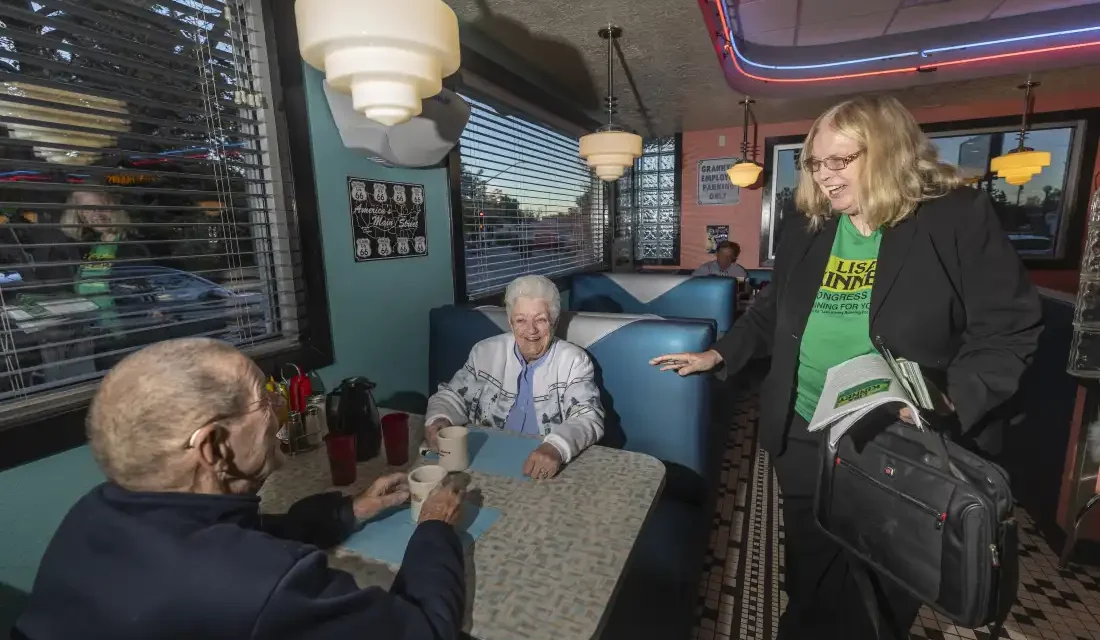
Lisa Kinney campaigns as a Democratic congressional hopeful at Johnny J’s Diner in Casper, Wyoming, on October 19, 2026. Her effort is part of a controversial election cycle where competitive races could decide congressional control, but 80% of districts honor a solid Republican or Democrat history. Kinney faces an uphill battle as the lone Democratic candidate against a Republican stronghold.
Wyoming’s congressional seat has been Republican-held since the late 1970s. Kinney emphasizes her moderate stance and her commitment to giving residents both sides of important issues. Despite negative ads linking her to progressive figures like Bernie Sanders and Zohran Mamdani, she remains focused on her campaign.
As Kinney navigates the diner, she’s met with concerns from voters wary of Democrats’ positions on Immigration and Customs Enforcement and trans issues. She assures voters of her ability to foster bipartisan dialogue to enact change.
In a conversation with Joe Beck, a disillusioned voter with no party allegiance, Kinney addresses questions regarding her ability to influence change in a deeply Republican state like Wyoming. Despite Beck’s skepticism about her influence, he admits to already voting for her, recognizing the arduous path she faces in a predominantly Republican environment.
Kinney’s campaign lacks traditional resources, relying on dedicated personal effort and a small team scattered across the state. Her focal campaign messages center on preserving public lands and reducing healthcare costs—a message she’s passionate about despite the extensive travel demands on the road.
Rodney Lang, Kinney’s husband, underscores that their ultimate goal extends beyond winning. Enhancing party strength through visible effort is a victory in itself.
Across the nation in Connecticut, George Austin, a Republican, identifies with Kinney’s political adversities. He’s running for Congress in a significantly Democratic region and encountering similar resistance due to entrenched partisan sentiments.
George Austin seeks to disrupt Democratic dominance in Connecticut’s second congressional district. Directing focus towards congressional gridlock, term limits, and AI regulation, he offers voters common-ground issues to counter partisan disengagement.
Austin highlights his campaign’s multifaceted approach, serving roles like scheduler and financial stakeholder, contributing financially to establish campaign credibility. Despite being outnumbered, he emphasizes the necessity to run devoted campaigns with earnest goals, acknowledging the need for resilience.
The combination of demographics and gerrymandering solidifies states’ partisan tendencies, presenting challenges for candidates like Kinney and Austin. Eric Ostermeier, who founded Smart Politics, notes that high single-party representation in state delegations echoes historic parallels dating back over seventy years.
Austin stresses the need for diverse representation, citing high numbers of uncontested state races. He encourages regular citizens to participate in political processes, hoping to catalyze a broader engagement.
Both Kinney and Austin recognize the difficulty of their roles but affirm the importance of their pursuits. Austin insists that candidates should run with intention beyond superficial motivations to maintain integrity within their campaigns.
For Kinney and Austin, navigating political climates against entrenched party lines may be daunting, yet their courage to compete defines necessary progress amid established partisan territories.
Chris Polansky contributed additional reporting from Connecticut Public.
 Mayor Mamdani’s Policing Reform Plans
 Gen Z Voter Shifts and Their Impact on the 2026 Midterm Elections
 Disappearance of US Senate Candidate Raises Questions
 DOJ Rule Change Reduces Appeal Time for Immigrants Facing Deportation
 Hakeem Jeffries’ Bid for House Speaker Faces Progressive Hurdles
 Ohio Judge Dismisses Defamation Lawsuit by Rep. Max Miller