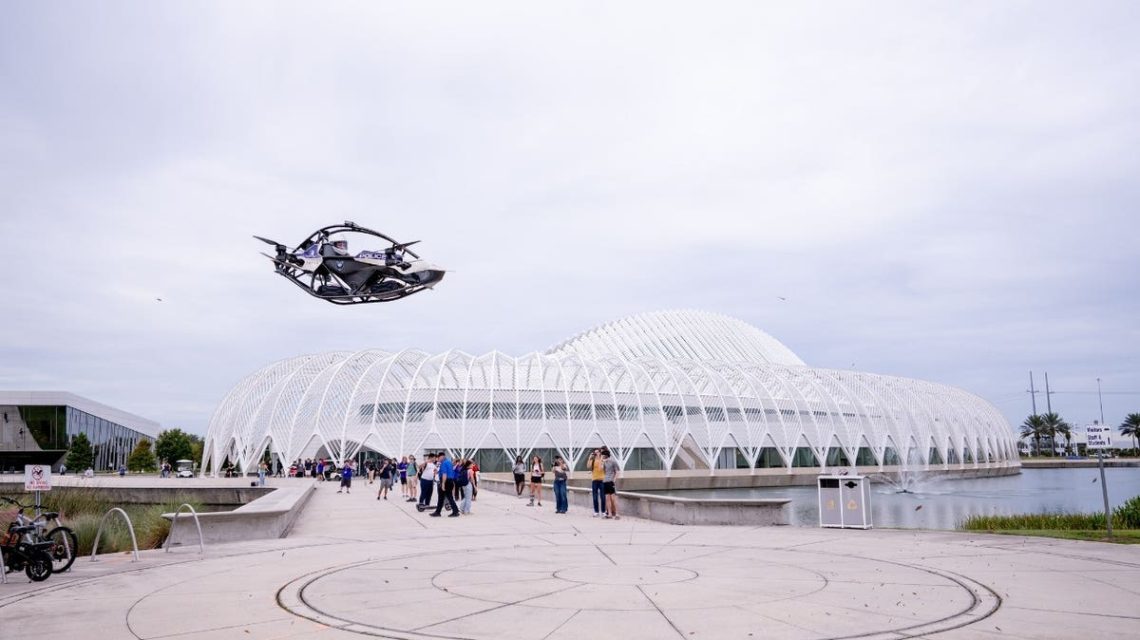
Florida Polytechnic University’s police department in Lakeland is testing a unique approach to emergency response: a flying patrol vehicle named Astro. Developed by Jetson, known for its Jetson ONE personal flying machine, Astro is a single-seat electric aircraft. The university claims it’s the first law enforcement agency in the U.S. to incorporate this kind of aircraft.
Introducing Astro
The compact Astro, resembling a giant drone, uses electric vertical takeoff and landing technology (eVTOL), enabling it to lift directly into the air without a runway. Unlike traditional helicopters, Astro’s frame folds for transport and storage. It features an open cockpit and lightweight structure powered by eight electric motors. A four-axis joystick facilitates control.
Astro’s maximum speed is approximately 63 mph, with a flight time of about 20 minutes per charge. Battery recharging takes roughly 90 minutes via a 240-volt connection or three hours using a standard outlet. Officers can swap batteries to expedite downtime between flights.
Potential Uses in Law Enforcement
The police department envisions Astro assisting in scenarios where traditional vehicles face challenges, such as during storms when roads are blocked. Police Chief Aaron Murray highlights the potential of advanced air mobility in enhancing emergency response. Astro, however, cannot transport injured individuals or carry additional passengers due to payload limits.
As part of a broader exploration, the university plans to collaborate with other agencies and use Astro for student research in electric aircraft technology. The university launched an aerospace engineering degree in 2026, utilizing Astro for educational purposes.
Regulatory Challenges
Before Astro can become fully operational, it requires FAA authorization. Jetson’s design follows ultralight classification under FAA Part 103, which limits operations to recreational purposes. The university seeks further authorization under FAA Part 91 for public safety missions.
Jetson indicates the approval process could conclude by the end of the year, with the university anticipating operational patrols in the near future.
Impact and Future Outlook
Astro’s entry into police operations marks a possible shift in how law enforcement agencies utilize aerial technology. While compact and innovative, it faces constraints like short battery life and regulatory hurdles.
Florida Polytechnic University aims to address these challenges while exploring privacy concerns related to aerial surveillance. The community’s input is seen as vital in shaping the deployment and regulation of such technologies.
 The Daily Routine of Klook’s CEO Focused on Fitness and Efficiency
 The Jensen Huang Controversy: Silicon Valley’s Divided Opinion
 California Lawsuit Against OpenAI: Key Details and Implications
 Updates on Key International and Domestic Events
 E.l.f. Cosmetics Breaks Makeup World Record at TwitchCon
 Understanding Credit Freeze, Fraud Alert, and Identity Monitoring