In 2015, Dr. Tom Chiller, then head of the fungal-diseases branch at the U.S. Centers for Disease Control and Prevention (CDC), received a call from British public-health officials. They were alarmed by a new fungus causing serious infections in a London hospital. This fungus, Candida auris, was spreading among patients and resistant to standard disinfectants and antifungal treatments. Hospitals even considered closing sections to control the spread. Chiller initially doubted the severity, as no known fungi behaved like this.
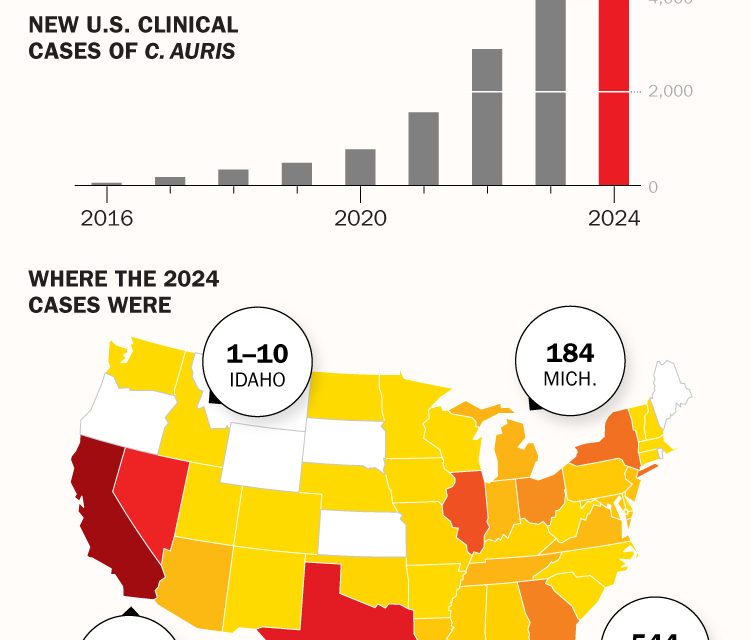
First identified in 2009 in Japan, Candida auris demonstrates unique characteristics. It thrives in warmer and saltier environments, is highly adhesive, and survives on various surfaces including hospital settings. Its resistance to antifungal drugs compounded the threat. Initially thought to be a minor concern, awareness grew as Candida auris began appearing worldwide, not least in the U.S. where over 3,000 cases were reported this year, with a mortality rate up to 60%.
“We realized that maybe this little ear fungus isn’t just a little ear fungus anymore,” Chiller notes.
Global warming is thought to contribute to the emergence of Candida auris. Rising temperatures may enable fungi, traditionally non-threatening, to adjust and pose health risks. The overuse of antifungals in agriculture and healthcare has led to increased drug resistance.
Fungi are everywhere, with more than 300 species capable of causing disease in humans. Human bodies are typically inhospitable to fungi due to our high temperature and immune responses. However, climate change might shift this balance.
For instance, Candida auris, possibly marine in origin, adapted to endure warmer temperatures and saltier conditions, now surviving at 107°F.
Other fungi, not just Candida auris, are thriving in warm conditions. New pathogens affect animals and plants but are now beginning to infect humans. For example, a mold once harming only trees has now infected three humans in the U.S.
A different mold strain has increased fourfold in cases over recent years, frequently causing fatal brain infections even in healthy individuals.
Challenges and Solutions
Researchers, together with healthcare officials and drug companies, are striving to combat these fungal threats. Efforts include raising awareness, improving surveillance, and developing new drugs and diagnostic methods. However, fungi’s rapid adaptation poses a formidable challenge.
As more people undergo immune-suppressing treatments for diseases like cancer and autoimmune conditions, or rely on invasive medical devices, the population vulnerable to fungal infections grows. Such scenarios have facilitated outbreaks of Candida auris in hospitals and skilled nursing facilities.
Despite antibiotics and typical therapy, Candida auris infections can be tenacious. This yeast is now seen not only in older individuals or those with weakened immune systems but also in a broader demographic, including healthy younger people.
Examples highlight this growing threat. For instance, Ryan Zwick, a young nurse, battled a Candida auris infection following severe COVID complications. Treatment required long-term antifungal therapy, yet the infection remains chronic, heightening concerns about drug resistance.
Fungal infections like urinary tract infections and vaginal yeast infections, while common, are now increasingly linked to Candida auris. Standard treatments often prove ineffective, necessitating powerful IV antifungal drugs.
Adapting and Evolving Threats
The emergence and spread of Candida auris appear inexplicably linked to climatic shifts. Similar hybrid strains of fungi have emerged across different continents around the same time, suggesting global warming as a catalyst.
Researchers have found in lab conditions that some fungi become more heat-tolerant when incubated at progressively higher temperatures. These findings underpin concerns about climate change accelerating fungal adaptability and pathogenicity.
Fungi already impact many ecosystems by wiping out certain animal populations and agricultural staples. In the wild, new species previously harmless or rare are moving into new habitats and affecting larger biological networks, amplifying concern among researchers and health professionals.
The adaptability of fungi makes them a persistent health risk, requiring ongoing research and awareness to prevent future pandemics driven by these pathogens. Health organizations, particularly under leadership like Chiller’s, have pushed for unified responses, encouraging early and accurate diagnoses to prevent prolonged health impacts.
Ongoing Research and Public Health Strategies
Efforts are intensifying to manage and eradicate Candida auris and similar fungal threats. Surveillance and awareness campaigns help stem the tide. Additionally, effective tests and treatments are in development to limit the spread and impact of these pathogens.
Chiller’s continued advocacy emphasizes the necessity of proactive approaches to tackle fungal diseases’ unpredictable evolution. Recognizing early symptoms and efficient diagnosis improve survival rates, offering a glimmer of hope against these expanding threats.
The article references the work of healthcare professionals and researchers dedicated to advancing fungal disease understanding as a critical concern for contemporary public health.
 The Future of MAHA in American Health Politics
 Insulin Cost Caps Gaining Support Amid Rising Prices
 Efforts to Counter Food Assistance Cutbacks in San Diego
 A Personal Journey Through Encephalitis
 Low-Cost Medication May Benefit Stroke Survivors
 The Complex Debate Over Kratom Use in the U.S.