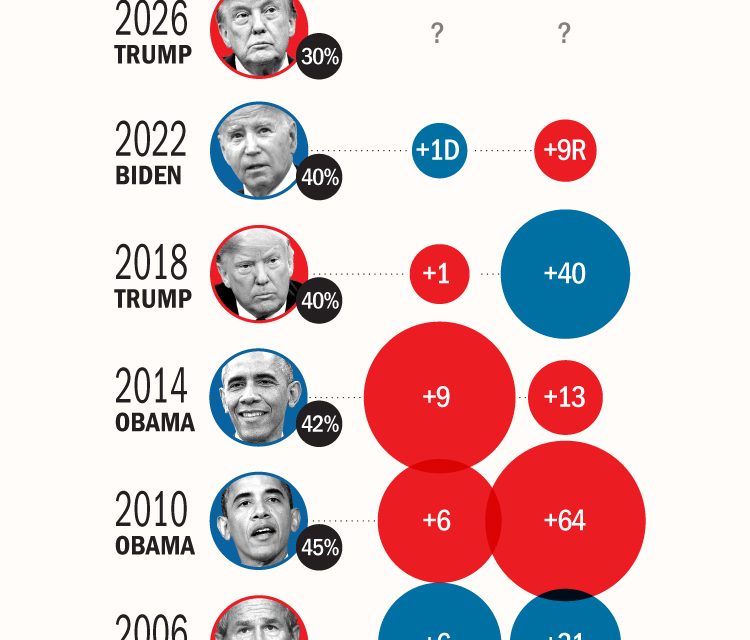
As the pivotal November elections approach, President Donald Trump’s approval rating has reached its lowest point of his second term. The Pew Research Center reports that his approval fell to 30% in early October. This marks the lowest presidential approval rating heading into midterms in decades, comparable only to Harry Truman’s in 1946.
Peter Enns, a professor at Cornell University and co-founder of Verasight, emphasizes the historical nature of this low rating. Data shows much of the dissatisfaction stems from the economy. The Associated Press-NORC Center for Public Affairs Research reveals only 26% of U.S. adults support Trump’s handling of the economy.
Additionally, only 17% approve of how he addresses the cost of living. The Trump Administration’s policy on Iran is similarly unpopular, with just 28% approval according to the same AP-NORC poll. Enns notes that Trump’s support for unpopular policies, such as the conflict in Iran, contributes to his low ratings. Many see Trump’s decisions as linked to high gas prices, adding to public discontent.
These issues are critical for voters heading to the polls. The Pew Research Center indicates that 84% of registered voters see the economy as a “very important issue,” while 57% view foreign policy as crucial in their voting decision.
Midterm elections traditionally pose challenges for the sitting President’s party. Historically, the party in the White House loses congressional seats. Enns explains this as a result of dissatisfaction from both supporters seeking more progress and opponents who disagree with the administration’s policies.
Costas Panagopoulos, a political science professor at Northeastern University, suggests voters may seek “partisan balance in Washington” when policies disappoint them. Republicans currently control the White House and both Congressional chambers, allowing voters to direct their dissatisfaction at them.
Exceptions exist in this historical trend. In 2002, President George W. Bush’s party gained seats, driven by his 63% approval rating post-9/11. There are also cases where the opposition party underperforms expectations, as in the 2022 midterms. Joe Biden’s 40% approval rating contributed to less Republican success than predicted. Newly drawn district lines and the Roe v. Wade decision also influenced outcomes in 2022.
Midterms serve as a “referendum on how things are going with the presidency,” says Michele Swers, a professor at Georgetown University. The President’s approval rating is a key predictor of midterm results, reflecting voter perceptions of the incumbent party’s performance. Lower ratings increase the likelihood of congressional seat losses for the President’s party.
Political experts agree that Republicans face a challenging climate. Most generic ballot polls show Democrats leading, and Democratic voters display greater enthusiasm than Republicans. Panagopoulos notes that while the President’s party typically loses seats, the opposition party may not always gain a majority. The outcome depends on various factors, including approval ratings and the candidates involved.
Enns reminds us that polling provides a snapshot in time, reflecting likely or registered voter intentions. The actual election outcome may differ, as voter turnout on Election Day remains uncertain.
 Mayor Mamdani’s Policing Reform Plans
 Gen Z Voter Shifts and Their Impact on the 2026 Midterm Elections
 Disappearance of US Senate Candidate Raises Questions
 DOJ Rule Change Reduces Appeal Time for Immigrants Facing Deportation
 Hakeem Jeffries’ Bid for House Speaker Faces Progressive Hurdles
 Ohio Judge Dismisses Defamation Lawsuit by Rep. Max Miller