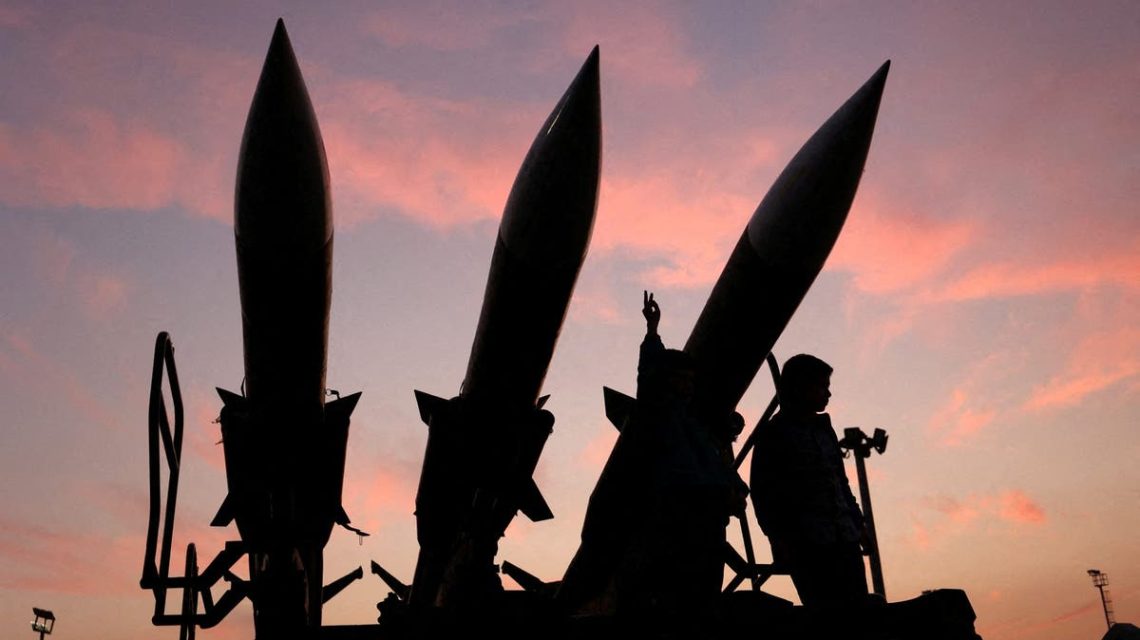
Iran has reportedly resumed its ballistic missile production, sparking concerns amid rising regional tensions. Host Kayleigh McEnany discussed recent developments, including attacks by Iranian proxies on Saudi Arabian pipelines. Former Navy SEAL Jack Carr contributed insights on ballistic missile production and Chinese satellite intelligence linked to a recent strike that killed three American troops. He emphasized the threat posed to global shipping routes near the Red Sea.
According to reports, Iran has lifted its self-imposed ballistic missile-range limit. This announcement came shortly after the U.S. military launched a task force aimed at curbing Iran’s weapon shipments and illicit trade. Brig. Gen. Hossein Mohebbi of the Islamic Revolutionary Guard Corps (IRGC) confirmed the abandonment of the previous 2,000-kilometer missile-range restriction.
The U.S. Central Command established “Task Force Iron Gate” to target the movement of advanced Iranian weapons systems, dual-use materials, and illicit revenue. This initiative aims to limit Iran’s ability to finance terrorism and rebuild weapons resources. Adm. Brad Cooper of U.S. Central Command highlighted the importance of interagency collaboration to constrain Iran’s military efforts.
FDD’s Behnam Taleblu suggested that the U.S. might use targeted strikes against facilitators and apply political and market pressure on countries involved in Iran’s illicit trade. However, Iran’s IRGC dismissed these efforts as mere “wordplay,” insisting it had prepared to withstand additional pressure and maintain coordination with neighboring countries.
General Mohebbi highlighted new weapons developments capable of striking U.S. and Israeli targets. Iran’s previous range limitation included the Arabian Peninsula and several Middle Eastern regions. In March, Iran unsuccessfully attempted to target a U.S.-British military base on Diego Garcia.
Iran also plans to unveil underground missile facilities, which will serve as protective measures for weapons production. These “missile cities” allow the IRGC to continue production even during conflicts. Mohebbi added that domestic expertise has enabled continued missile and drone production without reliance on foreign imports.
Behnam Taleblu noted the crucial role of the Caspian Sea basin in Iran and Russia’s sanctions-busting activities. Despite claims of military self-sufficiency, Iran remains dependent on imports due to constraints from the ongoing conflict.
The U.S. is intensifying efforts to restrict Iran’s trade routes, particularly land crossings with Iraq. Washington has pressured Iraq to close most border crossings with Iran. The Institute for the Study of War reported that Iraq has so far complied by closing one crossing. Meanwhile, the U.S. Treasury insists on closing additional crossings to hinder Tehran’s ability to withstand sanctions.
Iranian Ambassador to Iraq, Mohammad Kazem al-Sadegh, is reportedly pushing Iraqi leaders to reopen closed crossings. This reflects Baghdad’s struggle to balance its relationships with both Washington and Iranian-backed factions.
 In-Flight Altercation on Qatar Airways Leads to Police and FBI Response
 Virginia Residents Sue Over Alleged Immigration Violations
 Updates on Key International and Domestic Events
 Pope Leo XIV Completes South American Tour with Farewell Mass in Peru
 President Trump’s Critical Asia Trip: Key Meetings and Implications
 U.S. Plans to Restrict AI Chip Exports Before Trump-Xi Meeting