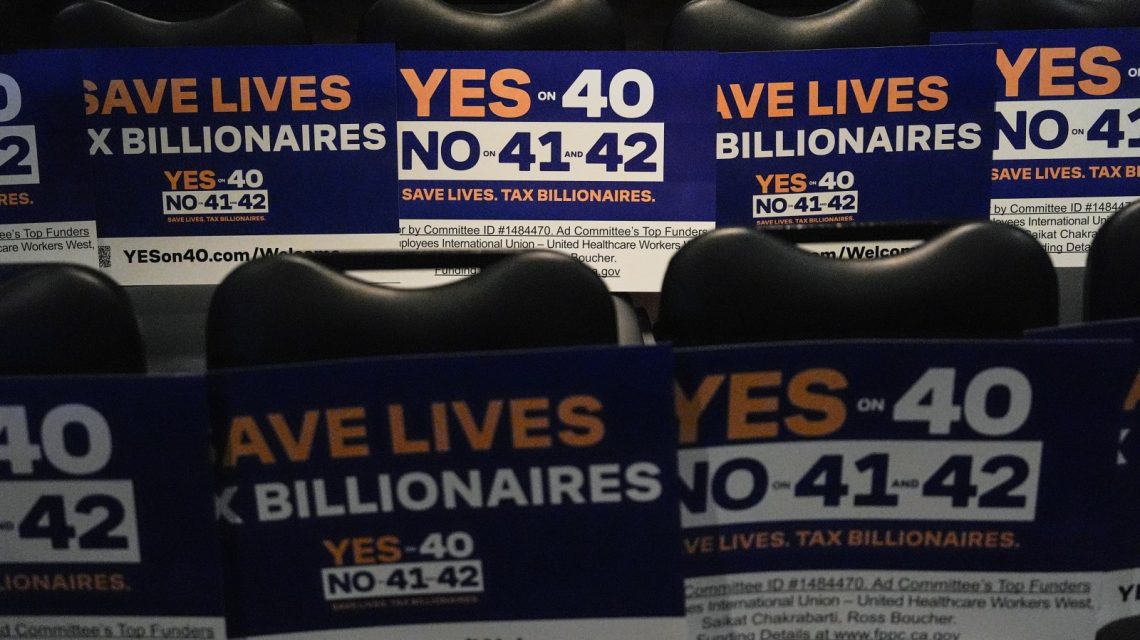
California voters have turned down Proposition 40, which aimed to impose a tax on billionaires based on their net worth, potentially making California the pioneer state in this domain. The Associated Press declared the outcome six days post-Election Day.
The proposal’s rejection comes after a divisive debate among leading Democrats. Governor Gavin Newsom, who considers a presidential run in 2028, opposed the tax, suggesting it might drive affluent residents out of the state. Conversely, Senator Bernie Sanders and Representative Ro Khanna, key progressive figures, supported the measure.
As of 5:14 p.m. Monday, semi-official counts from the Secretary of State’s office showed 5,789,026 voters (52.9%) opposed the initiative, while 5,159,356 (47.1%) supported it.
Campaign Funding and Opposition
Opponents of the measure significantly out-fundraised its supporters. The group ‘Building a Better California,’ which spearheaded the opposition, collected over $333 million. Notably, Sergey Brin, Google co-founder, contributed over $100 million.
Details of Proposition 40
The proposed tax targeted billionaires residing in California as of January 1, 2026, with a one-time 5% charge on their net worth due in 2027. This plan, according to the nonpartisan Legislative Analyst’s Office, would allocate 90% of the revenue towards healthcare, with the remainder supporting education, food assistance, and tax implementation costs.
The sponsoring union, SEIU-United Healthcare Workers West, anticipated about $100 billion. Meanwhile, the analyst’s office estimated ‘tens of billions spread over several years,’ with a potential ongoing decrease in annual state income tax revenue by less than $1 billion.
Economic Projections and Debates
Economists differed significantly on the financial implications. A Hoover Institution report predicted the tax would yield around $30 billion, well below union forecasts, citing the departure of nearly 30% of the tax base. Factoring in lost income tax as billionaires exit, the net impact was estimated at negative $38.9 billion for the state.
Conversely, drafters of the measure presented a research paper from the National Bureau of Economic Research. This paper, co-authored by one of the drafters, estimated potential revenues of $100 billion. It highlighted that billionaires contribute approximately 0.2% of their annual wealth in state income tax, around $3.2 billion, or 2.4% of California’s income tax income.
Countermeasures and Future Implications
‘Building a Better California’ also supported Propositions 41 and 42. Both initiatives were designed to interfere with the wealth tax. The analyst’s office cautioned that more ‘yes’ votes for either could lead courts to nullify the billionaire tax even with majority support.
While these measures were unnecessary to block the tax, Proposition 42 persists. It proposes entrenching a ban on new taxes on financial assets and most retroactive taxes in the state constitution. At 5:14 p.m. Monday, the count showed 51.7% support versus 48.3% opposition, with 5,612,642 affirmative votes.
Google co-founders, like Sergey Brin and Larry Page, had already started relocating before the residency deadline. Meta CEO Mark Zuckerberg took another path, securing an agreement to remain in California for eight years, absent unforeseen circumstances, in return for non-voting shares to manage his tax bill without losing company control.
A Democratic Division
Sanders supported the tax, stating in December 2025, ‘Our nation will not thrive when so few own so much.’ Khanna called Proposition 40 ‘the most important ballot initiative in America.’ Newsom, instead, advocated for a federal minimal tax on the extremely wealthy, starting from $100 million in net worth. He appreciated Sanders’ stance on inequality but held dissenting views.
Pre-election polls depicted a tight contest. A UC Berkeley poll indicated 45% voter support, 43% opposition, and 12% indecision.
Looking Forward
If Proposition 42 succeeds, future wealth taxes would necessitate voter consent to amend the state constitution anew.
Labor leaders viewed the effort as an initial move towards broader goals, with California Federation of Labor Unions President Lorena Gonzalez expressing hope in its influence on other states.
The vote count continues, with no official certification yet. Newsweek requested comments from ‘Building a Better California,’ SEIU-United Healthcare Workers West, and Governor Newsom’s office.
 Mayor Mamdani’s Policing Reform Plans
 Gen Z Voter Shifts and Their Impact on the 2026 Midterm Elections
 Disappearance of US Senate Candidate Raises Questions
 DOJ Rule Change Reduces Appeal Time for Immigrants Facing Deportation
 Hakeem Jeffries’ Bid for House Speaker Faces Progressive Hurdles
 Ohio Judge Dismisses Defamation Lawsuit by Rep. Max Miller