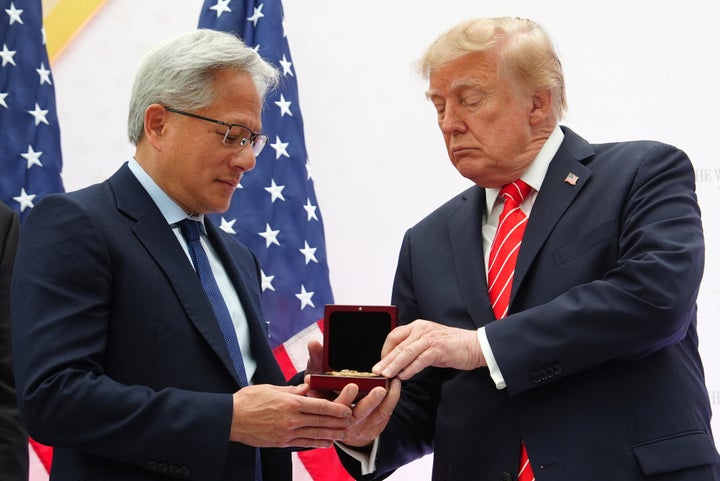
President Donald Trump allowed Jensen Huang, CEO of Nvidia, to participate in discussions with China even after being notified by U.S. intelligence that Huang had potential connections to a Chinese spy. Despite concerns, the company continued selling advanced chips to China, aligning with Trump’s goal to compete with China in artificial intelligence.
Nvidia, following a $25 million donation to Trump’s ballroom project, is now investigating Huang after he admitted to having an affair with an executive at a Malaysian data center company. Trump, speaking to reporters in South Florida, expressed his support for Huang, downplaying the situation as an affair that has impacted many people, dismissing its severity in terms of national security.
Trump acknowledged being informed about Huang’s involvement with a woman believed by U.S. intelligence to be a Chinese government operative but suggested Huang likely had an excuse. Monday’s news conference reiterated his support for Huang, stating he believed Huang’s claim of ignorance regarding the woman’s alleged espionage role.
The scenario’s disclosure has highlighted implications for the U.S. economy and national security, elements already tied closely with Trump’s administration. These revelations compromise Trump’s assertion of a competitive stance against China in artificial intelligence and technology development.
Interviews and reports suggest significant questions remain unanswered regarding Trump’s administration handling Huang’s case and others potentially impacted by financial interactions and security implications. Remarks from former officials suggest the situation reflects an administration driven by personal gains rather than strategic policies.
Sens. Elizabeth Warren and Jim Banks have responded by calling for congressional scrutiny. Their attention focuses on the potential national security risks and demanding Nvidia disclose any connections these activities might have with espionage concerns. They seek a review of Nvidia’s export licenses to China to assess the potential implications on U.S. security.
 The Daily Routine of Klook’s CEO Focused on Fitness and Efficiency
 The Jensen Huang Controversy: Silicon Valley’s Divided Opinion
 Mayor Mamdani’s Policing Reform Plans
 Gen Z Voter Shifts and Their Impact on the 2026 Midterm Elections
 Disappearance of US Senate Candidate Raises Questions
 DOJ Rule Change Reduces Appeal Time for Immigrants Facing Deportation