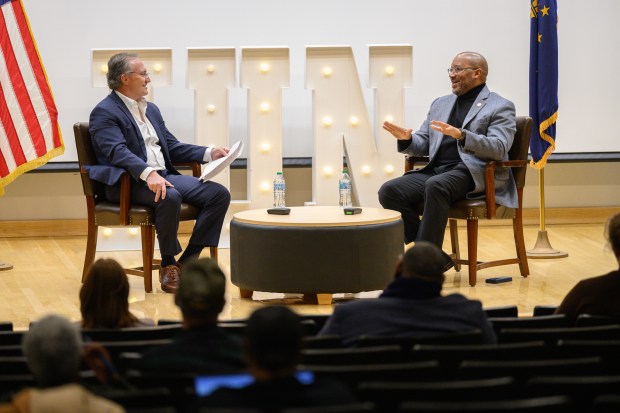
Chancellor Arrick Jackson of Indiana University Northwest credits his time in the U.S. Army as crucial to his career in higher education. He believed that military discipline and the ability to manage multiple challenges simultaneously helped shape his current path. ‘The persistence and innovative thinking from that time have been essential to what I do now,’ Jackson said.
Jackson shared these insights during a live interview with Patrick Russell, founder and director of the Making History Project, as part of Veterans Week programming on November 11, 2026. This organization is dedicated to preserving veterans’ stories through video oral history interviews, archived in the U.S. Library of Congress since its inception in 2015.
Russell asked Jackson about various aspects of his life, beginning with his upbringing in Saginaw, Michigan, and the motivations behind his military enlistment. Jackson joined the U.S. Army in 1987 and served two enlistments over six years. He held positions as an airborne officer in field artillery and as a noncommissioned officer in military intelligence, reaching the rank of sergeant.
Jackson faced significant personal challenges early in life, losing both biological parents before the age of nine. His mother was murdered, and his father died of a heart attack. These experiences pushed him toward a self-reliant mindset. ‘At nine or ten, I decided I had to make my own way in the world,’ he reflected.
Despite having relatives who served in the military, Jackson felt their influence was minimal due to the negative perceptions following the Vietnam War. He graduated high school at 16; his adoptive mother required him to attend school for a year before enlisting.
Recounting the moment he decided to enlist, Jackson said, ‘I told my mother I was joining the army and leaving by Friday. She responded by taking apart my bed and throwing it outside.’ He now perceives this decision as pivotal to his path in higher education. Jackson humorously remarked to his grandmother that military life seemed similar to growing up with his mother.
Jackson described his airborne training as intense, particularly the experience of jumping from aircraft. ‘I’ve never felt anything that quiet,’ he said. When he considered quitting due to the perceived danger, an officer told him, ‘Quit is not in the vocabulary of an airborne soldier.’
In his second enlistment, Jackson joined the military intelligence team, serving in Germany and Korea. While in Korea, he volunteered at an orphanage and pursued academic study, kindling his interest in higher education. These experiences led him to seek a doctorate and a career in teaching.
When asked by Russell about the role of higher education in democracy, Jackson emphasized its critical importance, asserting that an educated citizenry enriches national life. His mother had always highlighted the value of education.
Russell concluded by thanking Jackson for his contributions, acknowledging his desire for his children to recognize the significance of his achievements. ‘Mission accomplished, Dr. Jackson,’ he said.
 Department of Education Investigates Teacher Programs for Discrimination
 Immersion in French Culture at Ascension Catholic School
 Franklin Park School District Prepares Leadership Transition
 Orland High School District 230 Achieves Exemplary Status
 AI’s Impact on Math Education at Caltech
 NPR Student Podcast Challenge Returns for Ninth Year