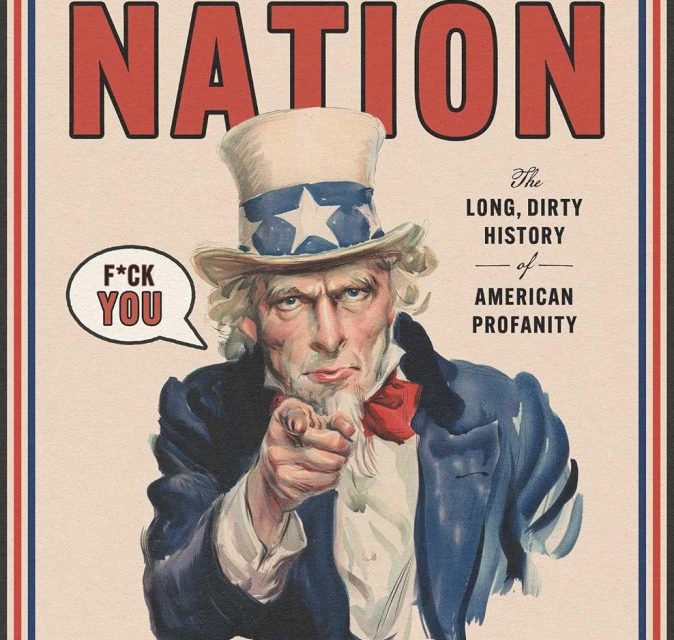
In 1665, John Porter Jr., a Puritan farmer’s son, faced trial in Massachusetts’s Essex County. His crime involved disrespectful insults toward his parents. Historian Steven H. Jaffe discusses this in his book, ‘Four-Letter Nation: The Long, Dirty History of American Profanity’. Called his father a ‘s–t-a-bed’ and his mother a ‘ram bugger,’ Porter narrowly escaped execution due to his mother’s pleas for clemency. Instead, the court fined him two hundred pounds, equivalent to around $50,000 today, and subjected him to a public shaming ritual.
Jaffe’s book explores America’s history with profanity. Porter’s case highlights that while America is known for aspirations and opportunities, it also has a history of colorful language and continual censorship attempts. ‘We’ve always cursed,’ Jaffe mentions, noting efforts to censor this language.
When English colonists arrived in the 17th century, they imported a variety of provocative words that expressed emotions like shock and intimacy. Despite their Puritan beliefs, which opposed profanity, these settlers incorporated such language. ‘Purity of tongue represented godliness and social order,’ Jaffe writes, reflecting ongoing efforts to maintain those standards.
Examples from that era include Thomas Baker, who, in 1662, faced court for publicly describing his neighbors’ genitalia. The court required Baker to seek forgiveness and cover lawsuit costs as a punishment for this ‘verbal injury.’
Profanity has evolved over time. During the Civil War, phrases like “kiss my ass” gained popularity. Capt. William Cronan humorously told another officer to ‘kiss my royal, majestic, brown, military touch hole,’ and President Abraham Lincoln reportedly said, in 1865, that the South ‘can kiss my ass.’
New words emerged in America. The term ‘motherf–ker’ appeared in 1888 in Bremond, Texas, during a conflict between two men, one of whom used a double-barreled shotgun on the other. By the early 20th century, profanity became rebellious and stylish. According to Jaffe, ‘Dirty words revitalized expression, breaking through phoniness.’
While historically a male-dominated domain, swearing has seen increased female participation, particularly over the last century. Women previously voiced such language more discreetly. Current exposure to profanity has lowered resistance levels.
‘Before the 1960s and 1970s, many words now casually used would have shocked people,’ Jaffe mentions, adding that individuals maintain a balance between desensitization and word-specific offensiveness.
Jaffe questions whether common swearing holds significance today. He observes that, despite its frequent use, ‘four-letter words’ still maintain power, especially in certain contexts. He highlights Gen Z’s role in creating new profane slang, particularly on social media platforms, which older generations often find unrecognizable.
Despite changes over time, traditional curse words still have impact. ‘The f-bomb and the s-word retain their punch in specific situations,’ Jaffe concludes.
 Democracy Dies in Darkness
 Syrnyky: A Ukrainian Culinary Tradition
 Macy’s Thanksgiving Day Parade: Performances and Highlights
 The Chronicles of Urban Exploration with a Hasselblad
 100th Macy’s Thanksgiving Day Parade Details and Highlights
 Macy’s Thanksgiving Day Parade: Key Highlights and Changes