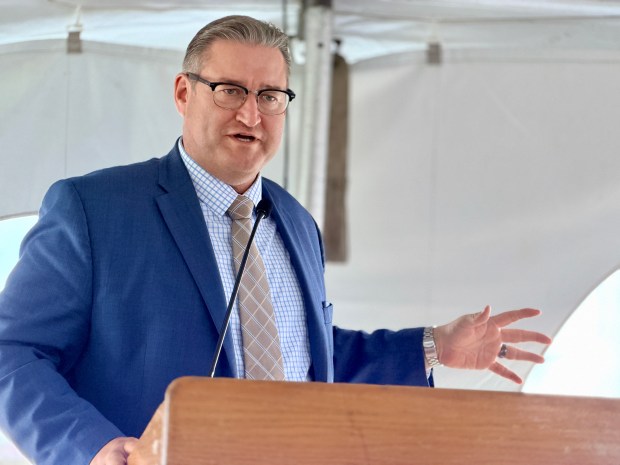
On his second day in the role, Mike Noland attended a public meeting in Munster to discuss the expansion of the South Shore Line from Hammond to Dyer. He recalled that this day marked the start of the environmental process for the West Lake Corridor, which occurred on October 28, 2014, at Munster’s Center for Visual and Performing Arts. Displays around the room showcased potential routes. This process might repeat as the Regional Development Authority’s (RDA) new 20-year plan considers further expanding the rail line to cities like Crown Point, Merrillville, and Valparaiso.
Even after retiring, Noland continues to finalize the Monon Corridor project that began full service on April 1. David Dech, his successor, mentioned this ongoing involvement. With prior experience at Metra Electric, Noland understands Chicago’s commuter rail. When he joined Metra in 1983, freight railroads were exiting the passenger business, resulting in fiscal challenges. The Chicago Rock Island and Pacific Railroad’s bankruptcy is an example from that era. The formation of Metra, paralleling the creation of the Northern Indiana Commuter Transportation District (NICTD), aimed to fill the commuter service gap left by private railroads.
This economic strain persists today. Both the Illinois Legislature and Indiana General Assembly have recently dealt with funding public transit due to pandemic hits. NICTD has pledged biennial fare hikes to keep pace with costs.
Noland started his career in human relations and pursued a law degree by 1989. His rise to chief HR officer by age 30 was followed by his appointment as general counsel. After a turbulent period with Metra’s leadership, he joined Iowa Pacific, gaining valuable short-line railroad experience. At Metra, he handled a staff of 3,000, but at Iowa Pacific, roles overlapped significantly. This versatility suited NICTD well.
At NICTD, Kelly Wenger manages strategic planning, grants, and compliance duties, work that a large railroad would spread across many employees. Noland noted the agency’s efficiency in achieving results with fewer resources.
Gerald Hanas, Noland’s predecessor, played a vital role as a consultant, aiding him to understand the railroad’s history and decisions. Before accepting the presidency at NICTD, Noland reviewed their 20-year service plan, eager to drive progress immediately rather than waiting.
One of Noland’s first actions was recruiting George Hardwich, a retired Metra executive, to provide insights into the South Shore Line operations. Hardwich identified opportunities for improvement, such as optimizing travel time through speed adjustments and infrastructure updates. Changes like relocating freight trains allowed passenger trains to travel faster.
Infrastructural projects, including the Double Track NWI and Monon Corridor, presented significant advancement opportunities. Straightening track curves and shifting stations, as seen in Hammond with Mayor Tom McDermott Jr.’s support, showcased strategic investments. The acquisition of 200 homes was necessary, yet no legal disputes arose.
Collaboration with Metra was crucial for improvements. Initial track speed restrictions were re-evaluated, leading to time savings. Testing with modern pantographs enabled trains to maintain higher speeds under certain infrastructure conditions, reinforcing efficiency.
Future plans include relocating the South Bend station, a change that improves funding appeal by eliminating grade crossings. Major time reductions for train travel enhance project value significantly, emphasizing Noland’s focus on continuous improvement even post-retirement.
 The Trump Team’s Challenge to the Military Leadership
  Maryland First State to Restrict Electronic Pricing in Grocery Stores
  Activists Push for Nationwide Ban on Child Marriage in the U.S.
  Democratic Hopes and Historical Warnings in 2026 Senate Race
  Republicans Face Challenges Amidst Cost of Living Concerns
  A Different Kind of Fall for Congress This Year