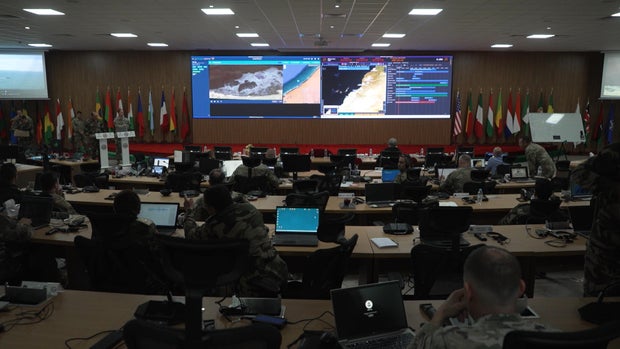
In arid southern Morocco, where the Sahara Desert meets the Atlantic coast, the quiet desert was disrupted by explosions and gunfire during the African Lion 2026 military exercise. This U.S.-led exercise involved American forces practicing alongside 30 partner nations. The event also provided a platform for testing AI-powered military systems.
The exercise aimed to modernize warfare techniques, with AI taking a prominent role. Alongside military forces, private defense contractors displayed their products, seeking feedback directly from soldiers while aiming to secure contracts with the U.S. military.
Shortening the Kill Chain
A significant focus was on using AI to reduce the time required to identify and engage targets. A robot with a machine gun moved across the Moroccan desert, supported by drones carrying explosives and rifles. Lt. Col. Ramon Leonguerrero highlighted the use of Palantir’s AI platform to speed up decision-making in the Joint Operations Center in Agadir. A process that previously took hours was reduced to minutes.
Even though autonomous systems capable of deciding when to engage targets exist, a human still approves the final decision. The system used in the operations, Project Maven, processes large amounts of data to prioritize information for battlefield commanders.
Anthropic’s Role and Ethical Concerns
Despite previous tensions with the Pentagon, Anthropic’s Claude language model was used to interface with Maven. It enabled operators to interact with data in plain English. Defense Secretary Pete Hegseth acknowledged moral and ethical issues with AI making lethal decisions, though he noted the technology’s rapid development and the need to stay competitive with adversaries.
General Dagvin R.M. Anderson expressed concerns over AI taking over lethal roles but emphasized the importance of adopting such technologies to avoid putting the nation at a disadvantage.
Robotic Advantage on the Battlefield
The exercise also introduced robots to replace soldiers in dangerous operations. Overland AI’s ULTRA vehicle, for instance, demonstrated its capabilities in a remote, hazardous environment. This fully autonomous vehicle can carry a machine gun, mines, and explosives, providing crucial support for soldiers.
Tim Bishop from Overland AI explained that ULTRA can autonomously navigate, offering a strategic advantage by laying mines and providing covering fire. Although currently controlled remotely, future automation of its weapon systems is feasible.
1st Lt. Vincent Gasparri commented on the potential of robots to save lives by replacing humans in risky operations. During one exercise, two robots were able to substitute for around 40 soldiers, significantly reducing exposure to danger.
Gasparri emphasized that the primary goal is to safeguard soldiers. Efficiency and faster decision-making are crucial to achieving this, he explained, with the overarching aim being the preservation of lives on the battlefield.
 British Police Arrest Man Suspected of Terror Plot
  Activists Push for Nationwide Ban on Child Marriage in the U.S.
  Investigation into Alleged Incident at Cornell University
  Trump Unveils AI-Powered America.gov Platform
  Rising Drone Threats Highlight Vulnerabilities in Moldova’s Airspace Defense
  Bolivia Faces Security Test Amid Unrest