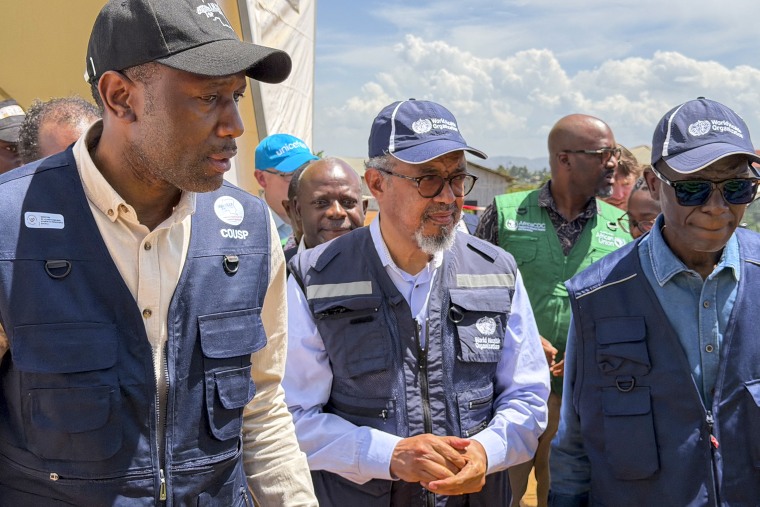
The World Health Organization’s Director-General, Tedros Adhanom Ghebreyesus, visited Bunia in eastern Democratic Republic of Congo on Saturday. This city is at the center of a fast-spreading outbreak of a rare form of Ebola. Despite improved health facilities and new aid, the virus continues to spread more quickly than the response efforts.
Tedros plans to tour a treatment center and engage with local authorities, health workers, and affected families in Bunia. He emphasized the necessity of ample support to combat the disease at its epicenter and to extend every necessary assistance.
According to the WHO, there are reports of 906 suspected cases along with 223 suspected deaths. Neighboring Uganda reported nine cases and one death.
The Bundibugyo variant of the Ebola virus lacks an approved treatment or vaccine. On May 30, 2026, Tedros arrived in Bunia, marking a crucial effort in addressing the outbreak.
Following a meeting with Congo’s Prime Minister Judith Suminwa Tuluka, Tedros expressed confidence in handling this outbreak, citing Congo’s experience with Ebola in the past.
EU medical aid reached Ituri on Thursday, with more shipments planned. The U.S. pledged an additional $80 million, increasing its total aid to over $112 million.
Efforts at Bunia’s Rwampara and General hospitals show signs of better organization, with increased staff and medical supplies. However, patients are arriving continuously as noted by an AP reporter.
This is one of the fastest Ebola outbreaks recorded, noted by Doctors Without Borders (MSF). Dr. Alan Gonzalez, MSF’s deputy director, highlighted the urgent need for expanded testing, aid worker deployment, and continuous medical supply access.
Health workers face challenges not only from the outbreak but also from local residents angered by the medical protocols conflicting with burial rites. These tensions led to several attacks on health centers.
Further complications arise from recent attacks by groups such as the Allied Democratic Force, linked to the Islamic State, and various ethnic militias. The outbreak impacted provinces of North Kivu and South Kivu as well.
Both Uganda and Rwanda have closed borders. The Trump administration banned entry for non-U.S. passport holders who recently visited Congo, Uganda, or South Sudan.
Tedros advocated against border closures and travel bans, deeming them ineffective. He stressed that such measures deter transparency. He urged countries to reevaluate these actions, promoting open reporting by the Democratic Republic of Congo.
 British Police Arrest Man Suspected of Terror Plot
  Activists Push for Nationwide Ban on Child Marriage in the U.S.
  Investigation into Alleged Incident at Cornell University
  Rising Drone Threats Highlight Vulnerabilities in Moldova’s Airspace Defense
  Bolivia Faces Security Test Amid Unrest
  Incident on FlyDubai Flight Raises Security Concerns