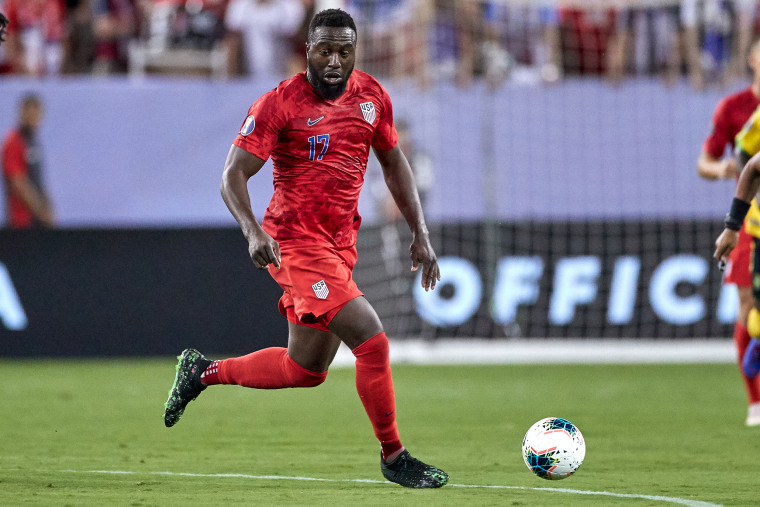
Jozy Altidore grew up in South Florida where Spanish was a common language. He often heard it while playing soccer with local kids and from his Dominican grandmother. As a teenager, he moved to Spain to play for Villarreal in the Castellón region, a place not known for tourism. His coach and teammates primarily spoke Spanish. During this time, Altidore learned the language. “A lot of people look at me like, ‘What? You speak Spanish?’” he told NBC News.
This summer, Altidore will use his Spanish skills as a World Cup commentator for Telemundo, the official Spanish-language network for the games. Although he has no broadcasting experience and admits his Spanish is basic, he sees this as a chance to stay involved with the World Cup. “It’s the biggest, most historical World Cup we’ve had,” Altidore said. “For me, it was a good opportunity to stay involved, be a part of the World Cup.”
Challenges and Excitement
Regarding his Spanish, Altidore says he can manage. “I can get by,” he mentioned. He views commentary as a “cool challenge.” Altidore values the opportunity to challenge himself regularly. He looks forward to witnessing the Telemundo broadcast’s energy, notably the distinctive “goal” calls by announcer Andrés Cantor. “I always wondered, how does he do that in one breath?” Altidore said. “This guy goes just the whole time. I can’t wait to see the legend in action.”
Altidore will offer insight on Team USA’s games, drawing from his experience as one of the top American players in recent times. With 42 goals in 115 matches, he helped the U.S. reach the 2010 and 2014 World Cups. Though injured in the latter, he played alongside members of the 2026 roster like Christian Pulisic.
Optimism for Team USA
Altidore speaks positively about the current team. “I’m optimistic,” he said. “I’m bullish. I think this team can win the World Cup. I really do. I think they have the talent. And I’m so excited for them to get their flowers.” He acknowledges the skepticism this might evoke but points to past host countries like South Korea in 2002 and Germany in 2006 that performed well at home, along with Colombia in 2014.
Hosting the World Cup could influence Team USA’s performance. “We’re able to push our team to a bit of a better performance than we have historically,” Altidore noted. He emphasizes the importance of fan support. “Can we show up in numbers in a way that, from the players’ arrival, they feel the emotion, they feel the enthusiasm, they feel the camaraderie?” Altidore asked. “And we can push them on to play a little bit above themselves, to play a little bit above what we’ve seen already.”
A Balancing Act
As a commentator, Altidore will balance his enthusiasm with objective analysis. “For me, it’s really getting behind these guys, applauding them for how far they’ve now taken the flag and where they’ve brought it,” he said. “But at the same time, it’s not all rainbows. You’ve got to be critical of guys, and you have to obviously critique their performances.”
Inspired by the Past
Altidore discovered soccer in 1994, the last U.S.-hosted World Cup, through VHS-recorded games by his father. He expects families to capture this year’s tournament with modern technology, inspiring a new generation of soccer enthusiasts. “They’re going to get exposed to soccer in a wonderful way for the first time, and it’s going to birth soccer players, it’s going to birth soccer fans, soccer enthusiasts,” Altidore said.
Through Telemundo broadcasts, Altidore aims to share his passion. “It’s more than just X’s and O’s in my opinion,” he stated. “This is a very good opportunity to continue growing the game for another 30, 40 years to come.”
 Nick Saban’s Comments on ESPN Spark Debate Over College Sports Regulations
  Freddy’s American Adventure: From Soccer to College Football
  Brock Purdy’s Impressive Start in the 2026 NFL Season
  The Value of Retaining Miles McBride for the Knicks
  Penguins Make History with Dominant Season Opener
  Sonny Gray Expresses Frustration After Game Against Yankees