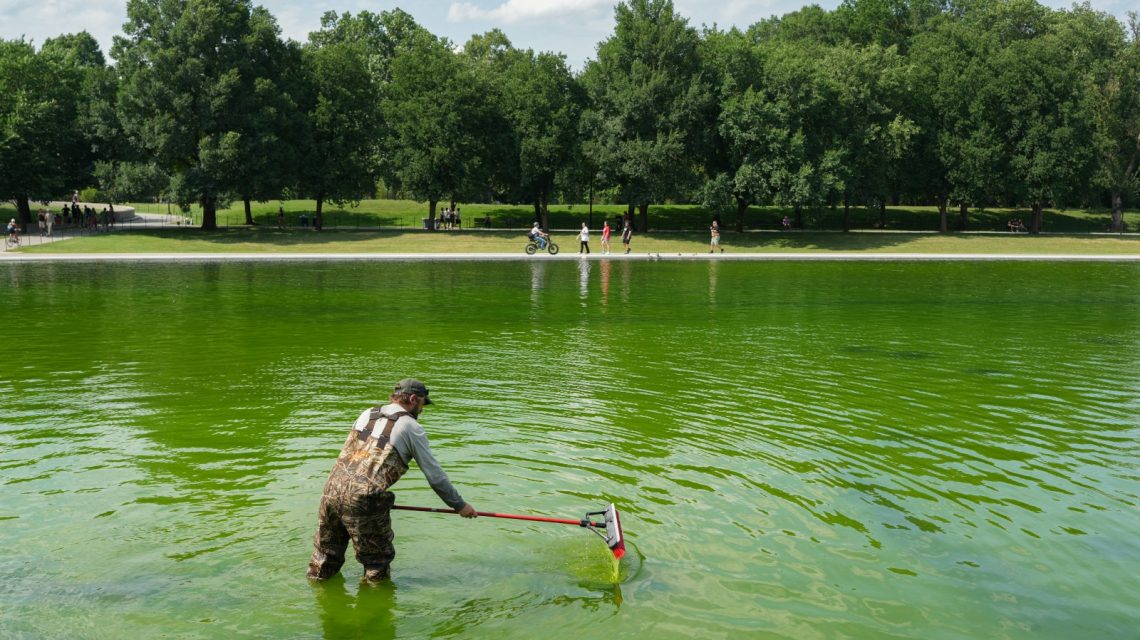
The Lincoln Memorial Reflecting Pool has unexpectedly turned green soon after reopening. Workers are addressing the issue by adding hydrogen peroxide to the water to combat a swift algal bloom. This situation arises despite a recent multimillion-dollar renovation aiming to give the pool a deeper “American flag blue” appearance. Concerns about the renovation process and the safety of the chemical treatment have surfaced.
Causes of the Green Pool
Algal blooms in the reflecting pool are not uncommon. The shallow, slow-moving water, partly supplied by the Tidal Basin, offers ideal conditions for growth. The quick spread of this latest bloom has drawn significant attention.
The pool underwent a drainage, repainting, and refilling process within a short timeframe. This rapid procedure may have left residual algae in pipes and introduced warm water during early summer heat. Marine biologist Christopher Lowe explains that a single algal cell can multiply into millions within days, making complete prevention challenging. Algae also enter water systems through birds and other routes.
Lowe emphasizes that the conditions needed for a bloom are simple: sufficient light and nutrients. While sunlight levels are constant in an outdoor area like the National Mall, controlling nutrient levels is possible.
The Role of Hydrogen Peroxide
Hydrogen peroxide is often used in water treatment as an oxidizing agent effective in breaking down algae and other organic matter. Officials describe it as a “milder treatment than chlorine,” which is often used in natural swimming pools and environments with wildlife. Alongside the hydrogen peroxide treatment, “nanobubble” ozone systems are in place to target algae and pathogens in the water.
Treating the large pool—which holds approximately 6.5 million gallons of water—poses significant logistical challenges. Lowe notes that maintaining water through hydrogen peroxide treatment effectively moves away from natural cycles into more controlled pool management. The benefit of this chemical is that it both kills and bleaches the algae, improving appearance.
Challenges of Using Hydrogen Peroxide
Workers applying hydrogen peroxide to handle the algal bloom prompt questions regarding the method’s effectiveness.
Scale of the Task
The vast volume of the Lincoln Memorial Reflecting Pool—around 6.5 million gallons—creates skepticism about the efficiency of manual dosing. Although videos show workers pouring 12 percent hydrogen peroxide into the pool, treating such a large water body typically requires greater quantities to significantly reduce algae levels. Experts highlight the need to calibrate dosing carefully based on concentration instead of volume, which is complex on such a scale.
Cost Versus Temporary Solution
While hydrogen peroxide is commonly used as an algicide, it offers only a temporary solution. It breaks down quickly into oxygen and water, making it insufficient for long-term algae prevention. Therefore, cost-effectiveness becomes a concern. Treating such a large pool repeatedly as algae returns could become expensive. Longer-term solutions focusing on nutrient management and circulation might be more economical.
Design Trade-Offs: Still Water vs. Circulation
The pool’s design poses a challenge. Algae thrive in warm, slow-moving waters—conditions necessary for the iconic mirror-like surface. Increased circulation can hinder algal growth but disrupt reflections. Managing the pool means balancing appearance with water quality, a challenge during numerous renovations. The recent renovation, including resurfacing and basin changes, could potentially alter heat and nutrient dynamics, speeding up bloom conditions.
Wildlife and Environmental Impact
The reflecting pool is part of a larger ecosystem with daily interactions from birds, debris, and runoff. The added chemicals will deal with the algae, but their ratio ensures no harm to nearby wildlife or humans. However, wildlife contributes to ongoing algae issues. Lowe notes that algae can enter via routes like being washed in or attached to birds’ legs.
Despite hydrogen peroxide’s breakdown into non-toxic substances, continuous dosing could create an ecological void in the pool, affecting plant and other wildlife survival. The ongoing chemical maintenance means the pool becomes an ecological desert, with little chance for life in the water.
 Swiss Glaciers Show Effects of Ice Loss Amid Global Warming
  Understanding Inflammation: Myths and Facts
  Climate-Resistant Rock Glaciers: Hidden Water Resources
  Senators Reach Bipartisan Agreement on Permitting Reform
  Experts Warn of Critical Period for the Colorado River
  Overcoming Weight Loss Challenges: Brain Health and GLP-1 Medications