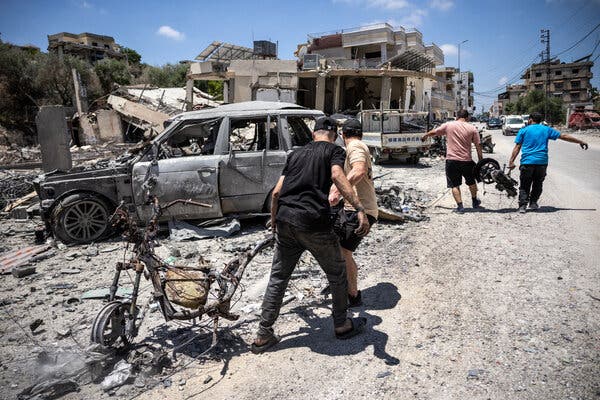
Diplomatic efforts on Friday aimed to sustain the fragile agreement between Iran and the United States after Israeli strikes in Lebanon led Iran to withdraw from peace discussions. Shortly after, Israel announced a cease-fire agreement with Hezbollah, an ally of Iran.
Iran’s temporary withdrawal from talks with the United States disrupted the framework agreement President Trump signed earlier in the week. Long-term peace negotiations were set to begin within hours in Switzerland. Despite the setback, it appeared that the shaky truce with Iran continued for the moment, with no indication of indefinite delays. Shipping traffic in the Strait of Hormuz showed an increase, although it was still below prewar levels.
Israel’s ambassador to the United States, Yechiel Leiter, stated Israel’s commitment to an immediate cease-fire. President Trump mentioned in a call with NBC News that he urged Israeli leaders to agree to a Lebanon cease-fire, noting it was like “icing on the cake,” but did not specify if he had direct communication with Prime Minister Benjamin Netanyahu. Hezbollah has not publicly confirmed its agreement to the cease-fire.
The events highlighted the U.S.-Iran agreement’s delicate nature, with Lebanon playing a key role. The first point of the 14-point agreement requires both countries “and their allies in the current war” to “immediately and permanently cease military operations on all fronts, including in Lebanon.” However, neither Israel, a wartime ally of the United States against Iran, nor Hezbollah, supported by Iran, has endorsed the agreement.
Following the cease-fire’s scheduled start at 4 p.m. local time, Lebanon experienced relative calm. This came after a night of intense Israeli bombing killing 47 people and injuring 97, according to Lebanon’s health ministry, which does not differentiate between civilians and combatants. Multiple countries’ officials confirmed the cease-fire, brokered by Qatar and the United States, while expressing conditions of anonymity due to the sensitivity of the diplomacy involved.
 British Police Arrest Man Suspected of Terror Plot
  Activists Push for Nationwide Ban on Child Marriage in the U.S.
  Investigation into Alleged Incident at Cornell University
  Rising Drone Threats Highlight Vulnerabilities in Moldova’s Airspace Defense
  Bolivia Faces Security Test Amid Unrest
  Incident on FlyDubai Flight Raises Security Concerns