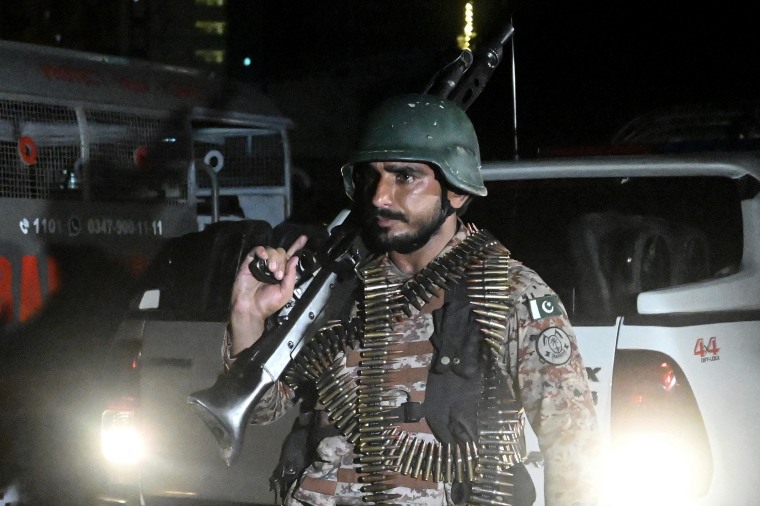
ISLAMABAD – On Sunday, Pakistani security forces conducted a ground operation near the Pakistan-Afghanistan border. Officials reported that the operation included targeted strikes against militant hideouts, resulting in 29 fighter casualties.
Information Minister Attaullah Tarar announced on X that the operation aimed to address recent militant attacks nationwide. Afghanistan has yet to respond to these developments.
Pakistan has experienced an increase in militant attacks, particularly targeting police and security forces. The Pakistani Taliban, known as Tehrik-e-Taliban Pakistan (TTP), alongside allied groups, are blamed for much of the violence.
Security personnel inspecting a compound in Karachi on Sunday.
On Saturday night, Karachi witnessed intensified security following an assault on the Security Rangers compound. Militants attacked the regional headquarters of the paramilitary Rangers, resulting in the deaths of three soldiers. Security forces neutralized three attackers and detained another, identified as an Afghan national.
Jamaat-ul-Ahrar, a faction of the Pakistani Taliban, claimed responsibility for the Karachi attack. The latest border operation targeted TTP hideouts. Despite being separate from the Afghan Taliban, both groups are allies. The Afghan Taliban regained power in Afghanistan in 2021.
The operations may further strain tensions between Islamabad and Kabul.
Increasing Cross-border Tensions
Sunday’s strikes continue a pattern of cross-border tension between the countries. A few weeks prior, Pakistan launched airstrikes on claimed militant hideouts in Afghanistan, following a period of relative calm. Islamabad had earlier described interactions as an “open war” between the countries, notwithstanding international attempts for peace.
People digging a mass grave for victims following airstrikes near the border in Nangarhar, Afghanistan, in February.
The escalation traces back months of reciprocal military engagements between the neighbors, with hundreds lost to cross-border skirmishes since February. Afghanistan had previously retaliated following Pakistan’s airstrikes.
Several attempts at peace talks led by international mediators have not produced a ceasefire. China facilitated discussions between the two nations in April, advocating non-escalation and exploration for a solution.
Since last year, Pakistan has conducted multiple operations targeting TTP and other militant sanctuaries along the border and inside Afghanistan. Pakistan asserts the Afghan Taliban government harbors militants responsible for violent acts within Pakistan. Kabul refutes these accusations.
 British Police Arrest Man Suspected of Terror Plot
  Activists Push for Nationwide Ban on Child Marriage in the U.S.
  Investigation into Alleged Incident at Cornell University
  Rising Drone Threats Highlight Vulnerabilities in Moldova’s Airspace Defense
  Bolivia Faces Security Test Amid Unrest
  Incident on FlyDubai Flight Raises Security Concerns