The First Bank of the United States, a crucial part of American history, has reopened as a museum following a $43 million restoration. Located in Philadelphia, this historic site opened its doors to the public again on July 1. It had been closed since around 2002. This reopening marks a renewed focus on the building that played a significant role in shaping the early U.S. financial system.
Managed by the Independence Historical Trust and the Independence National Historical Park, which is part of the National Park Service (NPS), the restored building now includes exhibitions developed in collaboration with the U.S. Department of State and Drexel University. These exhibits showcase art, artifacts, and commemorative items that narrate the story of American history and diplomacy.
Adaptive Reuse Trends
Across the U.S., historic buildings are increasingly being restored and repurposed instead of being destroyed. The American Institute of Architects (AIA) reports that nearly half of America’s 125 million buildings are at least 50 years old. Adaptive reuse projects have become more common, with RentCafe noting that about 25,000 apartments were made from converted buildings in 2024, showing a 50% rise from the previous year.
The AIA indicates that reusing buildings can cut carbon emissions by 50 to 75% compared to new constructions. This also prevents emissions linked to the production, transportation, and assembly of new building materials. Architect Gordon Gill emphasized the importance of enhancing the durability of existing buildings to avoid obsolescence.
Preserving a National Landmark
For the NPS, the restoration effort involved maintaining a balance between modernization and preservation. Rong Chen, a landscape architect on the project, mentioned that a key challenge was addressing unforeseen conditions during construction while keeping the building’s historic character intact.
“Because this was a rehabilitation project, the National Park Service’s primary goal was to preserve the building’s historic fabric, replacing materials in kind only when necessary,” Chen said.
The restoration included accessibility enhancements, along with new electrical, plumbing, heating, ventilation, and air conditioning systems. These upgrades were integrated to maintain the building’s historical integrity while meeting modern standards.
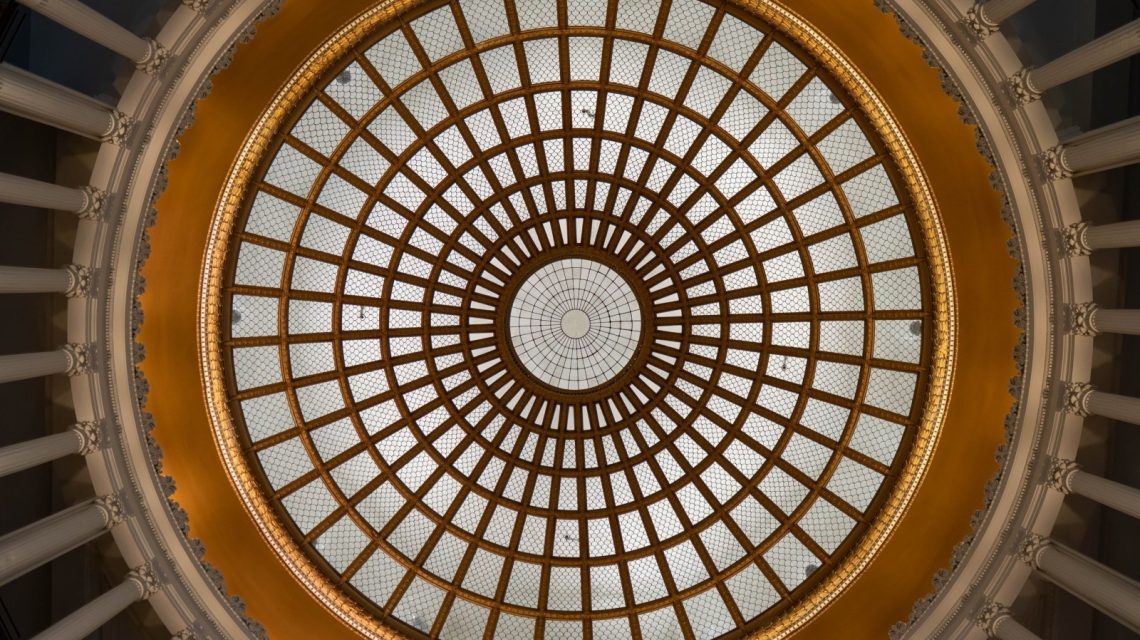
Visitors can now enjoy some of the structure’s most renowned spaces, such as its rotunda and glass dome. Park officials are eager for the public to explore the new exhibitions within this landmark. The displays highlight the influence of art and artifacts in American history and diplomacy. The collection features items from U.S. embassies and Philadelphia’s Atwater Kent Collection at Drexel University, alongside commemorative objects from Philadelphia’s 1876 Centennial, 1926 Sesquicentennial, and 1976 Bicentennial celebrations.
Ongoing Restoration Projects
The reopening of the First Bank is part of a broader initiative by Independence National Historical Park and the Independence Historical Trust to prepare for America’s 250th anniversary. The NPS has completed repairs and enhancements to historic sites across Independence Square, including Independence Hall, Congress Hall, and Old City Hall. Upcoming projects include the Join or Die sculpture project and an America 250 time capsule.
Chen highlighted that the restoration aims not only to preserve a building but also to instill an appreciation for its architectural beauty and historical significance. The project underscores the importance of historic preservation, reflecting the NPS’ dedication to safeguarding landmarks for future generations to learn from.
 Atlantic Ends September Without a Hurricane for First Time Since 1994
  Bobcat Sightings and Conservation Efforts in Illinois
  2026 El Niño: A Historical Comparison and Future Projections
  U.S. Records Warmest September in History
  Swiss Glaciers Show Effects of Ice Loss Amid Global Warming
  Climate-Resistant Rock Glaciers: Hidden Water Resources