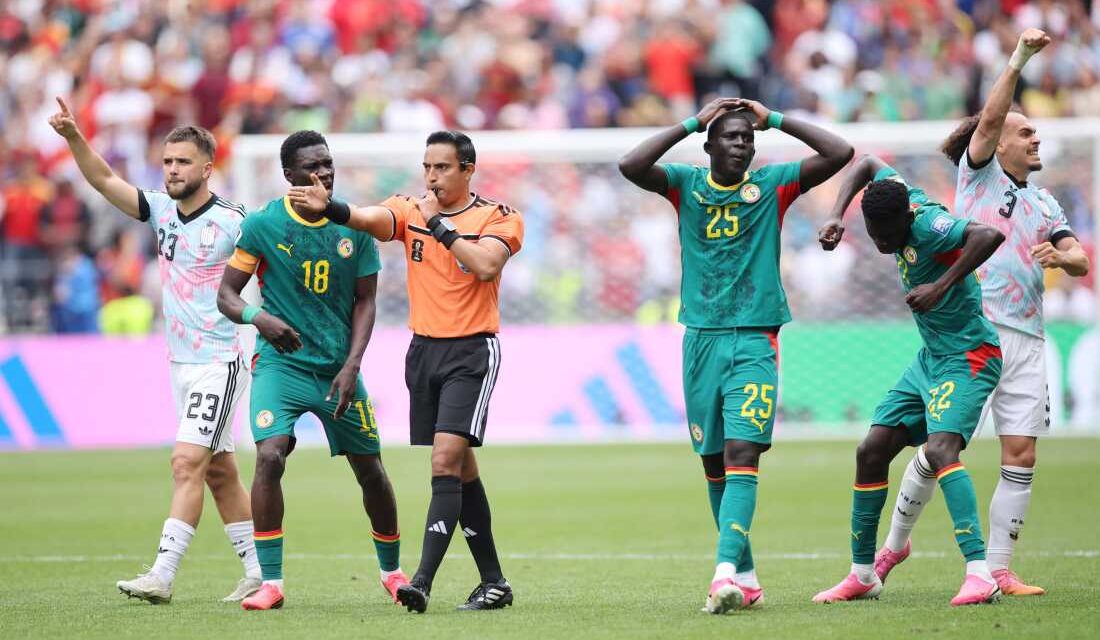
Players responded when FIFA referee Said Martinez awarded Belgium a penalty kick. This decision came after a VAR review during the World Cup’s round of 32 match against Senegal in Seattle on July 1.
Viewing a World Cup match today often means expecting the unexpected. A goal might not stand without scrutiny. As soon as players and fans celebrate, the video assistant referee, or VAR, steps in to review the play. This part of the game has stirred debate in the current World Cup. FIFA claims it enhances fairness, but many fans and teams disagree.
The craving for VAR’s presence in soccer arose only recently. The 2009 World Cup qualifiers between France and Ireland marked a pivotal moment. Thierry Henry of France assisted with a handball that went unnoticed by referees, leading to a goal. Such incidents had happened before. For example, Diego Maradona’s famous hand goal occurred in the Argentina-England 1986 World Cup game. By 2009, technology could have reviewed that play.
Soccer rules evolve slowly. Until 1970, teams couldn’t make substitutions. That same year, yellow and red cards were introduced.
FIFA sometimes tests changes in the U.S. Chris Davis, a professor at Adelphi University, explains that American fans tend to embrace technological updates more readily. VAR underwent testing in Major League Soccer games in 2014 and 2015. It debuted in the 2018 World Cup.
The VAR system relies on a referee team on the field and another team observing video replays from various angles. Initially, fans embraced these corrections. There were clear improvements in maintaining the game’s integrity. Yet, at that time, VAR wasn’t frequently used.
By 2026, referees regularly use VAR to check for missed fouls or offside plays. Understanding the offside rule can be challenging. It dates back over 150 years and includes numerous clauses. A player is offside when in the opponent’s half, closer to the goal line than the second-last opponent, and if they influence the play while the ball moves.
In 2026, referees often interrupt games to check VAR for offside positions, causing some controversial judgments. For instance, a goal by Iran against Belgium was dismissed because a player’s position was ruled offside. Similarly, a Colombian goal was annulled because an attacker’s toe was offside.
Felipe Cardenas, senior writer for The Athletic, notes how VAR affects the sport’s flow. Goal celebration now comes with the uncertainty of VAR checks, affecting game dynamics.
A contentious World Cup match between Egypt and Argentina highlighted the issue. Egypt appeared to dominate, scoring a second goal. However, VAR indicated a minor foul preceding that goal. The referee’s review led to a disqualification of the goal, aiding Argentina to a victory. Egypt later criticized this decision, claiming unfairness.
The core debate over VAR in soccer mirrors broader questions about technology’s role in life. If humans manage technology like VAR, bias might seep into judgments. Cardenas suggests balancing human error acceptance with the technology. While referees shouldn’t fear making mistakes, an equilibrium must exist.
Ultimately, respecting referee decisions matters. Accept the verdict, regardless of human error.
 Deadly Earthquake Strikes Indonesia, Causes Panic and Destruction
  Michigan Wolverines’ Decision on Bryce Underwood Sparks Debate
  Boomer Esiason Comments on WNBA’s DiJonai Carrington and Sophie Cunningham Incident
  U.S. Marine Robert Gilman Released from Russian Detention
  Caitlin Clark and Indiana Fever Face New York Liberty in Anticipated Matchup
  Buffalo Bills Face Criticism Over New Stadium Design