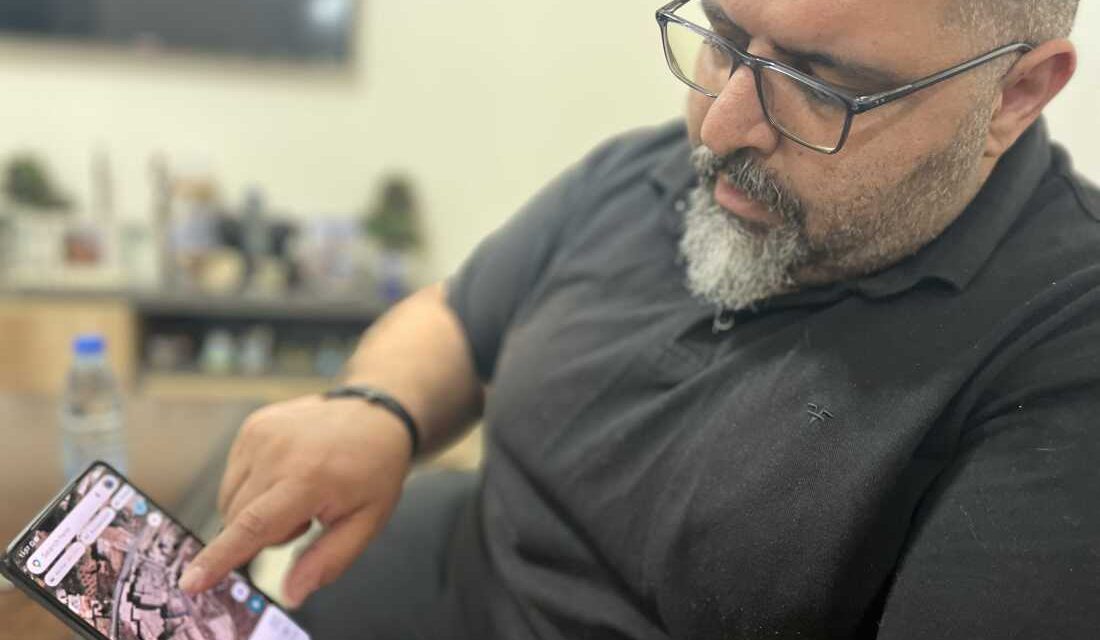
BEIRUT, Lebanon — Mazen Farah examines satellite images on his phone showing devastation in Yaroun, a southern Lebanese village. These images reveal the destruction of his family’s stone house, built after years of labor in the Gulf. Despite evidence, Israel denies damaging a convent in the area, offering a different building as proof.
In March, conflict flared between Israel and Hezbollah, causing mass displacement across over 100 villages. Following an April ceasefire, Israeli forces demolished more buildings, citing Hezbollah targets but providing little evidence. Defense Minister Israel Katz stated the aim to depopulate Lebanese villages near the Israeli border to create a buffer zone.
Yaroun’s residents, unable to return, use satellite imagery to assess the damage. Each image costs at least $112, but requests are frequently denied by providers, especially after U.S. government intervention in April to restrict access.
Geryes Saloum, a municipal worker from Yaroun, awaits news about his three-bedroom home. Most homes around his are already gone. He recalls efforts to restore infrastructure after a 2024 ceasefire, only for conflict to resume, heavily impacting Yaroun’s landmarks and religious sites.
Yaroun Mayor Hafez Ghacham highlights, “180 out of 200 houses in the village are destroyed.”
The Israeli military has not responded to inquiries about the village’s destruction. The conflict, ignited by an attack orchestrated by Hamas, impacted large swathes of southern Lebanon. Ghacham recounts the demolition of a convent and a Catholic school, integral to both Christian and Muslim communities, despite Israel’s denial.
Yaroun, part of the historic Galilee region, has deep-rooted religious significance. It was a locale of olive and citrus groves and ancient oak forests, now razed. Homes ranged from 200-year-old structures to elegant stone houses with characteristic red-tiled roofs.
A Community Dispersed
Israel’s 1982 invasion of southern Lebanon led to a prolonged occupation. Many young men left, forming diaspora communities in the U.S., Canada, and Australia while maintaining ties to Yaroun. Mazen Farah’s family, among these, heavily invested in restoring their beloved homes before the conflict reignited.
Despite surveillance cameras proving no militant activity, residents face allegations of housing Hezbollah. Farah vehemently disputes such claims, highlighting a wolf alert as the only security breach on his property before connectivity was severed.
Many property owners are American citizens. Hanna, residing in New York, recalls the erasure of his mother’s repaired home visible through satellite images, illustrating the extent of the destruction.
“Seeing the bulldozer still there in the images breaks my heart,” reflects Hanna, questioning the feasibility of rebuilding amidst uncertainty.
Loss and Resilience
Yaroun’s diaspora, facing property loss equivalent to significant financial investments, struggle with reconciling dreams of returning with the harsh reality of ongoing conflict. Qasem Fares, now in Panama, shares the heartbreak of losing his grand home, built with decades of savings and representing his life’s work.
He hopes for peace, yearning for a future where Yaroun stands resilient. Meanwhile, Hanna voices the village’s continued legacy, with memories kept alive through photographs and keepsakes.
For the Farah family, rebuilding remains fraught with difficulty under the threat of future destruction. Mazen reflects on the elderly residents’ hopes of returning, drawing parallels with the enduring Palestinian refugee plight, but holding on to Lebanese sovereignty as a beacon of hope.
 Dutch Review Board’s Euthanasia Ruling and International Debate
  Israeli PM Commends Heroic Actions in Flight Emergency
  Rabbi and Jewish Leaders Criticize Adam Brody for ‘Genocide’ Comment
  Flydubai’s Emergency Landing Highlights Cockpit Security
  Former Israeli PM Naftali Bennett Commends Passengers and Crew for In-Flight Heroism
  Diplomatic Complexities Unfold at U.S. National Archives Visit