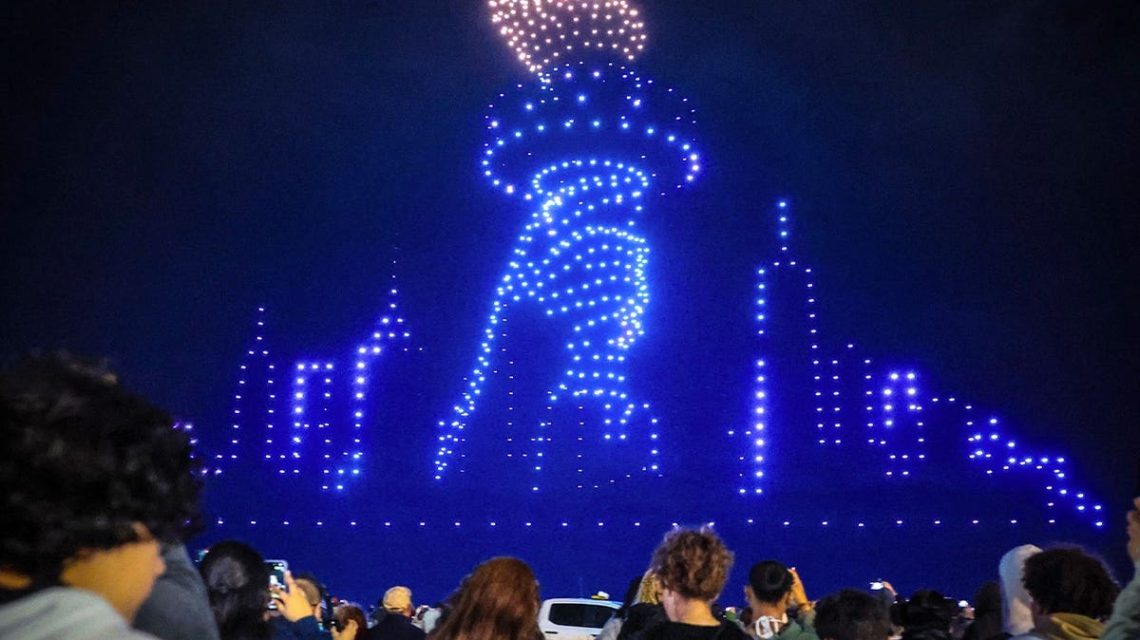
Drone shows are increasingly becoming a popular substitute for fireworks at various events like concerts and Fourth of July celebrations. They are considered a safer and more eco-friendly alternative. However, the rising number of drones in the skies poses new security challenges, especially around large gatherings.
Security Concerns with Drone Shows
Cordell Bennigson, CEO of U.S. Operations for R2 Wireless and a retired Marine Corps officer, expressed concerns about the security implications of widespread drone usage. He indicated that the accessibility of drone technology presents challenges for event security and public safety.
While Bennigson appreciates drone displays, he emphasized that the technology increases the potential for illicit activities. He noted that the crowded airspace, especially the radio frequency (RF) spectrum used by devices like cellphones and drones, complicates the detection of unauthorized drones.
“A drone show itself isn’t a security risk, but it’s an indication of how accessible drones are,” said Bennigson.
The Role of Technology in Enhancing Security
Detecting unauthorized drones is crucial. Bennigson stated that simply reducing wireless transmission isn’t feasible due to the technology’s growing presence. Instead, the focus should be on refining detection capabilities within the noise of the electromagnetic spectrum.
He compared the situation to the development of night vision goggles, explaining the need to improve visibility in complex environments. Artificial intelligence plays a significant role in rapidly analyzing wireless data and detecting unusual patterns that could indicate unauthorized drones.
“AI is good at picking up patterns and quickly sorting through data, making it effective in environments with numerous transmissions,” Bennigson explained.
The Broader Implications of Drone Shows
The challenge extends beyond individual events. Bennigson suggested that with the proliferation of drones, regulatory bodies need to rethink airspace monitoring around critical areas. This includes stadiums and other places where large crowds gather.
He emphasized that advancing detection technology is vital to staying ahead of those with malicious intentions. Relying solely on radar systems has limitations, as they can disrupt other signals in urban settings and struggle with low-flying drones.
Bennigson highlighted the need for comprehensive systems, beyond just radar, to identify drones that may not be following legal protocol.
“Relying only on radar and friendly transmitters leaves a gap that bad actors can exploit,” he cautioned.
The Federal Aviation Administration (FAA) currently uses systems for legal drones, but Bennigson urged for improvements to address those who bypass regulations. These enhancements are crucial in managing the increasingly crowded airspace and maintaining public safety.
 State Department Simplifies Passport Process with Online Applications
  Senate Democrats Block Data Center Bill Over Efficiency Concerns
  Future Cities: Ambitious Projects Aiming for Innovation and Sustainability
  High-Profile Hearing and AI Developments: Key Political Moves
  Key Events in Today’s Discussions Involving Jack Smith and President Trump
  Jack Smith Faces Scrutiny Amid Investigations into Trump