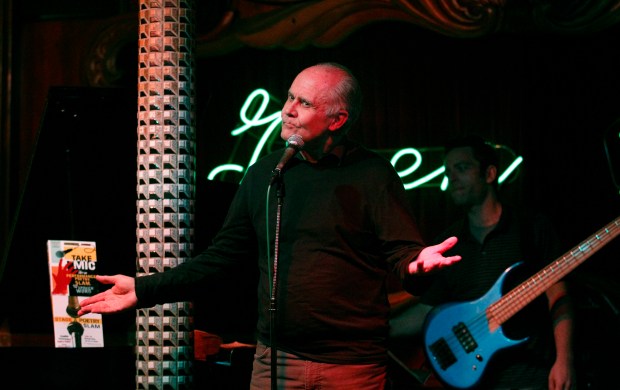
Poets are everywhere. This truth was evident at the Newberry Library on July 25 during a celebration for Marc Kelly Smith. Smith, the creator and host of the Uptown Poetry Slam, was honored as the community celebrated the 40th anniversary of the first poetry slam. It took place at the Green Mill, where it continues weekly.
The Newberry Library formally accepted a collection of materials documenting the history of the slam. The assemblage includes photos, programs, publicity, audiovisual materials, artifacts, administrative files, Smith’s personal notes, shows, poets’ performances, newsletters, and marketing materials. Among these items is a pair of boxing gloves from the late poet and artist Tony Fitzpatrick.
“The acquisition of the Marc Kelly Smith Poetry Slam Collection is an amazing gift to the Newberry and to the city of Chicago,” said Alison Hinderliter, the curator of modern manuscripts at the Newberry.
Hinderliter mentioned that the staff is diligently processing, organizing, and cataloging the collection. Some materials will be available for public and academic purposes by the end of the year. However, full completion might take around three years. She noted another slam event planned for September 26 in celebration of World Poetry Slam Day, the first global event of its kind, with participation from 50 cities in France and 15 other countries, including the Ivory Coast and Mexico.
Hinderliter emphasized the global impact of the poetry slam, stating, “It is stunning how far the slam has grown. It’s a global phenomenon.” The New York Times crossword recently featured a clue highlighting this influence, with “slam” as the solution to “Poetry competition.”
Marc Kelly Smith’s influence is recognized universally. He calls a slam “a word symphony of organized chaos,” where poets of varying talent compete, scored by randomly chosen judges from the audience. Participants express discontent through snapping, stomping, groaning, hissing, or grunting. The winning poet earns a modest prize of $10. These competitive events occur in diverse venues, from stages and taverns to laundromats and classrooms.
“Since our opening event, there have been numerous emails, calls from everywhere,” Hinderliter stated. “Other poets have contributed books, magazines, and more, to be showcased at the September event as examples of Marc’s influence.”
Marc Kelly Smith is a central figure on Chicago’s cultural scene. Michelle Boone, president and CEO of The Poetry Foundation, attended the August event with Adrian Matejka, editor of Poetry magazine. Matejka expressed high regard for Smith’s contributions during the celebration.
“The celebration was something else,” Matejka said. “It reminded me how much hustle and ingenuity it takes to make space for poetry in the world. It’s always there when I write poems though I am a bit distanced from it at the foundation.”
On discussing why he writes poetry, Matejka expressed personal devotion to the craft.
“Poetry lets me make sense of what’s happening around me. There are many moments, especially now, where everyday language can’t hold my frustrations, worries, or curiosities. Metaphor and simile give those feelings tangible shape, offering clarity to others. Poetry provides the language necessary to navigate daily challenges, touching on personal or other’s works.”
Items from Smith’s earlier collections are now part of Newberry’s exhibit, reflecting the evolution and influence of the poetry slam over the years. Adrian Matejka, author of “Be Easy: New and Selected Poems” and other works, acknowledged Smith’s impact on poetry.
Yonder how a younger poet, Dylan Weir, shares his perspective. His first collection, “Public House,” illustrates his thoughts through poetry.
“I write to find out what I’m thinking. I have a lot to say, but in ordinary conversation, I miss getting it right. Poetry gives me time and space to capture those expressions that are otherwise elusive.”
Weir described the essence of poetry as capturing intangible emotions.
“Truth can’t always be expressed in prose. Prose is linear and logical, unlike how I perceive the world. Prose explains, poetry recreates. Sound itself has meaning, with silence, rhythm, and fragmentation playing essential roles.”
Reflecting on these insights, the words of Marc Kelly Smith, spoken years back, echo strongly today: “Poetry is the heart of the people and the people is everyone.”
 Valet’s Kindness Transforms Lives at Cancer Center
  Michael Goessling’s Remarkable Discovery: Michael McDonald is His Biological Father
  Billy Joel’s Motorcycle Collection Heads to Auction in New York
  Wynonna Judd Responds to Rosie O’Donnell’s Political Assumptions
 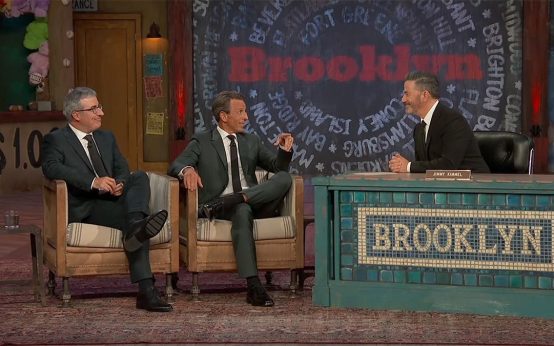 Late Night Hosts and Trump: A Comedic Armor
 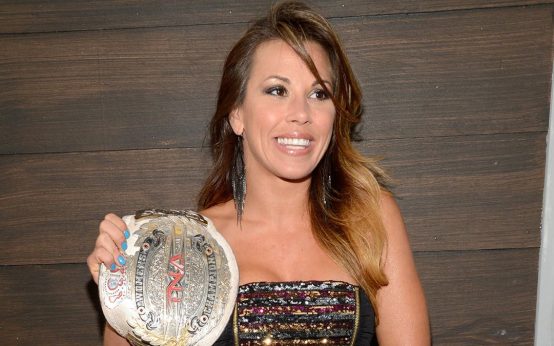 Mickie James Returns to TNA for Bound for Glory Event