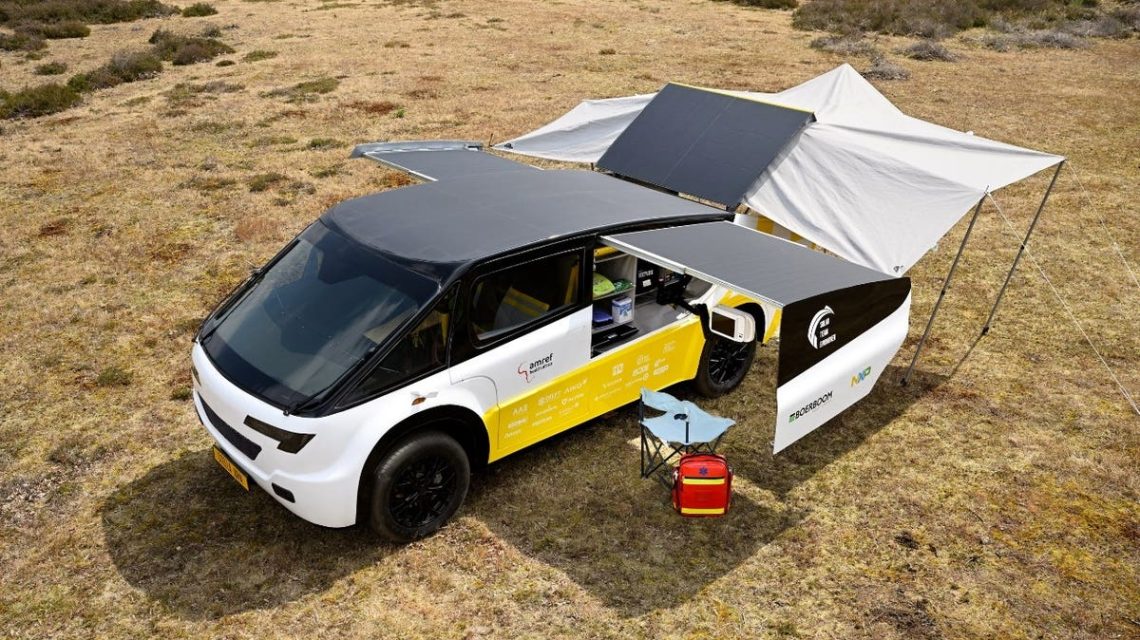
Imagine you’re hours away from the nearest hospital with no reliable electricity once you reach there. This scenario is a significant challenge in remote areas, but university students in the Netherlands are addressing it with a groundbreaking vehicle. Solar Team Eindhoven has introduced Stella Juva, considered the world’s first solar-powered ambulance.
Unlike traditional ambulances focused on transporting patients, Stella Juva serves a unique purpose. It’s designed to deliver medical care directly to individuals in remote areas, powered by solar energy. This vehicle is significant for communities where fuel is scarce and electricity is unreliable.
Stella Juva showcases technology applied to a vital human need. It employs solar panels for both driving and powering medical equipment. This approach allows healthcare workers to visit communities without depending on external charging infrastructure.
Challenges of Healthcare in Remote Areas
The World Health Organization estimates that about one billion people rely on healthcare settings with unreliable electricity or none at all. Stella Juva addresses this issue by bringing its electricity source along for the journey. The solar-powered mobile clinic can change perceptions of what an ambulance can achieve.
This shift in healthcare access mirrors the use of drones for medicine deliveries. Emphasizing mobile care delivery can reshape how healthcare reaches those in need.
Solar Power Technology Details
Stella Juva incorporates high-efficiency solar cells, employing All Back Contact technology, which places electrical contacts on the back of the cells, exposing more surface area to sunlight. This design is crucial for a vehicle where roof space is limited.
To keep Stella Juva functional, students assembled a 50-kWh lithium-based battery pack to store solar energy. This capacity ensures operations can continue when sunlight is sparse and even after dark.
With optimal solar conditions, Stella Juva can travel up to 715 kilometers (about 444 miles) per day at speeds nearing 75 mph. However, performance may vary based on weather and terrain.
The Medical Equipment Power System
Stella Juva uses an intelligent electrical setup. It isolates the power system for medical equipment from the vehicle’s propulsion system, prioritizing critical medical needs when battery levels are low. This design reduces risks related to unstable voltage impacting medical devices. Healthcare workers thus receive consistent power support.
Addressing Weight Challenges
The development of solar vehicles often struggles with weight limitations. Solar Team Eindhoven succeeded in constructing Stella Juva from lightweight carbon-fiber composite materials, resulting in a total weight of around 1,350 kilograms (approximately 3,000 pounds). This is relatively light compared to conventional ambulances.
Students crafted an aerodynamic teardrop shape for reduced wind resistance, optimizing energy use.
Real-World Testing in Kenya
The next significant step is testing Stella Juva’s capabilities in real-world conditions. In collaboration with Amref Health Africa, the vehicle will be field-tested in Kenya. The team will simulate healthcare scenarios, such as those involving tuberculosis, to evaluate actual performance.
This stage is critical to pass beyond theoretical effectiveness, focusing on practical reliability.
Broader Implications and Challenges
Although Stella Juva won’t appear in commercial hospitals soon, the project demonstrates practical applications for solar-powered medical units. These could be valuable in disaster-stricken or rural areas with limited healthcare access.
The efficiency of solar panels and battery improvements suggest potential advancements in off-grid medical transport. However, cost, maintenance, and strict regulatory adherence are key factors that need consideration.
Overall, Stella Juva illustrates a pioneering approach to marrying transportation technology with healthcare access, showcasing a future where mobile clinics might deliver essential care in regions lacking infrastructure.
 Trump Administration Distributes ACA Refund Checks
  Higher Consumption of Ultra-Processed Foods Linked to Increased Health Risks
  How Modern Windows Improve Home Insulation
  Understanding Inflammation: Myths and Facts
  Calm Parenting: Strategies to Manage Stress
  Trump’s Executive Order to Combat Mosquitoes and Ticks in D.C.