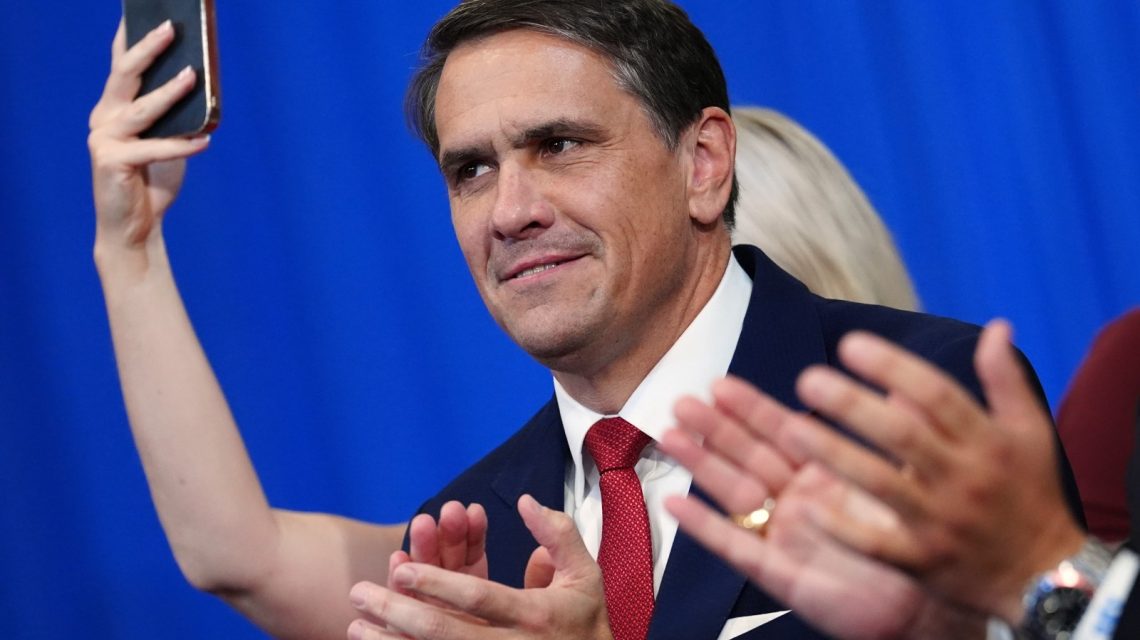
Attorney General Todd Blanche recently refrained from assuring that the Department of Justice (DOJ) would always function independently of the White House. He indicated that a commitment to such total independence isn’t suitable for any attorney general and that he would take President Donald Trump’s views into account when making decisions. Blanche’s remarks have reignited concerns regarding the DOJ’s independence, a primary issue during his contentious confirmation battle.
Critics of Blanche’s nomination, including Democratic lawmakers, watchdog groups, and even two Republican senators, expressed alarm. They argued that Trump’s former personal attorney was too closely associated with the president to serve effectively as the nation’s top law enforcement official. During an interview on NBC News’ Meet the Press, host Kristen Welker asked Blanche, “Can you pledge that the Justice Department will always act independently of the White House?” Blanche replied, “No, I’m not going to pledge that,” asserting that no attorney general should make such a pledge.
Blanche argued that a president has the right to communicate priorities to the DOJ. He suggested that a strict promise of independence might conflict with these priorities. When asked if Trump should have a role in individual prosecution decisions, Blanche stated, “Will I take the president of the United States’s view on something into consideration? Yes, of course.” He hoped that every attorney general in history would share this stance.
The confirmation of Todd Blanche as Attorney General was marked by one of the most contentious nomination battles of Trump’s second term.
Blanche narrowly secured Senate confirmation with a 50-49 vote. His confirmation attracted warnings from Democrats, watchdog groups, and some Republicans about the potential for the DOJ to become too closely aligned with the White House.
Confirmation Battle Centered on DOJ Independence
Blanche’s independence was a central issue during his confirmation process. Before becoming attorney general, he served as Trump’s personal defense lawyer and later as acting attorney general after Pam Bondi’s removal in April. His promotion immediately drew criticism from opponents who feared it might undermine the DOJ’s traditional independence.
Senate Minority Leader Chuck Schumer accused Republicans of compromising the department’s independence by confirming Trump’s former attorney. “If you want to wipe out corruption, you can’t have the president’s personal attorney as the Attorney General,” Schumer remarked after the confirmation vote.
The watchdog group Citizens for Responsibility and Ethics (CREW) cautioned that Blanche could lead a DOJ that “will serve [Trump], not the American people.” Republicans Susan Collins of Maine and Lisa Murkowski of Alaska both voted against Blanche’s confirmation. Collins expressed concerns about Blanche’s previous actions undermining the DOJ’s independence, while Murkowski doubted his ability to “check the worst impulses of this administration.”
Blanche Rejects Concerns
During the interview, Blanche dismissed criticisms about his alignment with the White House. “I will act with integrity. Our prosecutors will act with integrity. We will prosecute without fear or any form of favor,” he declared. Blanche also refuted claims that Trump influences individual prosecutions.
“There is this extraordinarily false narrative that the president wakes up in the morning and calls me and says, ‘Todd, go prosecute X or Y.’ He does not do that. He has never done that. He will never do that,” Blanche asserted. When asked if he would reject a presidential request that breached legal or ethical lines, Blanche maintained that such situations would not arise. “The president will never ask me to do something unethical or illegal,” he assured.
Election Lawsuits Could Head to Supreme Court
Blanche suggested that the DOJ might persist in pursuing its controversial legal initiative to acquire voter registration data from states before the midterm elections. When asked if the administration might take its voter-roll fight to the Supreme Court after losing 22 lower-court cases, Blanche confirmed that it was indeed “absolutely” a possibility.
The administration has sued numerous states to access voter registration records, arguing the need for the information to investigate election-law compliance and possible registration irregularities. Federal judges in at least 22 cases have ruled in favor of states refusing to provide the requested data, finding the DOJ lacked authority to compel disclosure of complete voter databases.
Blanche defended the effort, stating the DOJ would continue pursuing what he termed election integrity investigations. He argued that the federal government has a responsibility to ensure elections comply with federal law, even though states administer these elections.
The Ongoing Debate Over DOJ Independence
Blanche’s statements touch on a sensitive matter regarding the DOJ: the extent to which the department should remain free of political influence. Supporters argue that a president is entitled to set law-enforcement priorities through appointed officials. Critics counter that criminal investigations and prosecutorial decisions should remain insulated from political pressure, especially involving the president, allies, or opponents.
Those concerns were significant during Blanche’s confirmation battle and will likely remain a key point of scrutiny as he assumes the attorney general role.
 The Trump Team’s Challenge to the Military Leadership
  Maryland First State to Restrict Electronic Pricing in Grocery Stores
  Activists Push for Nationwide Ban on Child Marriage in the U.S.
  Democratic Hopes and Historical Warnings in 2026 Senate Race
  Republicans Face Challenges Amidst Cost of Living Concerns
  A Different Kind of Fall for Congress This Year