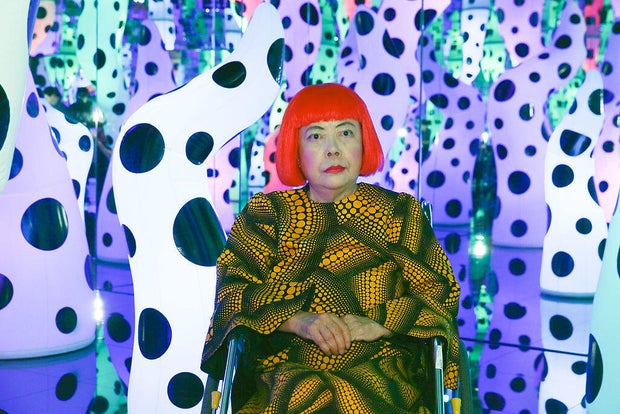
In August 2026, Japanese artist Yayoi Kusama, who captivated the world with her distinctive polka dots, passed away at 97. Kusama died on August 14 in a hospital in Tokyo, as confirmed by her studio. Known for painting up until her final days, she embodied the pursuit of love and eternal spirit through her art.
Yayoi Kusama’s influence spanned various prestigious institutions, such as the Museum of Modern Art and the Whitney Museum of American Art in New York. Her signature style featured repetitive motifs in diverse forms, with dots being the most prominent. These dots appeared vibrantly on her canvases, in installations, and as sparkling elements showcasing psychedelic allure.
“Polka dots are fabulous,” she said in a 2012 interview with The Associated Press, displaying her affinity for the pattern. She was determined to produce as many paintings as possible, declaring her commitment to continue painting until her death.
Throughout her life, Kusama confronted hallucinations she had experienced since childhood. Despite decades in psychiatric institutions, her condition didn’t deter her achievements. She was among the first Japanese women to move to New York to further her art career in 1957. Her soft-spoken nature belied the boldness of her artistic vision, characterized by accessibility and widespread appeal.
In later years, Kusama’s collaborations included partnerships with renowned brands like Louis Vuitton. Her art reached mass audiences through teacups, T-shirts, and key chains. In 2008, her work fetched $5.8 million at Christie’s auction, and in 2016, she received Japan’s prestigious Order of Culture award.
Upon receiving the award, Kusama reaffirmed her dedication to art, emphasizing sincerity as a vital part of her legacy. She expressed a strong resolve to continue her artistic endeavors, hoping her work would resonate long after her passing.
Kusama resisted labels like pop, avant-garde, and feminist, believing they did not fully capture her essence. Raised in a middle-class family, she often felt misunderstood by her parents, who preferred traditional pursuits over her artistic ambitions. Rather than conforming to expectations, she chose to seek opportunity in America.
Arriving in New York when “action painting” prevailed, Kusama endured poverty and anonymity but persisted with her dot motif. Her performances in the late 1960s, including placing paper circles on people and animals, gained media attention despite causing controversy.
Her connections with influential artists like Andy Warhol, Georgia O’Keeffe, and Joseph Cornell underscore her innovative impact. Kusama’s whimsical creations, such as “Macaroni Girl” and “The Visionary Flowers,” exhibited her unique artistic voice.
Besides her visual art, Kusama also created films and published novels. Her creative process often surprised her, showcasing the spontaneity and mystery involved in her work.
Though she sometimes expressed vulnerability, Kusama was unafraid to assert her revolutionary artistic stance. Her legacy of creativity and resilience remains an inspiration to art enthusiasts globally.
 Midwest Underground Railroad Network Gains National Recognition
  Art Collective Critiques Administration with Mall Installation
  American Hagwon: A Tale of Family and the Korean Diaspora
  Volunteer Enthusiasm Shines at Frank Lloyd Wright Home and Studio
  Bible’s Role in Times of War
  Arrival of Giant Pandas in Atlanta Marks Historic Agreement