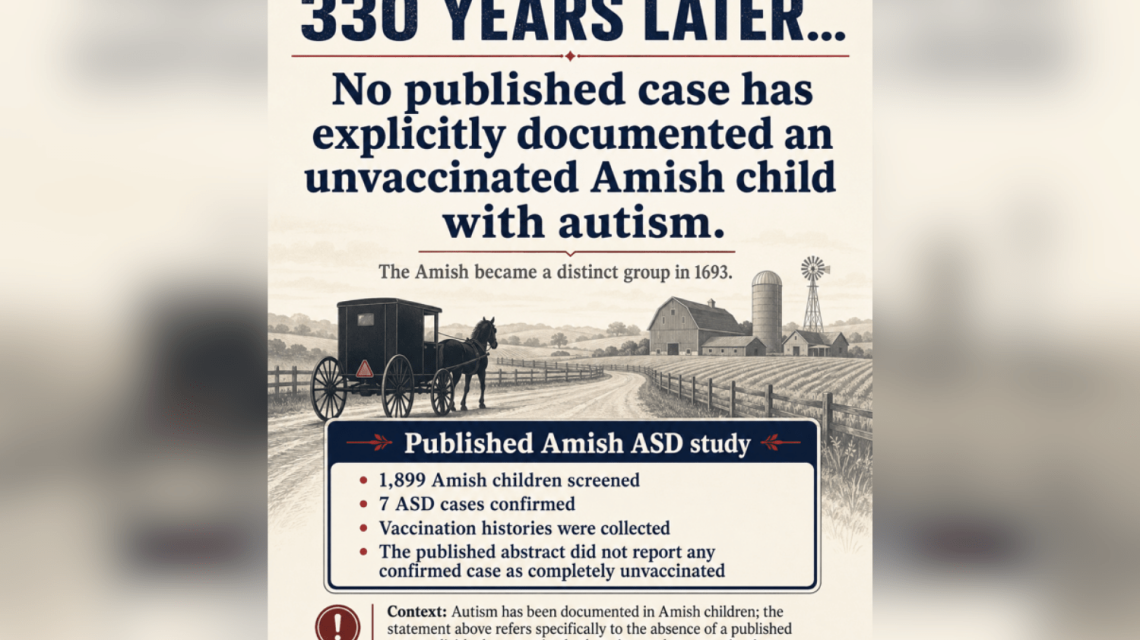
President Donald Trump shared a graphic that claims no published case has documented an unvaccinated Amish child with autism. This argument is commonly cited by vaccine skeptics. The graphic, posted on Truth Social, acknowledges autism exists in Amish communities but suggests vaccination status may impact autism rates.
The nation’s autism rates have been central to Trump’s Health and Human Services Department. Secretary Robert F. Kennedy Jr. aims to uncover the cause of the “autism epidemic” while overhauling the U.S. health care system.
The 2010 study mentioned in the graphic analyzed 1,899 Amish children in Ohio and Indiana over 13 months. It found that 25 children screened positive for autism spectrum disorder, with seven cases confirmed after further evaluation. The graphic’s claim relies on the published abstract not identifying any confirmed autism cases as completely unvaccinated. Experts caution this does not prove a causal link between vaccination and autism.
Trump and his administration have raised questions about vaccines and autism links. Kennedy, a known vaccine skeptic, has previously promoted claims in this regard. The administration’s “Make America Healthy Again” initiative calls for more research into autism’s causes. Public health experts point to substantial evidence barring vaccines from being linked to autism spectrum disorder.
Research Findings in Amish Communities
The findings of the 2010 study refute claims that Amish children do not experience autism. It collected vaccination histories, highlighted in Trump’s shared graphic. However, researchers did not conclude vaccines cause autism or that vaccination status explains autism prevalence or protection.
The study’s population was small compared to national autism surveillance efforts, complicating direct comparisons. Diagnosis rates vary due to healthcare access, screening practices, and cultural factors affecting evaluations.
“It’s untrue to say that Amish communities have no autism,” said David Mandell, director of the Penn Center for Mental Health.
Mandell emphasized difficulties in measuring autism in Amish communities, relying on parental reporting and access to specialists. He noted, “Autism is behaviorally determined and highly reliant on parent report.”
Vaccination Rates in Amish Communities
The Amish are referenced in vaccine debates due to some communities having lower immunization rates than the general U.S. population. An American Academy of Pediatrics article noted lower vaccination uptake among Amish, varying across settlements and families.
Experts warn against treating the Amish as a uniform group. Different communities can vary in healthcare practices, engagement with healthcare providers, and vaccination attitudes. This distinction matters because claims often generalize Amish children as unvaccinated despite differences among communities and households.
“Amish people do get vaccinated,” Mandell said. “Although their rates are lower than surrounding populations, more than half of Amish children receive vaccinations.”
Scientific Consensus on Vaccines and Autism
The scientific consensus is vaccines do not cause autism. The Public Health Communications Collaborative states many studies over decades have found no causal link between vaccines and autism spectrum disorder.
The organization addressed renewed claims involving Amish communities, noting documented autism among Amish children. Absence of specific reports does not prove vaccine causality.
Trump administration officials support this view. In a Senate hearing, National Institutes of Health Director Jay Bhattacharya stated he had not seen a study suggesting vaccines cause autism. Public health experts stress proving a causal link requires evidence of autism rate differences while considering other factors.
Mandell stated, “There are now at least two to three dozen epidemiologic studies of vaccines and autism. All but two show no causal link.”
The studies reporting a link were withdrawn after challenges to their methodology.
Why The Claims Persist
Claims about Amish autism rates have long persisted due to misinterpreting lower reported diagnosis rates as evidence of autism absence.
Research indicates those figures may show differences in healthcare access, diagnostic practices, and family evaluations, rather than autism’s nonexistence in a community.
Trump’s post highlights the lack of published cases involving unvaccinated Amish children with autism. Existing research confirms documented autism among Amish children without proving vaccines cause the condition.
 Understanding Inflammation: Myths and Facts
  Calm Parenting: Strategies to Manage Stress
  Trump’s Executive Order to Combat Mosquitoes and Ticks in D.C.
  Overcoming Weight Loss Challenges: Brain Health and GLP-1 Medications
  Supporting Children’s Mental Health at Home: Practical Steps for Parents
  Abdul El-Sayed’s Strategy to Attract Health-Conscious Voters in Michigan