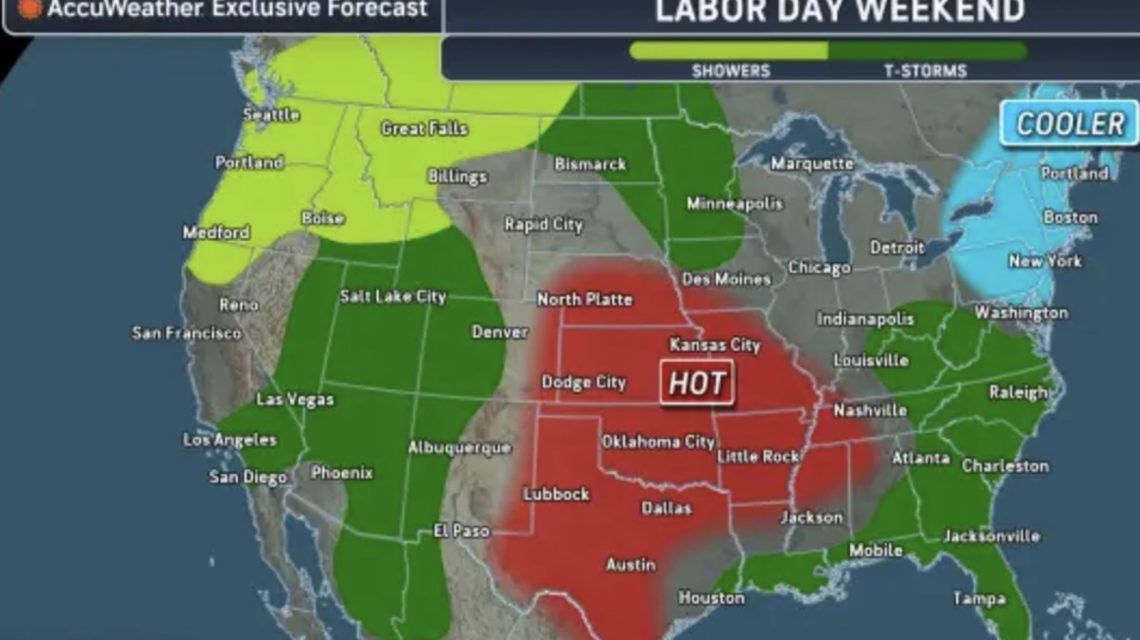
As Labor Day weekend approaches, the United States is bracing for two major weather phenomena: severe heat in the central regions and intense storms threatening various parts of the country.
Extreme Heat in Central States
According to the National Weather Service (NWS), multiple states face extreme heat warnings. The heat, exacerbated by high humidity, can lead to significant health risks, especially during prolonged exposure.
AccuWeather forecasts a significant heat wave due to a massive heat dome affecting areas like the central and southern Plains and the Mississippi Valley. States like Texas, Oklahoma, Missouri, Tennessee, and Nebraska will experience temperatures possibly exceeding 100 degrees Fahrenheit. The oppressive heat could feel even hotter due to humidity, sometimes up to 15 degrees above the actual temperature.
The NWS notes increased heat levels in the middle Mississippi Valley, Ohio Valley, Tennessee Valley, and mid-Atlantic regions. Dangerous conditions are predicted, with heat advisories issued across these areas.
The record warmth results from a persistent ridge of high pressure, with temperatures reaching the 80th to 99th percentile.
Storms Threaten Flash Flooding
While parts of the central U.S. may remain dry under the heat dome, surrounding areas face showers and thunderstorms. The storms are expected to deliver heavy rain and wind across the West, northern Plains, Midwest, and Southeast.
Particularly concerning is the Southwest, where increased storm activity by Thursday may result in heavy rain and flash flooding. Storm activity is also likely in the Great Basin, central and southern Rockies, and areas from the lower Great Lakes to the northern mid-Atlantic.
Understanding Heat Domes
A heat dome forms when stationary high-pressure systems trap heat and humidity over a region. This process causes the air below to compress and increase temperatures, creating several days of high heat.
Michael Muccilli from NOAA explained that sinking air coupled with ample sunshine further raises temperatures. These heat waves typically last one to two weeks but may extend during drought conditions, heightening health risks.
Texas Faces Flood Risks
Forecasters are also monitoring flood dangers in Texas after Tropical Storm Edouard passed through, becoming a tropical depression. Though it weakens as it moves northward, heavy rains persist, threatening flash flooding in urban and low-lying areas.
The NWS predicts Edouard will dissipate by Thursday, but heavy rains will continue affecting parts of eastern Texas. AccuWeather urges caution around the heat dome’s edges, where storms may lead to additional flash floods in the West.
 Cargo Plane Crash at Miami International Airport
  Marine Veteran Suing Oregon School District Over Curriculum Reimbursement
  Tennessee Execution Halted as Issues Persist with Lethal Injection Protocol
  Judge Dismisses Case Against Former Olympian Over Lincoln Memorial Incident
  Minnesota Family Files Civil Rights Lawsuit Over ICE Agent Shooting
  California Bans Child Marriage, Protecting Minors