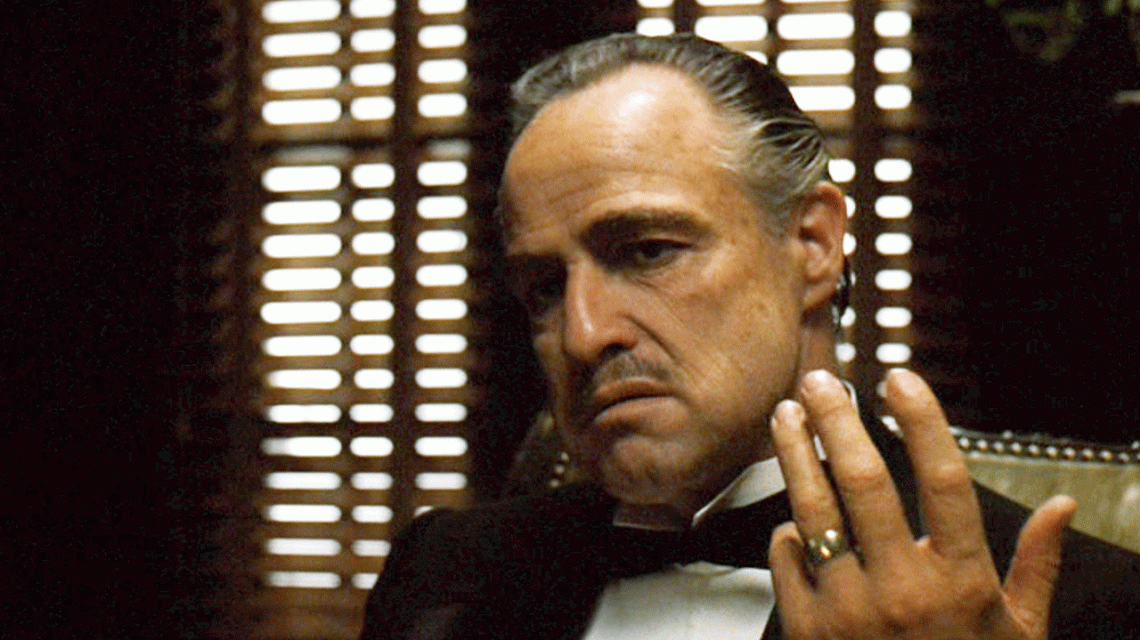
One of the most impactful scenes in The Godfather features Don Vito Corleone warning the crime families of New York. He states that if his son Michael experiences a supposed accident, he will hold them accountable. This message is clear: do not disguise an attack behind coincidence.
Similarly, for NATO and the European Union, adopting a ‘Godfather Test’ approach might be beneficial. Consider a scenario where a drone crosses into Eastern Europe. We should assume culpability from Vladimir Putin. If infrastructure like a power cable under the Baltic Sea is cut, the same presumption applies.
“I’m a superstitious man.” – Don Vito Corleone, The Godfather
Typically, Western democracies honor innocence until guilt is proven. Our systems ensure fair justice, vital in individual court cases. However, for geopolitical activities, this presumption needs reevaluation. Putin and Russia should not receive the same due process extended to individual defendants in American courts.
This issue arises because the Kremlin exploits our cautious approach. Western reluctance to act without solid evidence creates vulnerabilities. Russia often conducts operations that lack clear evidence, thus evading accountability.
Russia’s repeated aggressive actions, cyberattacks, and political meddling erode any benefit of the doubt. By constantly denying involvement, Putin ensures no quick backlash from the West.
While caution is necessary, excessive hesitation allows Putin to operate within the gray zone between war and peace. His strategy involves using anonymous hackers and intelligence operatives, making direct attribution challenging.
When NATO or EU countries detect potential Russian activity, Moscow should be held responsible unless proven otherwise. Prolonged investigations and debates lead to public disinterest, allowing Russia to continue its operations unchecked.
Adjusting our response to be asymmetrical in nature could impose costs on Russia without mirroring its actions directly. For example, instead of retaliating in kind for a cyberattack, measures could be taken to disable Russian military or intelligence capabilities at a strategic moment.
Putin should experience consequences discreetly, just as Russia does not publicly announce its deeds. This will introduce uncertainty for Moscow, counteracting one of its own favored tactics.
While action should not be mindless, national security decisions often involve incomplete information. We must shift away from the need for courtroom-quality proof to justify defensive actions.
Concerns about potential miscalculations exist, yet the greater risk lies in emboldening Putin by not responding decisively. Deterrence works by demonstrating beforehand that attacks will incur penalties.
 Defense Secretary Emerges as Key Player in the Trump Administration
  Ukraine Converts APCs to Explosive Devices in Donetsk Offensive
  Hegseth’s Vision for the Military: Balancing Tradition and Innovation
  Significant Funding Boosts Ken Paxton’s Texas Senate Campaign Amid Tight Race
  U.S. States Extend Gas Tax Waivers Amid Rising Fuel Costs Due to Iran Conflict
  USCIS Raises Immigration Fees