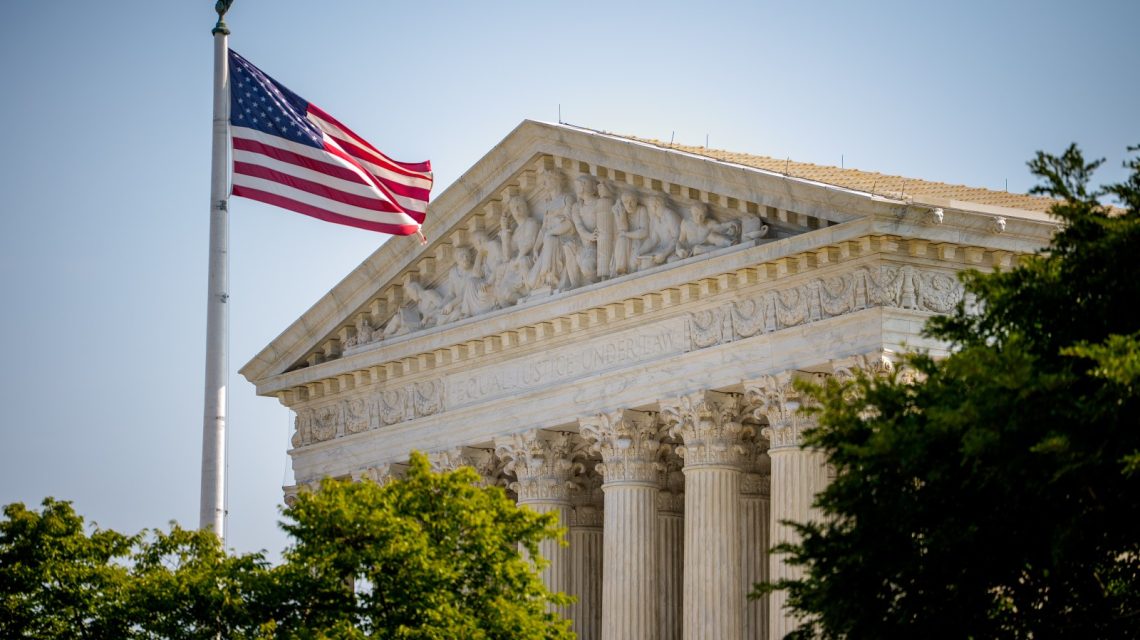
The United States Supreme Court refused Missouri State leaders’ appeal to utilize a congressional district map from recent primaries for November’s midterm elections, initiated by President Donald Trump. This case has garnered significant attention for raising key questions about the timing of court interventions in congressional map alterations before an election and the potential impact on voters transitioning between districts before a general election.
A federal-election-administration disaster is unfolding in Missouri, Missouri State Attorney General Catherine L. Hanaway wrote in her appeal, stating it was too late to change maps before the midterms.
On Tuesday, the appeal was rejected by U.S. Supreme Court Justice Brett Kavanaugh. Consequently, Missouri is required to use the previously established 2022 map per the state’s Supreme Court ruling.
Abha Khanna, an Elias Law Group Partner involved in the case, expressed satisfaction with the decision. She noted that the state constitution empowered Missouri residents to have the final say on whether congressional maps undergo changes at President Trump’s urging, emphasizing this as a win for democracy.
This ruling has broader implications beyond Missouri, potentially influencing how other states address congressional map disputes. Newsweek sought comments from the Missouri Secretary of State and the Missouri Attorney General.
Missouri’s Path to Supreme Court Intervention
In September 2025, Missouri’s legislature passed House Bill 1, replacing a 2022 congressional map. This bill was signed into law by Republican Governor Michael Kehoe. Missouri employed the new map during its August 2026 primary elections, seeing about 1.2 million voters participate.
Following the map’s adoption, People Not Politicians, led by Richard von Glahn, initiated a referendum campaign to place the map before a statewide vote. Legal challenges quickly emerged, questioning the applicability of Missouri’s referendum process to congressional redistricting legislation. Missouri courts initially upheld the map during the ongoing litigation, leading state officials to rely on it during the primaries.
On September 3, Missouri’s Supreme Court invalidated a lower court’s decision, enforcing an injunction barring the implementation of House Bill 1. It directed the use of the 2022 map instead.
Why Missouri Sought Supreme Court Intervention
Missouri’s Supreme Court filing highlighted concerns regarding voters being moved into different congressional districts and potentially voting for candidates they didn’t nominate in the primaries. A trial court concluded changing district boundaries at this stage, describing it as impossible, a claim Missouri argued was overlooked.
Justice Kavanaugh’s refusal to grant emergency relief maintained the Missouri Supreme Court’s ruling, without addressing the merits of Missouri’s legal arguments. This left the state without the intervention it deemed necessary to prevent election disruption.
Richard von Glahn of People Not Politicians celebrated the decision, emphasizing that over 305,000 Missouri voters, across the political spectrum, acted to oppose the political maneuver last fall.
Constitutional Disputes Surrounding Missouri’s Appeal
The appeal raised constitutional questions anticipated to engage Supreme Court scrutiny. Among these was an Elections Clause claim arguing that Missouri’s redistricting process should not be halted by a referendum petition before a statewide vote. Missouri criticized the state supreme court’s action as allowing a minority of voters to suspend a legislatively approved map.
Further, Missouri contended that changing congressional districts between primary and general elections contravened equal-protection principles by treating voters disparately if relocated into new districts.
Republican organizations supportive of the appeal, including the Republican National Committee, argued the ruling plunged Missouri into electoral chaos influenced by a minority of voters.
On the other side, supporters of the Missouri Supreme Court asserted state law demanded halting the map pending a statewide vote.
Implications of Missouri’s Case Nationwide
The case’s national significance lies in the central issue: how changes to congressional maps can be enforced late in the election cycle. Missouri and national Republican bodies warned that absent federal restrictions, state courts might mandate map alterations post-primary elections, creating challenges in other states.
Election-law experts point to the Supreme Court’s Purcell principle, deterring courts from major election-rule alterations close to elections to avoid voter confusion and administrative issues. Missouri cited these concerns in its plea for emergency intervention.
Despite Kavanaugh’s rejection without clarifying reasons, issues from the case might impact future nationwide discussions. The litigation re-focuses on state referendum systems, legislative powers over congressional districts, and judicial roles in election administration.
For now, Missouri election authorities must comply with the Missouri Supreme Court’s ruling. Candidates, voters, and political entities remain alert to this highly scrutinized election-law debate of 2026.
 Lindsay Clancy Faces Potential Retrial After Mistrial
  Tennessee Prepares for Rare Execution of Woman on Death Row
  Mistrial in Lindsay Clancy Case: Juror Speaks Out
  Utah Judge Orders Release of Man on Death Row After DNA Evidence Emerges
  Kurt Olsen Resigns from the Justice Department Amid Investigation
  New Developments in Cornell University Fraternity House Assault Case