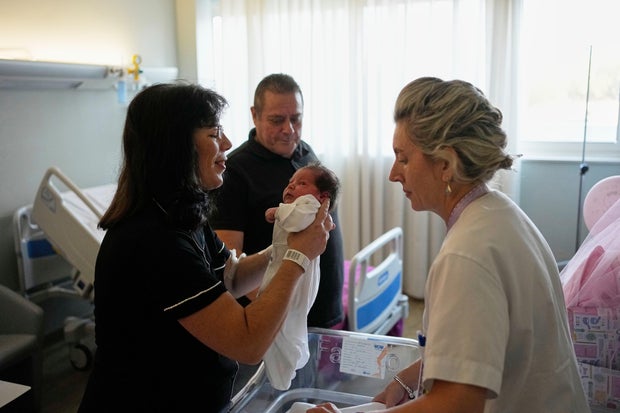
In a heartening story, a Greek couple has successfully welcomed a new life despite immense personal tragedy. Cristina Rapti-Tzelepi, aged 54, and her husband faced the grief of losing their 21-year-old son in a road accident last October. In a bid to find a new beginning, they turned to a frozen embryo they had stored 22 years ago.
The couple decided on this path with the ticking clock of Greece’s regulations for in vitro fertilization (IVF). These rules prevent women over 54 from undergoing such procedures. Rapti-Tzelepi had only a slim window of 2½ months to undergo the procedure. “It was stressful,” she told the Associated Press, “but with inner strength and our doctor and his whole team by our side, we got through every obstacle.”
On a Wednesday in Athens, Greece, Rapti-Tzelepi gave birth to a healthy baby girl weighing 7 pounds, 11 ounces. As she and her husband celebrated in a room adorned with pink balloons and flowers, they shared a sense of renewal and continuity. “We decided to give life a second chance,” said Rapti-Tzelepi, expressing hope for the new chapter in their lives.
The use of a 22-year-old embryo is rare but not unprecedented. Previously, an Ohio couple successfully used an embryo over 30 years old with a method called “embryo adoption.” This event even made it into the Guinness World Records.
Dr. Kostas Pantos, the gynecologist who assisted the couple, highlighted an issue with Greece’s strict age limits for IVF. He mentioned the declining birth rates in the country and called for policy revisions. “Maybe it’s time for it to change,” Pantos said, emphasizing the right of couples to parent despite age barriers.
Constantinos Raptis, the proud father at 60, was deeply grateful for Dr. Pantos’ role in their journey. “He took us by the hand and pulled us out of our deepest darkness,” Raptis shared, hopeful for the future alongside their daughter, Georgia. In a tribute to their late son Giorgos, also an IVF child, the couple found solace and a path forward.
Their story reflects a broader trend where embryo donation is seeing increased popularity. A report from the American Journal of Obstetrics and Gynecology noted a quadrupling of frozen embryo transfers in the U.S. from 2004 to 2019. More than a million frozen embryos currently exist in the U.S., often from those hesitant to discard them post-IVF cycles.
 Trump Administration Distributes ACA Refund Checks
  Higher Consumption of Ultra-Processed Foods Linked to Increased Health Risks
  Trump’s 2024 Campaign Targets Young Men Through Cryptocurrency
  How Modern Windows Improve Home Insulation
  State Department Simplifies Passport Process with Online Applications
  Understanding Inflammation: Myths and Facts