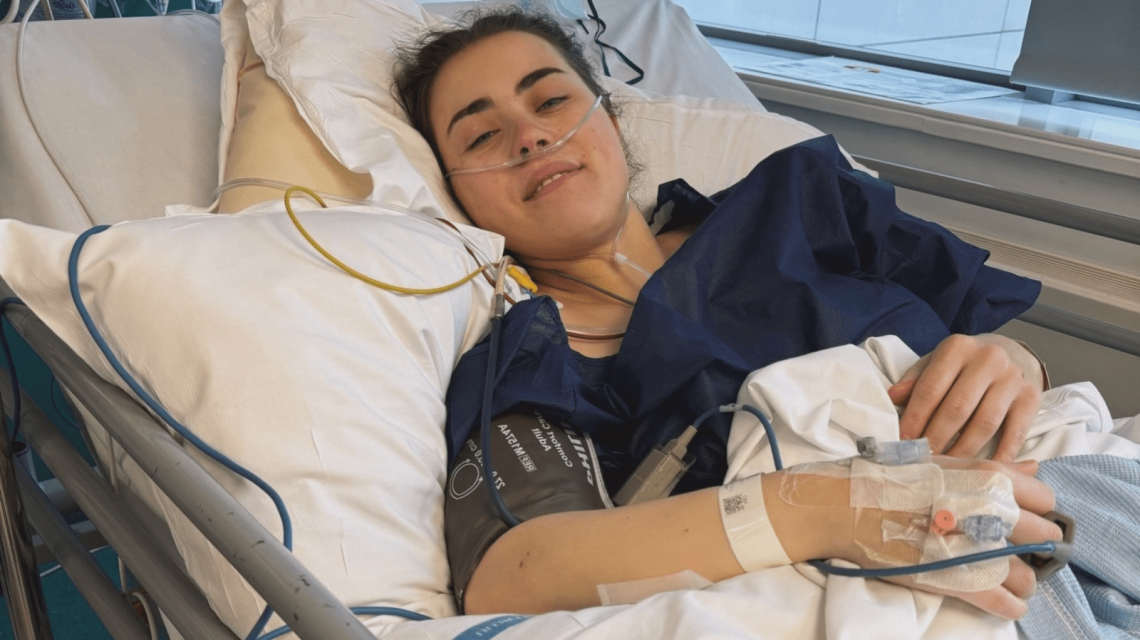
Mia Constantinou, a 28-year-old from Northern Ireland, faced a sudden health crisis following a soccer game. Playing for Ballymoney Ladies, she experienced intense pain described as a “lightning strike” in her left leg. She also suffered severe back pain.
Despite her history with endometriosis and surgeries, Mia avoided hospitals unless necessary. Her partner, Alexs, urged her to seek medical help. At the hospital, a doctor provided suppository medication for pain relief but no further action was taken. Mia continued her work as a healthcare assistant and playing soccer, but her condition worsened.
Months later, Mia saw a physiotherapist. Even though she was in significant pain, the physiotherapist was hesitant to order an MRI. Feeling dismissed, Mia insisted on a referral, sharing how the pain disrupted her life and work. She finally got a spine and lumbar MRI scan in November 2025.
Before receiving official results, Mia anxiously compared her scans to others online, sensing discrepancies. When she consulted her physiotherapist, she assumed nothing significant would be found. However, the MRI showed multiple issues, including small vertebra fractures, a slipped vertebra, a bulging disc, joint inflammation, and nerve pressure. A benign growth and a cyst were also detected.
In April 2026, Mia underwent an L5/S1 spinal fusion to improve spinal stability and pain relief. Post-surgery, she experienced severe pain. “It felt like a hot pole was stuck to my spine,” she recalled. Hospital physiotherapists encouraged her to walk, but she found basic movements challenging and painful.
Returning home, her lifestyle changed drastically. She moved her bed downstairs, used a recliner for mobility, and a commode replaced her bathroom. As she focused on recovery, new challenges emerged. Her leg pain returned and she experienced a new back pain. A neurosurgeon diagnosed retrolisthesis, a condition that can follow spine surgeries, according to a 2026 Orthop Surg study.
Mia required another surgery in July when her mobility deteriorated further, rendering her reliant on a wheelchair. Despite this second procedure, her nerve pain persisted. Subsequent scans led doctors to suggest another spinal fusion. “My story feels like constant repetition,” she lamented.
The day after her third surgery, Mia remarkably walked further with physiotherapists than she had in months, free of neuropathic pain. “I was so excited this is maybe how it was meant to feel all along,” she said.
Eight weeks post-operation, Mia endures daily agony. She takes morphine for her degenerative disc disease and works with a community physiotherapist to regain independence. Reflecting on her journey, she expressed, “I feel heartbroken and grieve the life I once had.” Mia advises others to listen to their bodies and advocate for their health.
 Understanding Inflammation: Myths and Facts
  Calm Parenting: Strategies to Manage Stress
  Trump’s Executive Order to Combat Mosquitoes and Ticks in D.C.
  Overcoming Weight Loss Challenges: Brain Health and GLP-1 Medications
  Supporting Children’s Mental Health at Home: Practical Steps for Parents
  Abdul El-Sayed’s Strategy to Attract Health-Conscious Voters in Michigan