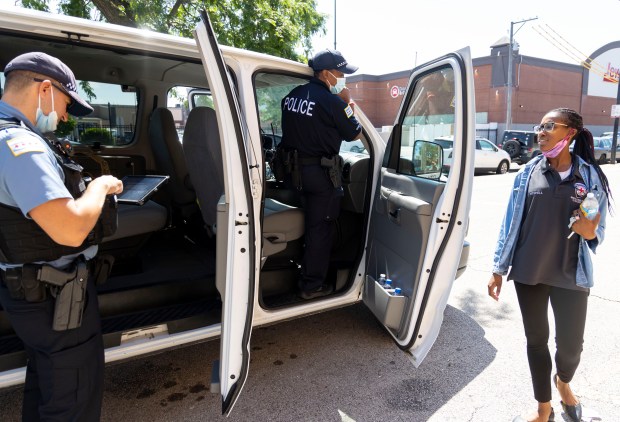
Mayor Brandon Johnson is delivering on his campaign promise to enhance mental health services in Chicago without relying on police involvement. His administration is spotlighting the Crisis Assistance Response and Engagement (CARE) team, a non-police mental health response unit. Recent videos show Johnson in CARE vans, highlighting the 51% increase in responses since May.
To further address mental health crises, Chicago will soon introduce an evening shift for these teams, consisting of behavioral health workers and EMTs. This initiative aligns with Johnson’s progressive agenda.
Chicago police Officer Dantra Daniel and mental health clinician Gabrielle Mitchell, both members of the CARE team, begin their workdays by preparing their van for service.
Johnson explained the program’s expansion since May, noting CARE’s response to over 115 emergency calls and managing 72 dispatches through a non-urgent email channel. Despite some resistance from previous health officials, Johnson emphasizes that CARE must be citywide, well-coordinated, and accessible through proper dispatch channels.
The mayor’s program has broadened its reach, now inclusive of ages 6 to 65, and begins a new evening shift, extending service hours from 8 a.m. to 10 p.m.
Though CARE aims to reduce the burden on police officers, some responses have involved law enforcement. Yet, Johnson maintains that his vision of a non-police mental health team remains intact.
Critics have acknowledged the need for specialized responses to mental health emergencies but cite obstacles such as interagency clashes and labor tensions. CARE’s integration into the city’s emergency response network, a work in progress since 2019, remains essential.
Under Johnson’s administration, the city seeks to restore a public dashboard for CARE responses to ensure transparency. Past fluctuations in program activity have sparked political debate, yet proponents of the initiative regard it as a vital shift towards improving mental health care in Chicago.
CARE stems from broader efforts to reimagine public safety following national movements emphasized after George Floyd’s murder. Though challenges persist, stakeholders insist perseverance is key to evolving the system.
 Families Fight Trump Administration’s Ban on Medical Care for Trans Youth
  Addressing Concerns Over Child’s Health Decisions
  Expanded Recall of Bettergoods Lemon Alfredo Fettuccine Due to Listeria Concerns
  FDA Investigation into Cyclosporiasis Outbreak Concludes
  Roseland Community Hospital to Suspend Labor and Delivery Services
  Increased Funding Needed for Psychiatric Hospitals