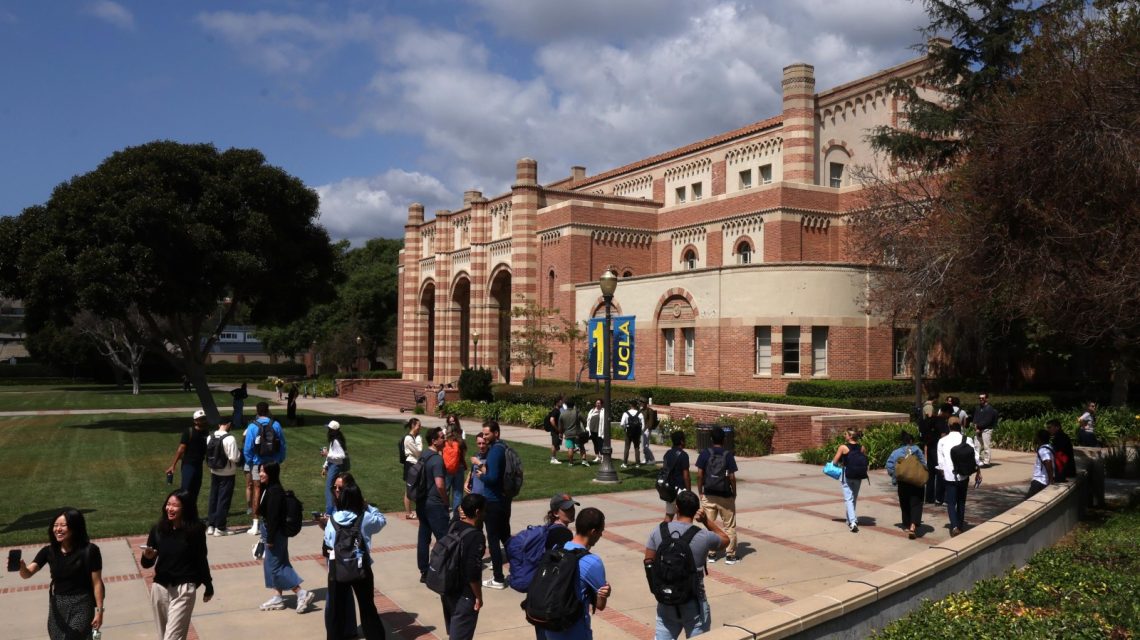
Juan Rosales Jr. decided to return to college in his 30s, hoping to escape unsatisfying jobs. As a full-time student at Long Beach City College, he balances part-time work and plans to earn an associate degree in film, television, and multimedia by May. Despite his efforts, Rosales remains uncertain about the benefits of his educational investment.
He questions the financial and professional gains of obtaining a degree, expressing doubts about the value of his time and money. Nonetheless, Rosales follows the traditional advice given to Americans: invest in education, earn credentials, and improve future prospects. Yet, he describes this journey as a leap of faith, uncertain of the outcome.
In 2026, this perspective mirrors the broader American attitude toward college. Historically, college promised a tangible return on investment, offering education, employability, connections, and life readiness. However, several elements of this proposition face increasing pressure, starting with rising costs.
The College Board reports that the 2025-26 average annual student budget, covering tuition, housing, and other expenses, is $30,990 for in-state students at public institutions and $65,470 at private colleges. This can amount to over $260,000 for a four-year education at today’s rates. While financial aid can lower these costs, tuition prices have increased dramatically, even after adjusting for inflation.
Beyond tuition, prospective students must consider opportunity costs. Enrolling in college means postponing years of potential work experience and income.
Data indicates that, on average, college education pays off. In 2025, full-time workers with a high school diploma earned $966 weekly, according to the Bureau of Labor Statistics. Those with an associate degree earned $1,135, and bachelor’s degree holders earned $1,578, along with lower unemployment rates.
Yet, these averages do not address individual family decisions. They don’t factor in specific tuition bills, loan interest, or potential alternative earnings. Families must weigh whether a particular college, major, and price will be a worthwhile investment.
Allison Shrivastava from Niche highlights that today’s graduates should compare their prospects to current high school graduates, not those from past decades. Higher living costs significantly reduce early-career financial gains. Federal statistics show recent graduates face a 5.6% unemployment rate, with 42% working in jobs typically not requiring a degree.
Employers now seek evidence of practical application beyond academic credentials. Economist Randy Tarnowski notes that graduates must demonstrate rather than declare their skills.
The debate about college value extends beyond economics. It encompasses intellectual exploration, community, independence, and cultural connections. Shannon DeLeon, whose son studies business at Boise State University, values these elements as much as textbook learning.
American campuses face various challenges, from social issues to student safety. A Knight Foundation-Ipsos study in 2024 found significant self-censorship among college students, potentially limiting educationally valuable conversations.
“The experience of attending university connects you to culture, to people you’d never otherwise meet, with professors, students, companies, and industries you wouldn’t otherwise have access to,” DeLeon told Newsweek.
Universities promise more than just education or credentials. They offer a conducive environment for young adults to develop crucial life skills. Families are evaluating whether the high costs justify these intangible benefits.
DeLeon emphasizes selective investment in education. Her son entered Boise State after completing two years of coursework and works while studying. She would advise pursuing a degree, but not at any cost, and not without considering alternatives.
The current outlook suggests a shift in how families and students perceive college. While graduates still enjoy financial advantages, the automatic pursuit of higher education is no longer a given. Today’s decisions require careful consideration of school, major, debt, potential income, and non-monetary benefits. For Rosales and many others, pursuing a degree involves risk, making what was once a secure path now a leap of faith.
 ProPublica’s Experiment in Opening Private Schools
  Record Low Satisfaction with U.S. K-12 Education System
  Escalating Student Protests in France: A Call for Educational Reform
  Understanding Misperceptions Around Sexual Violence and Intervention
  Colleges Adapt to Supreme Court’s Impact on Race-Conscious Admissions
  Cornell University Responds to Allegations of Sexual Assault at Fraternity